


Florian Heigl
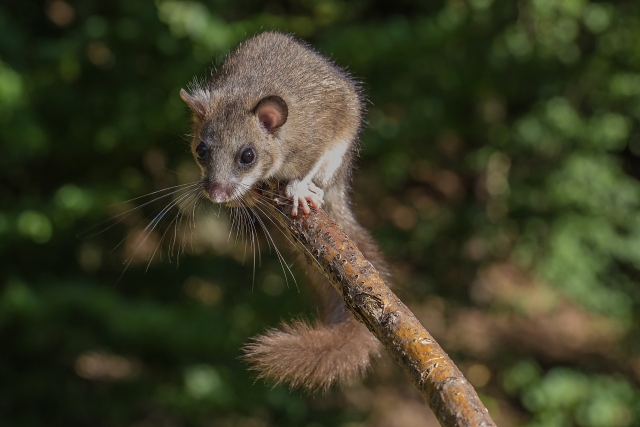
Dormouse
Description
The appearance of this animal is reminiscent of squirrels and grey squirrels. But the dormouse is much smaller, has large black eyes, roundish ears and a less bushy tail. The face has no markings but long tactile hairs. The foot pads of these animals are always slightly moist and are such that dormice can climb trees and walls without any problems. The animals live up to 9 years and reach a weight of 70 to 160 g. The snout-vent length is 13 is 13 to 18 cm, plus the 11 to 15 cm long tail.
Habitat
These animals are found in deciduous forests or large gardens (ideal: orchards). The dormouse likes to find its sleeping quarters in tree holes, nesting aids and also under the roofs of houses. While it sleeps there during the day, it tends to run around at night and can make so much noise that it could be attributed to an adult human, such as a burglar, and not to such a small animal.
The text is a translation of an excerpt from Wikipedia (https://de.wikipedia.org/wiki/Siebenschläfer). On wikipedia the text is available under a „Creative Commons Attribution/Share Alike“ licence. Status: 19 August 2021
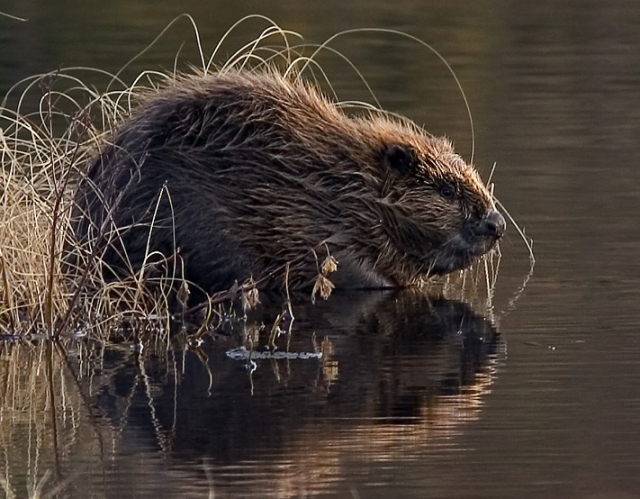
Beaver
Description
Adult European beavers weight between 23 and 30 kg and have snout-vent lengths of 83 to 102 cm and tail lengths of 30 to 35 cm. The body is plump and stocky and increases in volume towards the back. The head is short, broad and flattened at the top, so that it merges directly into the strong neck muscles and the rump. The eyes and ears, which are very high up, as well as the snout, are above water even when the body is submerged.
Front and hind legs are short. The front feet are trained for grasping and have five fingers. The hind feet are large and have webbed toes, the second hind toe has a double claw for grooming the fur. The very dense coat is grey to dark brown or black on the underpart, lighter underneath. The tail is flat, broad, hairless and covered with scales. It serves as a control, propulsion organ and fat depot.
Habitat
Like all beavers, they live semi-aquatic and inhabit water bodies and their banks.
The text is a translation of an excerpt from Wikipedia (https://de.wikipedia.org/wiki/Europäischer_Biber). On wikipedia the text is available under a „Creative Commons Attribution/Share Alike“ licence. Status: 19 August 2021
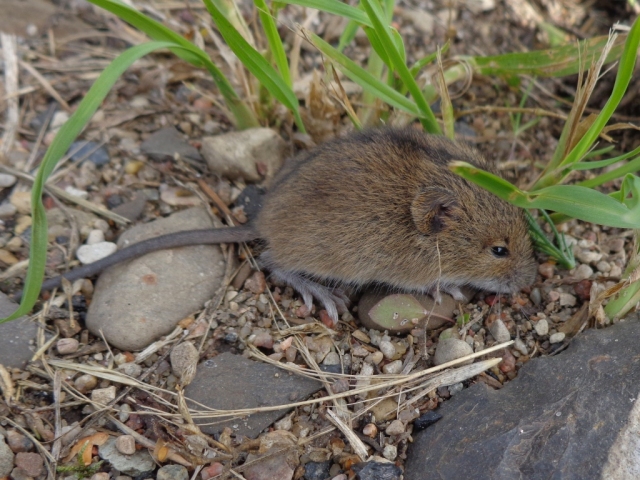
Northern birch mouse
Description
The tiny Northern birch mouse is even smaller than the Eurasian harvest mouse. It reaches a snout-vent length of 50 to 72 mm, a tail length of 140 to 150 % of the snout-vent length and a weight of 5 to 11 g. The upperpart is yellow-grey with blackish streaking and a dark dorsal stripe, the underpart is light grey.
Habitat
The Northern birch mouse prefers damp to swampy areas with a lot of cover. Except in bogs and wet meadows, it lives in forests. In the mountains it can be found up to 2000 m altitude.
The text is a translation of an excerpt from Wikipedia (https://de.wikipedia.org/wiki/Waldbirkenmaus). On wikipedia the text is available under a „Creative Commons Attribution/Share Alike“ licence. Status: 20 August 2021
Montane water vole

Description
The montane water vole was formerly considered a subspecies of the European water vole. The European water vole, which is widespread in Eurasia and lives amphibiously, is larger and has shaggy fur; the montane water vole is a smaller, burrowing species with softer fur, isolated in certain European mountains. The upper incisors of the mountain vole protrude forward and are adapted to the burrowing lifestyle.
Habitat
The main distribution area of the montane water vole is the highlands. There they make extensive burrows, usually no deeper than one metre, in meadows and pastures, more rarely in forests. They are predominantly herbivorous, feeding on plant cover in summer and on roots, root bulbs and tubers in winter.
The text is a translation of an excerpt from Wikipedia (https://de.wikipedia.org/wiki/Gebirgsschermaus). On wikipedia the text is available under a „Creative Commons Attribution/Share Alike“ licence. Status: 20 August 2021
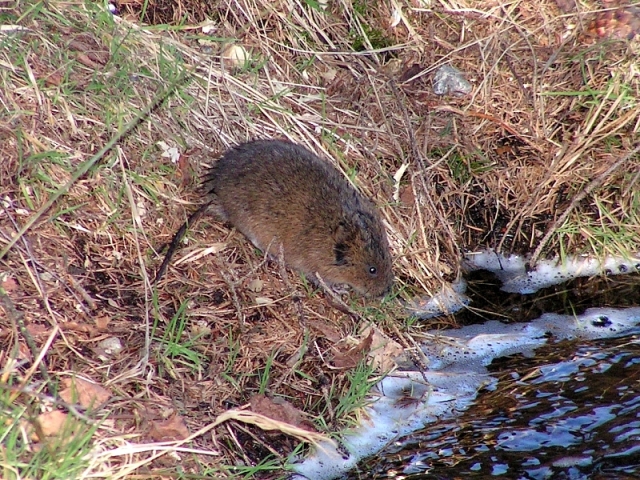
European water vole
Description
European water voles are large, stocky and long-tailed voles and is the second largest vole species in Europe after the introduced muskrat. It has a snout-vent length of 130-165 mm, a tail length of 50-90 mm, and a foot length of 22-27 mm and ear length 12-15 mm.
The coat is long, dense and glossy. It is variable on the upperparts, mostly dark brown, rarely light brown. The tail is lighter. The underpart is whitish or yellowish grey.
Habitat
Depending on the population, the animals live mainly aquatic in rivers, streams and swamps or terrestrial in meadows, orchards and gardens, less frequently in wooded areas.
The text is a translation of an excerpt from Wikipedia (https://de.wikipedia.org/wiki/Ostschermaus). On wikipedia the text is available under a „Creative Commons Attribution/Share Alike“ licence. Status: 20 August 2021
Field vole
Description
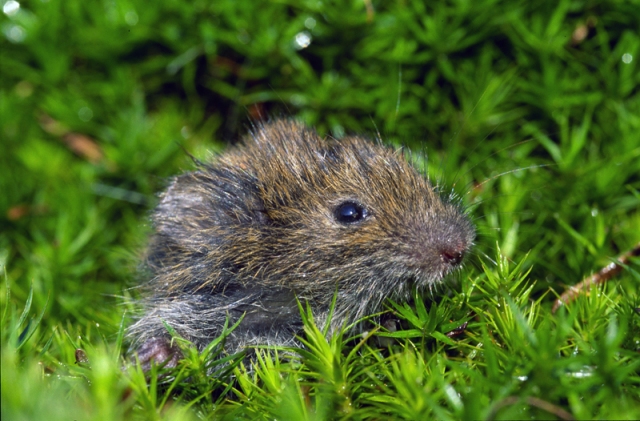
The field vole is slightly larger on average than the very similar field mouse and the coat is slightly darker, looser and longer haired. The snout-vent length is 95-133 mm, the tail length 26-47 mm, the length of the hind foot 16-19 mm and the ear length 11-14 mm. The animals weight 20-47 g, rarely up to 55 g. The fur is dark brown on top, occasionally reddish brown. The underpart is whitish, occasionally with a yellowish tinge.
Habitat
The field vole prefers relatively damp and cool habitats, in Central Europe above all sparse forests, clearings, grassy meadows and wet meadows, and of all the small mammals of Central Europe it enters upland moors the furthest. It occurs in the Alps up to 1800 m altitude.
The text is a translation of an excerpt from Wikipedia (https://de.wikipedia.org/wiki/Erdmaus). On wikipedia the text is available under a „Creative Commons Attribution/Share Alike“ licence. Status: 20 August 2021
Field mouse
Description
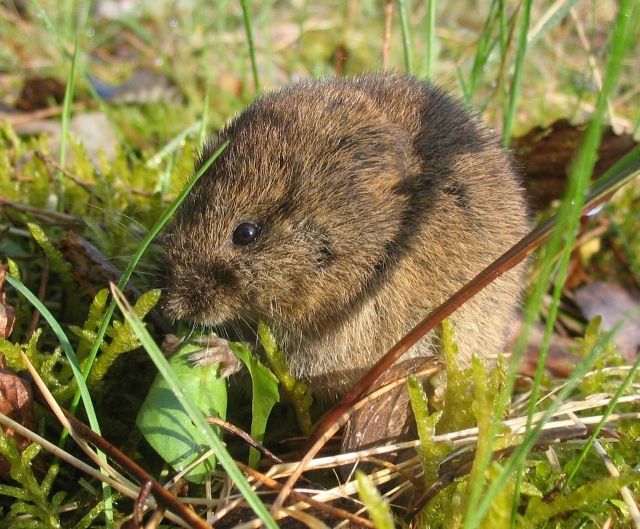
The snout-vent length is 90-120 mm, the tail length 25-38 mm, the length of the hind foot 14.5-16 mm, rarely up to 17 mm and the ear length 9-12 mm. The animals usually weight 18-40 g, rarely up to 51 g. The coat is yellowish grey on top, more brown in the west of the range, more grey in the east. The underpart is whitish and occasionally rusty yellow.
Habitat
The field mouse mainly inhabits open, agriculturally used cultivated landscapes, i.e. fields, short-grassed meadows and pastures, but also, for example, dunes and dry and very open pine forests.
The text is a translation of an excerpt from Wikipedia (https://de.wikipedia.org/wiki/Feldmaus). On wikipedia the text is available under a „Creative Commons Attribution/Share Alike“ licence. Status: 20 August 2021
European pine vole
Description
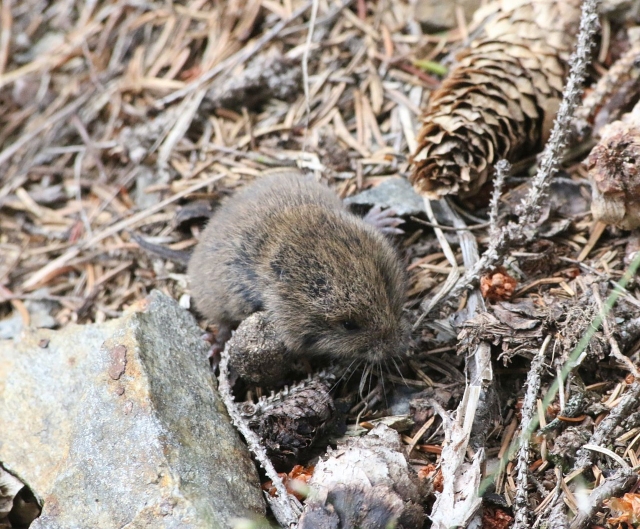
The species resembles the field mouse, but is much smaller and has relatively smaller eyes. Snout-vent length is 77-105 mm, tail length 24-40 mm, hind foot length 13.0-16.1 mm and ear length 7-10 mm. The animals weigh 13-23 g. The fur is softer and denser than that of the field mouse and brownish grey on top, the underpart is whitish.
Habitat
In Central Europe, the European pine vole prefers slopes and loose soils with a lot of humus and requires ground vegetation that provides cover; otherwise, however, the species is very adaptable with regard to its habitat requirements. It inhabits forests of all kinds, dry or moist meadows from sea level to above the tree line as well as vegetable gardens and vineyards. Its occurrence in many areas is probably limited less by the habitat features per se than by the presence of other vole species with a similar, partly subterranean way of life.
The text is a translation of an excerpt from Wikipedia (https://de.wikipedia.org/wiki/Kurzohrmaus). On wikipedia the text is available under a „Creative Commons Attribution/Share Alike“ licence. Status: 20 August 2021
Liechtenstein's pine vole

Description
The Liechtenstein´s pine vole is slightly larger than the similar European pine vole. The snout-vent length is 84-115 mm, the tail length 27-45 mm, the length of the hind foot 15-18 mm and the ear length 8-10 mm. The animals weight 14-33 g. The coat is pale yellowish on the upperpart and reddish brown, the underpart and the backs of the feet have whitish hairs. The ears are almost completely hidden in the fur. The skullcap is slightly arched and the ear capsules are relatively large.
Habitat
The relatively small range of the Liechtenstein´s pine vole extends from the Italian Eastern Alps and the extreme south-east of Austria to Istria and the north-western Dinaric Alps in Croatia. In addition, the species is also known from two isolated localities in the northern Alps. It mainly lives in clearings and small meadows with dense ground vegetation in mountain forests, but also in dry meadows and hedgerows from sea level to 1700 m altitude.
The text is a translation of an excerpt from Wikipedia (https://de.wikipedia.org/wiki/Illyrische_Kurzohrmaus). On wikipedia the text is available under a „Creative Commons Attribution/Share Alike“ licence. Status: 20 August 2021
Bank vole
Description
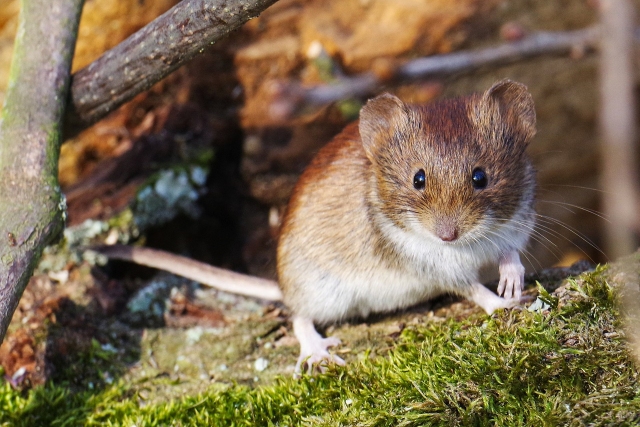
With a snout-vent length of seven to more than 13 cm, this relatively small mouse species has a tail length of 3 to 6.5 cm and weighs between 12 and 35 grams. The species shows size and weight differences of up to 300 percent between populations of different regions.
The dorsal fur is reddish brown to foxy red, sometimes yellowish. The flanks are brownish to grey-brown and usually cream-coloured. The belly coat is whitish to grey. The undercoat is grey. The paws are pale. The black fur at the end of the tail is slightly longer than the rest of the fur on the tail and clearly separated from it in colour. The ears are large to medium sized at nine to 16 mm.
Habitat
Its habitat is formed by beech and mixed forests, hedges and bushes close to forests, and wetlands. It is also often found near watercourses. Gardens close to forests are also accepted as habitats. There, the bank vole also builds its nests in little-used barns, storage sheds, garden huts or other wooden structures. Indications of an existing nest include foliage, dry moss cushions and twigs that have been brought in and deposited by the bank voles.
The text is a translation of an excerpt from Wikipedia (https://de.wikipedia.org/wiki/Rötelmaus). On wikipedia the text is available under a „Creative Commons Attribution/Share Alike“ licence. Status: 20 August 2021
