


Florian Heigl
Third Paper published
We published our third paper in the project in the Journal BMC Ecology yesterday (27 June 2017). The article is open access available, please visit the article webpage to read the fulltext: https://link.springer.com/article/10.1186%2Fs12898-017-0134-z
We would also be happy if you read and share our blog: http://blogs.biomedcentral.com/bmcseriesblog/2017/07/07/using-citizen-science-to-monitor-road-kills/
To get an impression, here is our abstract:
Background
Amphibians and reptiles are among the most endangered vertebrate species worldwide. However, little is known how they are affected by road-kills on tertiary roads and whether the surrounding landscape structure can explain road-kill patterns. The aim of our study was to examine the applicability of open-access remote sensing data for a large-scale citizen science approach to describe spatial patterns of road-killed amphibians and reptiles on tertiary roads. Using a citizen science app we monitored road-kills of amphibians and reptiles along 97.5 km of tertiary roads covering agricultural, municipal and interurban roads as well as cycling paths in eastern Austria over two seasons. Surrounding landscape was assessed using open access land cover classes for the region (Coordination of Information on the Environment, CORINE). Hotspot analysis was performed using kernel density estimation (KDE+). Relations between land cover classes and amphibian and reptile road-kills were analysed with conditional probabilities and general linear models (GLM). We also estimated the potential cost-efficiency of a large scale citizen science monitoring project.
Results
We recorded 180 amphibian and 72 reptile road-kills comprising eight species mainly occurring on agricultural roads. KDE+ analyses revealed a significant clustering of road-killed amphibians and reptiles, which is an important information for authorities aiming to mitigate road-kills. Overall, hotspots of amphibian and reptile road-kills were next to the land cover classes arable land, suburban areas and vineyards. Conditional probabilities and GLMs identified road-kills especially next to preferred habitats of green toad, common toad and grass snake, the most often found road-killed species. A citizen science approach appeared to be more cost-efficient than monitoring by professional researchers only when more than 400 km of road are monitored.
Conclusions
Our findings showed that freely available remote sensing data in combination with a citizen science approach would be a cost-efficient method aiming to identify and monitor road-kill hotspots of amphibians and reptiles on a larger scale.
New citizen science paper published

Today (10th October 2016) we published a new paper in Remote Sensing with the title "Comparing Road-Kill Datasets from Hunters and Citizen Scientists in a Landscape Context".
It is open access and therefore free for everyone to read: http://www.mdpi.com/2072-4292/8/10/832/htm
We really wish to thank all citizen scientists in Project Roadkill for investing time and reporting data.
Here is the abstract of our published paper:
Comparing Road-Kill Datasets from Hunters and Citizen Scientists in a Landscape Context
Authors: Florian Heigl 1,*, Carina R. Stretz 1, Wolfgang Steiner 2, Franz Suppan 3, Thomas Bauer 3, Gregor Laaha 4 and Johann G. Zaller 1
1Institute of Zoology, University of Natural Resources and Life Sciences Vienna
2Institute of Wildlife Biology and Game Management, University of Natural Resources and Life Sciences Vienna
3Institute of Surveying, Remote Sensing and Land Information, University of Natural Resources and Life Sciences Vienna
4Institute of Applied Statistics and Computing, University of Natural Resources and Life Sciences Vienna
Road traffic has severe effects on animals, especially when road-kills are involved. In many countries, official road-kill data are provided by hunters or police; there are also road-kill observations reported by citizen scientists. The aim of the current study was to test whether road-kill reports by hunters stem from similar landscapes than those reported by citizen scientists. We analysed the surrounding landscapes of 712 road-kill reportings of European hares in the province of Lower Austria. Our data showed that road-killed hares reported both by hunters and citizens are predominantly surrounded by arable land. No difference of hedges and solitary trees could be found between the two datasets. However, significant differences in landcover classes and surrounding road networks indicate that hunters’ and citizen scientists’ data are different. Hunters reported hares from landscapes with significantly higher percentages of arable land, and greater lengths of secondary roads. In contrast, citizens reported hares from landscapes with significantly higher percentages of urban or industrial areas and greater lengths of motorways, primary roads, and residential roads. From this we argue that hunters tend to report data mainly from their hunting areas, whereas citizens report data during their daily routine on the way to/from work. We conclude that a citizen science approach is an important source for road-kill data when used in addition to official data with the aim of obtaining an overview of road-kill events on a landscape scale.
1. European Citizen Science Conference
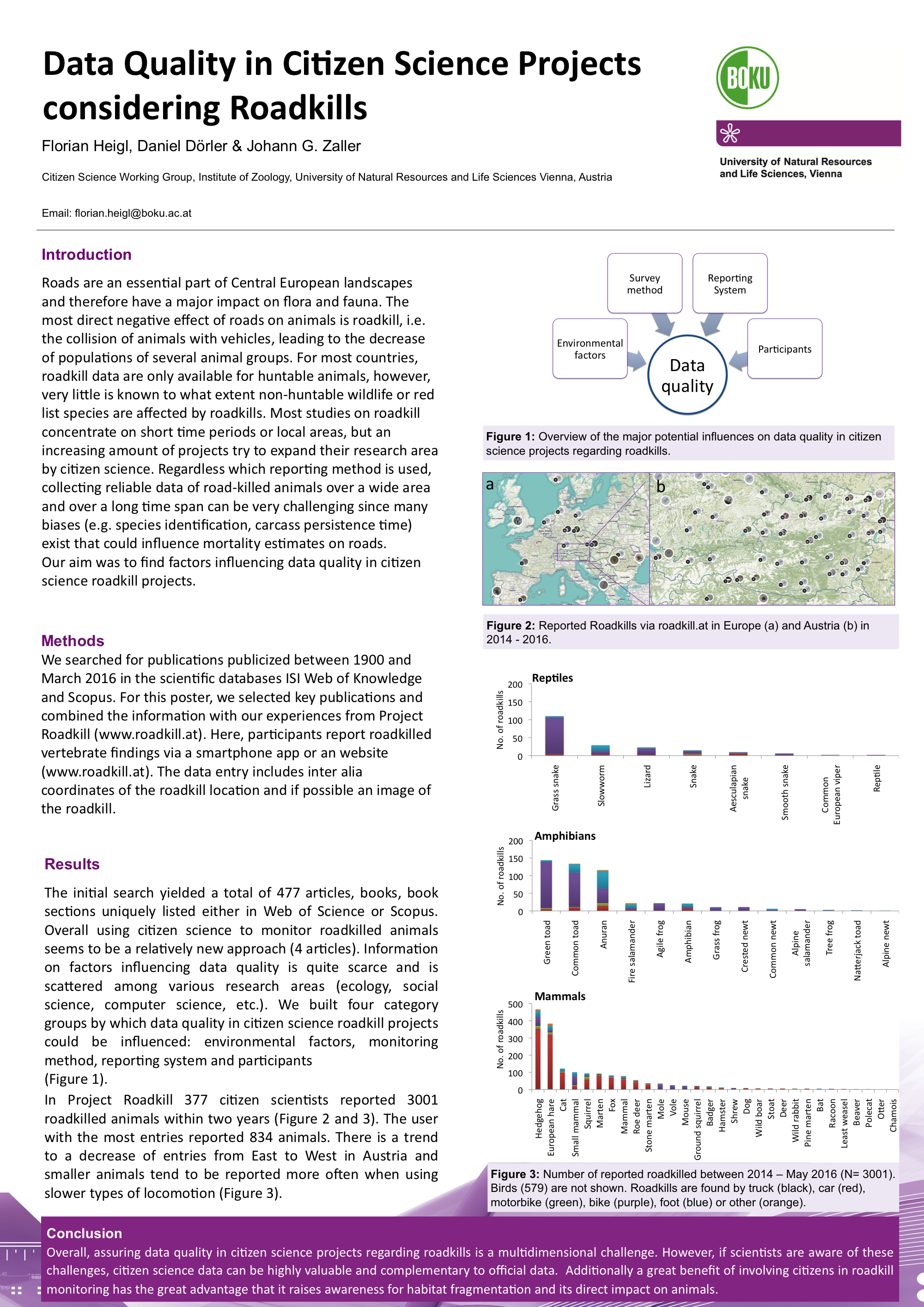
Poster presentation “Data quality in citizen science projects considering roadkills” by Florian Heigl, Daniel Dörler and Johann Zaller; 1. European Citizen Science Conference in Berlin, Germany; 19. - 21. May 2016. More information regarding the conference: http://www.ecsa2016.eu/
The presented poster:
Team

Although the Roadkill project is coordinated at BOKU University, we consider all contributors to be part of our project team. Our citizen scientists are at the forefront of this, as without their data reports, discussions about recorded animal species and suggestions for improving the apps, website and method itself, the project would not be possible. Some of our citizen scientists are also featured on our blog.
|
|
Florian Heigl
|
|
|
Daniel Dörler
|
Contact

Florian Heigl
Citizen Science Working Group
Institute of Zoology
BOKU University, Vienna
Gregor-Mendel-Straße 33
1180 Wien
This email address is being protected from spambots. You need JavaScript enabled to view it.
EGU 2015
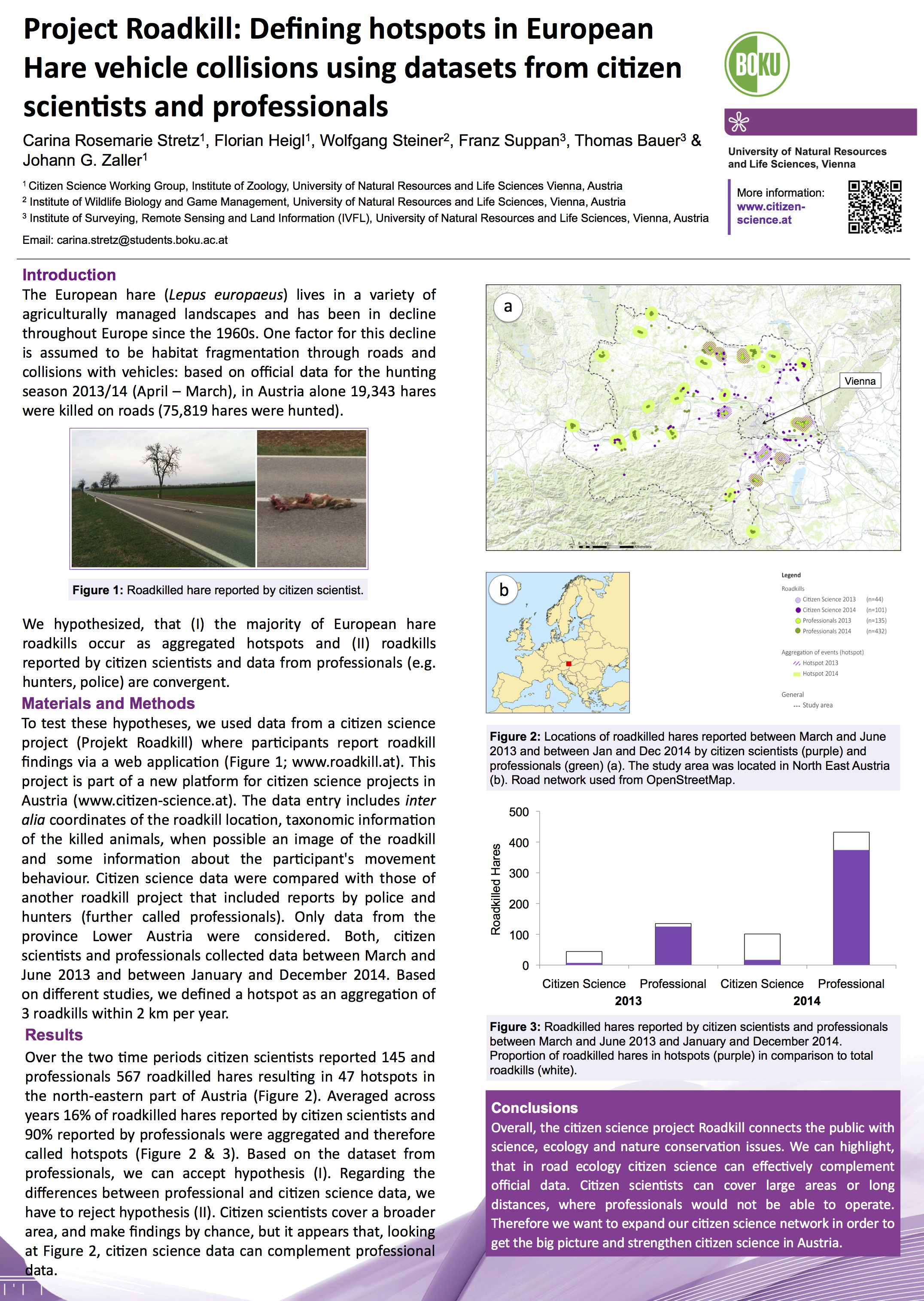
15th April 2015, Carina Stretz, master student at the Institute of Zoology at the University of Natural Resources and Life Sciences, Vienna presented the poster Project Roadkill: Defining hotspots in European Hare vehicle collisions using datasets from citizen scientists and professionals at the European Geosciences Union
General Assembly 2015. More than 11000 scientists are attending the EGU GA to talk about latest trends and findings in a variety of scientific fields.
The presented poster:
Dialogue at eye level
In recent years citizen science is getting more important in professional science. More and more professional scientists are integrating citizens in their research. However what is citizen science and where does it come from? Which impact does citizen science have on the cooperation of laypersons and professionals? How do citizen science projects work and are there examples in Austria? Can we do something to promote citizen science in Austria and make it easier for laypersons?
Florian Heigl and Daniel Dörler are answering these questions in German in the "Jahrbuch 2015 der Bildung für eine nachhaltige Entwicklung", which was published in June 2015.
More Information regarding the Jahrbuch: https://www.umweltbildung.at/shop/bne-reloaded/
