


Florian Heigl
Tree sparrow

Description
The tree sparrow is up to 14 cm tall and weights 20 to 24 grams. The wing length is between 6.8 and 7.4 cm in males and between 6.6 and 7.1 cm in females. The male tail measures 4.8 to 5.8 cm, while the female tail measures between 5 and 5.6 cm.
The tree sparrow is somewhat more cleanly marked than the house sparrow and is overall somewhat smaller and slimmer than the latter. The top of the head and the nape of the neck are brown, the throat bears a small black throat patch. The cheeks are white with a black spot in the ear area. The pale collar is almost closed at the nape. The top of the body is brownish with darker longitudinal stripes, which are particularly noticeable on the back and shoulders. The rump is yellowish brown, the belly and breast are brownish grey. The wings have two white bands.
Juveniles resemble adults but are more greyish brown on the top of the head. The upperpart is paler with longitudinal grey stripes, the cheek and throat patches are still sooty grey. They undergo a full moult about five to eight weeks after fledging and show their first adult plumage after an average of 77 days. The nestlings are initially naked. They have pink skin, and the throat and tongue are also pink. The beak bulges are pale yellow.
Habitat
The habitat is sparsely wooded regions, forest edges, field margins, hedgerows, avenues, gardens and the fringes of settlements. In western Europe in particular, the tree sparrow is less of a synanthropic bird than the house sparrow. However, it is increasingly penetrating towns and villages and occupying the niche of the increasingly rare house sparrow.
The text is a translation of an excerpt from Wikipedia (https://de.wikipedia.org/wiki/Feldsperling). On wikipedia the text is available under a „Creative Commons Attribution/Share Alike“ licence. Status: 20 October 2021
European spotted flycatcher
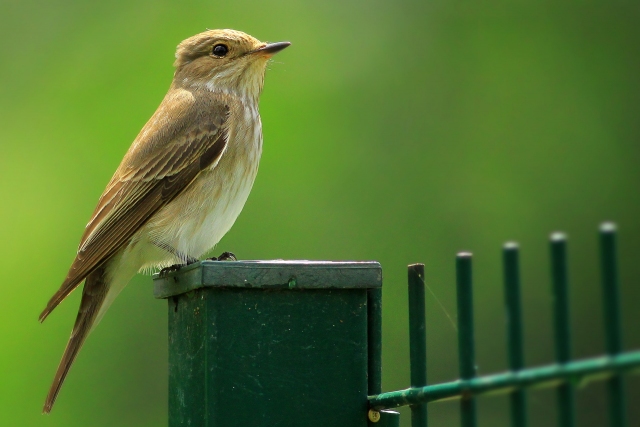
Description
European spotted flycatchers are quite small, slender songbirds with rather large heads, relatively long wings and long tails. They are overall rather plain grey-brown and have no conspicuous markings. The sexes are equally coloured.
With a body length of 13.5 to 15 cm, the species is about the size of a house sparrow. In adult birds, the entire upperpart of the rump, including the hindneck and head, as well as the lesser coverts are a solid dark to greyish brown, only the plumage on the forehead and front upper part of the head is a patchier brown with dark shaft stripes and pale fringes. Wings and tail feathers are darker grey. The primaries and the tail feathers have narrow brownish fringes on the outer plumes, the secondaries are broader and have more whitish fringes. In fresh plumage, the large and medium coverts show beige tips and similarly coloured fringes, with increasing wear these light parts become more and more indistinct. The throat and the entire underpart of the rump as well as the undertail coverts are dirty white, the throat and middle of the breast are finely streaked on this ground, the light brownish overcast breast sides and flanks are more strongly dark streaked. The iris is dark brown. The rather long beak is blackish horn-coloured, the base of the lower beak is lightened. The legs are black.
In juvenile plumage the upperparts are more brown with pale rusty beige to isabelline spots. The secondaries and the greater coverts have reddish brown fringes. The underpart of the rump has a dark spotted pattern on an isabelline background and hardly any stripes.
Habitat
The European spotted flycatcher is bound to taller trees, which allow it to use free airspace for hunting insects in the air and on the ground due to a large number of perching places. It therefore primarily inhabits sparse areas in forests of all kinds up to copses, but also parks, cemeteries, gardens and avenues in villages and towns. Buildings enrich the habitat by providing nesting sites and an increased supply of insects due to heat radiation. In Central Europe, probably the greater part of the population breeds in the area of human settlements, older parks usually have the highest breeding pair densities.
The text is a translation of an excerpt from Wikipedia (https://de.wikipedia.org/wiki/Grauschnäpper). On wikipedia the text is available under a „Creative Commons Attribution/Share Alike“ licence. Status: 20 October 2021
Eurasian greenfinch
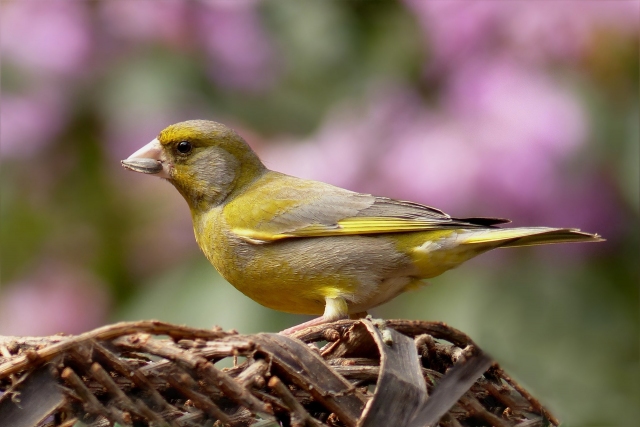
Description
With a body length of 14 to 16 cm, the Eurasian greenfinch is about as large as the house sparrow. The body, head and beak are strikingly strong. The beak is light horn-coloured. The outer plumes of the primaries are yellow, resulting in a greenish-yellow wing patch. When the wing is folded, the outer edge is also distinctly yellow. The parts of the tail feathers close to the body are also yellow.
The male is yellow-green on the underparts and grey-green on the upperparts. The rump is lighter green. The cheeks, neck, nape and greater coverts are grey, the flanks are light grey. On the wings there is a grey wing patch in the area of the secondaries. The tips of the wings and tail feathers are dark. The throat is dirty yellow. The legs are flesh coloured.
The female is overall much duller and less yellow in colour than the male. The entire body plumage is faintly streaked longitudinally. Her upperparts and head are brownish, the underpart of the rump is faintly greenish-grey. The throat is pale, the cheeks brown.
The juvenile plumage is distinctly lighter, the underpart of the body whitish with light grey longitudinal stripes, the upper side washed-out grey-brown and faintly longitudinally striped. The yellow colouring of the wing is very indistinct. There is a pale grey area around the eye. The greater coverts have broad, beige-coloured terminal seams. In females and juveniles the legs are dark sandy. The iris is dark in all.
Habitat
The Eurasian greenfinch is originally a resident of sparse tree stands, clearings or open areas bordering forest edges, as well as riverbanks and copses. Today, it mainly inhabits a wide variety of human settlements: From individual farms and hamlets with scattered orchards to large city centres with parks or cemeteries, provided there are at least individual trees, rows of trees or greened house facades.
The text is a translation of an excerpt from Wikipedia (https://de.wikipedia.org/wiki/Grünfink). On wikipedia the text is available under a „Creative Commons Attribution/Share Alike“ licence. Status: 03 November 2021
Black redstart
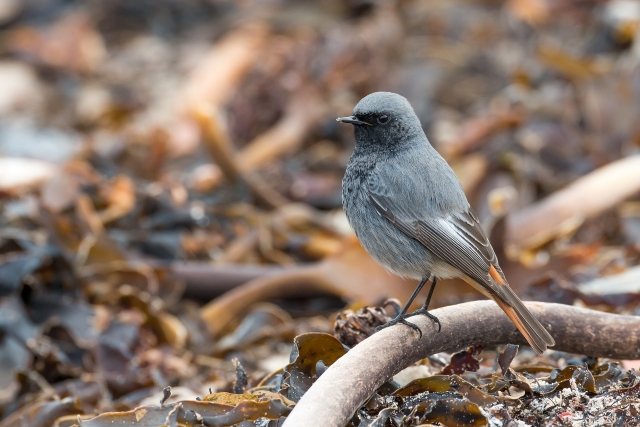
Description
With a body length of 14 to 15 cm, the black redstart is slightly smaller and, above all, slimmer than the house sparrow. The eponymous characteristic of the genus is the rust-orange coloured uppertail coverts and tail feathers, whereby in the black redstart the middle pair of tail feathers is dark brown. This feature is present in all dresses in both male and female. The brown-black beak is relatively long, broad at the base and ringed by rather long beak bristles. The black, slender legs are strikingly long, the perching posture is upright. The weight is between 14 and 20 grams, on average 16.2 grams. The wings are relatively long, the wing length of Central European representatives of the species ranges from 85 to 91 mm, the wingspan is about 26 cm.
The upperparts of adult males are dark slate grey during the breeding season. The forehead is black, sometimes with a white forehead patch. The reins, cheeks and the underpart from the chin to the belly are black, the underparts are lighter and greyer. The dark brown-grey primaries and secondaries have a white fringe, which is particularly evident on the middle secondaries, forming a white wing patch. This is only visible on a sitting bird and may be barely visible in summer. In autumn and winter, males appear slightly lighter overall due to grey feather fringes.
Females are much more inconspicuous than males. The rump and uppertail coverts appear less bright than the male and more reddish brown than rusty orange. On top, females are uniformly grey-brown in colour, only the middle and underbelly are blurred grey-white and thus lighter.
distinction between black redstart and common redstart
In Europe, the closely related commonn redstart (Phoenicurus phoenicurus) breeds alongside the redstart. Adult males of the common redstart can be easily distinguished during the breeding season by their white forehead, black facial mask and rust-orange rather than brown-grey underparts. It is more difficult to distinguish females; those of the common redstarts differ from female black redstarts by their pale, usually whitish-isable throat and much lighter rusty-orange to isabel-brown underparts.
Habitat
As the only bird species of the Western Palearctic, the black redstart inhabits all altitudinal zones from sea level to the alpine, sporadically even to the lower nival altitudinal zone. The species' primary habitats already cover a wide range of dry to moist mountain and rocky regions; in addition, the black redstart now colonises a large number of man-made habitats.
Common to all primary habitats is the open, largely clear character and the absence of higher, dense vegetation. These habitats have at least individual rocks or boulders that are important as breeding sites or waiting areas.
The range of secondary habitats colonised by the black redstart is extraordinarily broad, and the connection to the primary habitats, although not obvious in all cases, is recognisable on closer inspection. A key factor of these habitats is the existence of at least single clear-cut, short-grassed or vegetation-poor areas, which are preferentially hunted. In its choice of nest sites, the black redstart is markedly flexible and insensitive to disturbance. There are secondary habitats inside and outside human settlements. Examples include gravel pits, quarries, vineyards interspersed with retaining walls and virtually all types of residential, commercial and industrial sites. In Europe, settlements are now thought to host 90 per cent of the total population.
Open, clear habitats are also preferred as resting places after the breeding season and during migration. Settlement birds also use surrounding cultivated land in late summer, especially fallow fields and harvested maize fields. Riverbanks are particularly popular resting places during migration, especially in bad weather. Reeds and reed beds, on the other hand, are avoided despite their abundance of food and their open to semi-open character.
The text is a translation of an excerpt from Wikipedia (https://de.wikipedia.org/wiki/Hausrotschwanz). On wikipedia the text is available under a „Creative Commons Attribution/Share Alike“ licence. Status: 03 November 2021
Great tit
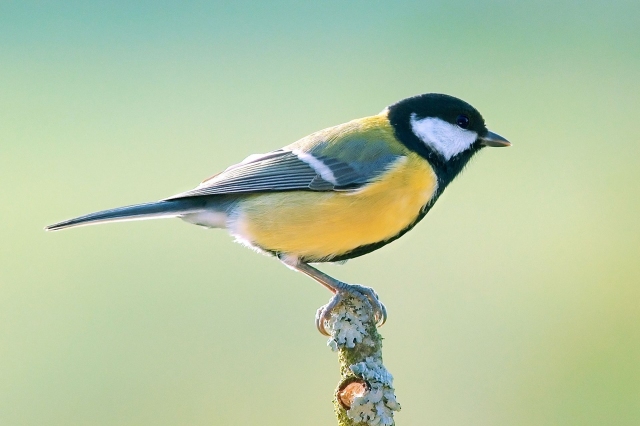
Description
With a body length of 13-15 cm, the great tit belongs to the larger tit species and is the largest tit in Europe. The wing length of males is between 71 and 82 mm, of females between 69 and 81 mm. The tail length of the male is 59-66, that of the female 55-63 mm. The weight is between 14 and 22 g. The 11.5-13.5 mm long beak is relatively strong and blackish horn-coloured with slightly lighter edges. The iris is vivid reddish brown to blackish brown. The legs and feet are blue-grey to slate-grey.The sexes are very similar, but can be distinguished partly by the expression of the black breast band.
adult birds
In adult males, the top of the head, upper nape, sides of the neck, throat and a band on the middle of the breast are glossy blue-black. Cheeks and ear coverts are pure white, neatly edged by the black areas. The sides of the chest and belly are sulphur to lemon yellow. The black band in the middle widens to a deep black patch between the legs. A whitish band on the nape of the neck separates the black of the back of the head from the back and fades into a greenish yellow towards the back. Dorsal and shoulder feathers are otherwise olive green with a greyish tinge. Lower back, rump and uppertail coverts are blue-grey with a greenish tinge on the rump. Longer uppertail coverts and tail feathers are dark blue-grey. The middle pair of tail feathers bears a dark shaft line, the others black inner vanes, the penultimate also a white tip and the outer one a white outer vane, the whiteness of which extends to the middle of the inner vane. The outer sides of the tail therefore appear white. The upper wing coverts are grey-blue, with the lesser and middle coverts showing slightly duller coloured centres, the inner plumes of the greater coverts and the primary coverts showing obscured black-grey centres. The large greater coverts also show white tips forming a white wing band. The primaries, secondaries and the tertials are predominantly black-grey. The tertials are also broad and fringed with light greenish yellow with a white lace fringe. The wings, with the exception of the two outer primaries, are narrowly grey-blue fringed and white-tipped, with only faint tips on the primaries.
The female strongly resembles the male, but is duller and darker on top. The head plate is less shiny bluish and the throat patch is duller. The black band framing the cheeks on the sides of the neck is narrower and sometimes interrupted. The vertical chest band is narrower and duller in colour. It often appears messier at the edges and may be interspersed with white towards the belly. The dark belly patch is smaller and there is often more white on the undertail coverts. The grey-blue fringes of the arm wings are less conspicuous.
juvenile plumage
The juvenile plumage resembles the adult plumage, but is much less colourful. The sides of the head, the light band on the nape and the wing band are tinted yellowish or dirty white. The head plate and the sides of the neck are dark olive-brown to dark grey and without gloss. The dark grey breast band runs out on the rear breast. The wing and tail feathers are rather dark brown instead of blackish. The fringes of the upper wings and the uppertail coverts are dull olive-green instead of grey-blue. The undertail coverts are whitish. The beak, unlike adult birds, is more horn-coloured with yellow edges and beak angles, the iris is greyer.
The sexes are not easily distinguished in juvenile plumage, but the differences present in adult plumage are already apparent. For example, the dark band on the sides of the head below the cheek patch is absent in the female, and the band on the middle of the breast is very faint or absent. The wing and tails feathers appear duller or more brownish than in the male. The best distinguishing feature, however, is the fringes of the primary coverts, which are already bluish and distinct in the male, but diffuse brownish, greenish or pale grey in the female.
Habitat
The great tit breeds primarily in deciduous and mixed forests where the tree population is 60 or more years old enough to guarantee a sufficient supply of nest holes, whereby it nests remarkably more often in rotten tree stumps than in woodpecker holes. In younger forest stands it occurs only sporadically, in closed forest areas it colonises only the marginal areas, valley locations are preferred to mountain forests. The preferred forest composition can vary regionally; in western Central Europe the highest population densities are found in oak forests, whereas further east they are found in mixed coniferous forests. Relatively low stand densities are achieved in pure beech forests; pine and spruce forests are generally only very sparsely populated.
However, due to its great adaptability, the great tit can also be found in numerous other habitats with old trees or artificial nest holes. In addition to copses, groves, hedgerows with interspersed trees, parks, cemeteries, olive groves and orchards, it also inhabits gardens or green spaces with individual trees in the middle of towns. At higher altitudes, in cleared cultivated landscapes or arid areas, it is particularly tied to human settlements.
Outside the breeding season, the great tit occurs in all conceivable habitats and has also been found, for example, in treeless steppe areas.
The text is a translation of an excerpt from Wikipedia (https://de.wikipedia.org/wiki/Kohlmeise). On wikipedia the text is available under a „Creative Commons Attribution/Share Alike“ licence. Status: 11 November 2021
House martin
Description
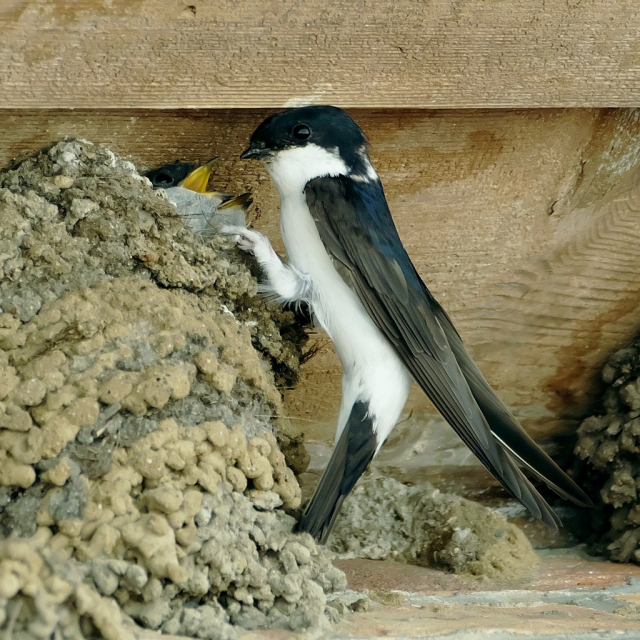
The house martin has a body length of about 13 cm and weights between 16 and 25 grams. It is thus smaller and slimmer than a sparrow and belongs to the medium-sized birds within the swallow family.
The head, back, upper side of the wings and tail of adult house martins are blue-black. The entire underparts of the body and the rump contrast with this with a pure white to floury white colouration. The short legs and feet are also white feathered. The toes and the few unfeathered parts of the legs are pale flesh-coloured. Compared to the barn swallow, the tail is less forked; strongly elongated outer feathers are absent. The eyes are brown; the beak is short and black.
Occasionally, house martins also include whites whose plumage is either completely white or in which the white parts are much more extensive than in normally coloured house martins. The literature describes individuals in which only the head was normally coloured and the rest of the body was feathered in white, or in which only the right wing feathers, wing coverts and primaries were pure white.
Juveniles can be distinguished from adults by their brownish to brownish-black upperparts, which only shine bluish-black in some areas. The wings are also brownish and still lacking in lustre. The throat and flanks are grey feathered. The most striking distinguishing feature is the grey rump (pure white in adults). It has a speckled appearance as its dark brown feathers have white tips.
Habitat
House martins are originally breeding birds that nest on vertical rock cliffs. Breeding colonies in such natural places still exist today. In its European range, however, the species is predominantly a synanthropic bird, using the open and populated cultural landscape as its habitat. Even in the European range, house martins still settle at high altitudes. In Austria, a colony of house martins has been documented on the Großglockner at an altitude of 2450 metres.
House martins depend on open areas with low vegetation. This enables them to hunt aerial plankton even when it flies low due to rainy or stormy weather. The proximity of larger bodies of water is also necessary to find suitable nesting material. There are different statements in the literature about how pronounced the cultural succession behaviour of the house martin is, especially in comparison to the barn swallow. High levels of air pollution may be responsible for house martins avoiding cities in some regions.
The text is a translation of an excerpt from Wikipedia (https://de.wikipedia.org/wiki/Mehlschwalbe). On wikipedia the text is available under a „Creative Commons Attribution/Share Alike“ licence. Status: 11 November 2021
Common chaffinch
Description
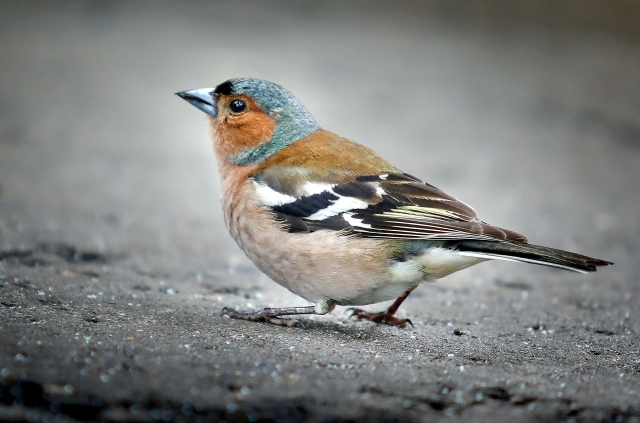
The common chaffinch can reach a body length of 14 to 18 cm and weights between 18 and 25 grams. Regardless of sex, common chaffinches have a conspicuous white shoulder patch, a white wing band and white outer tail feathers. Otherwise, there is a striking sexual dimorphism.
In males, the underparts and the sides of the head are brownish pink to reddish brown. The top of the head, the nape of the neck and the sides of the neck are a striking greyish-blue in summer and more brownish-grey in winter. The forehead is black, the back is chestnut brown and the rump is greenish. The male's beak is steel blue in spring, otherwise horn-coloured. Females are olive grey on the upperparts and slightly lighter on the underparts. The female's beak is light brown to horn-coloured all year round.
Newly hatched common chaffinches initially have pale smoky grey down on the upperparts of the body, wings, thighs and belly. The skin is flesh pink. The throat is deep pink, the beak bulges are white or cream-coloured to yellowish. Juveniles resemble adult females, but their head and body feathers are slightly shorter and softer, and the tail feathers are narrower and more pointed.
Habitat
The common chaffinch is widespread in Europe and North Africa, but also in Western Asia, where it lives mainly in forests, but also in parks and large gardens up to about 1500 metres above sea level. It is one of the most common songbird species in Europe.
The habitat of the common chaffinch is forests, thickets, hedges, gardens and large orchards.
The text is a translation of an excerpt from Wikipedia (https://de.wikipedia.org/wiki/Buchfink). On wikipedia the text is available under a „Creative Commons Attribution/Share Alike“ licence. Status: 16 November 2021
Icterine warbler
Description
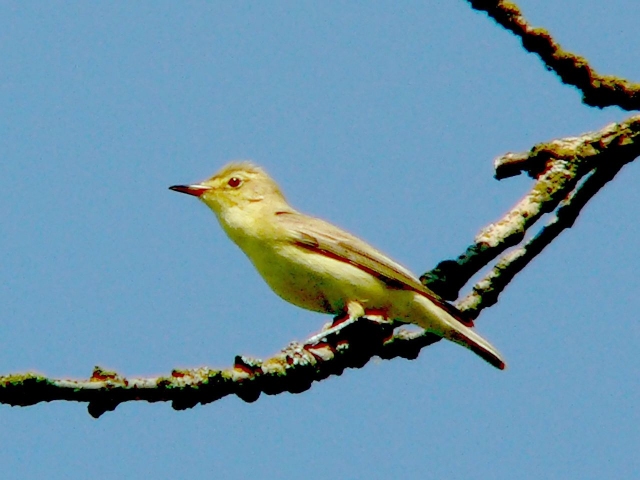
Icterine warblers are quite small, slender songbirds with rather large heads, quite strong beaks, long wings and relatively short tails. They are quite strikingly coloured compared to other tree warblers, with a brownish olive-green upperparts and a pale yellow underpart when freshly plumaged, but otherwise, like all warblers, they do not show any conspicuous markings. The sexes do not differ in size and colouration.
With a body length of 12.0 to 13.5 cm and a weight of 11 to 19 g, the species is clearly smaller than a house sparrow and only about half as heavy. In adult birds, the entire upperparts of the rump as well as the neck and head are a brownish olive-green. The wing region, the short over-eye stripe and the eye area are pale yellow. The middle coverts are dark brown, the greater coverts olive brown. The wings are blackish brown, the primaries and the tertials show narrow, the secondaries broader yellowish fringes on the outer vanes and yellowish tips. The tail feathers are dark brown with very narrow lighter brown edges. The entire underpart of the rump, the underwing coverts as well as the undertail coverts are pale yellow, the more intense yellow colouring often being restricted to the throat and forechest. Breast sides and flanks show a brownish tinge.
The iris is dark brown. The beak is clearly bicoloured; the upper beak is dark brown, the entire lower beak yellowish. The legs are leaden grey.
In juvenile plumage the upperparts are more brown-grey and less olive, the underparts paler yellow with more extensive brown flanks. The wings, tail feathers and the coverts have warm brownish edges.
Habitat
The icterine warbler inhabits a wide range of habitats with loose trees and higher shrubbery, preferring multi-layered deciduous woods with a low degree of cover in the upper layer. In Central Europe, the species inhabits riparian forests and damp mixed deciduous forests, but also copses, hedgerows, cemeteries and semi-natural parks.
The text is a translation of an excerpt from Wikipedia (https://de.wikipedia.org/wiki/Gelbspötter). On wikipedia the text is available under a „Creative Commons Attribution/Share Alike“ licence. Status: 17 November 2021
European dunnock
Description
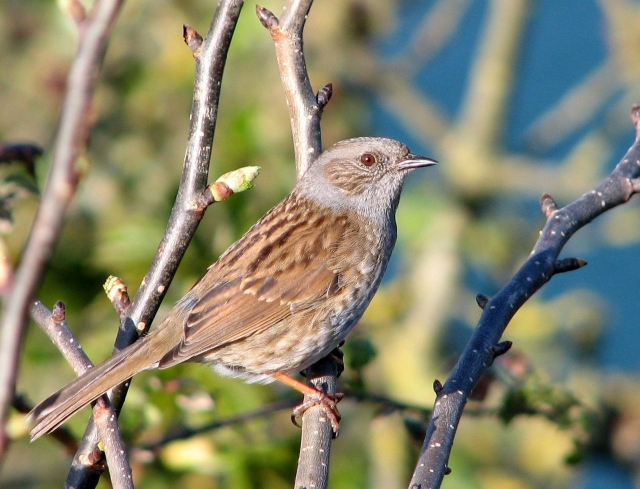
The European dunnock is just under 15 cm long and thus somewhat smaller than a sparrow. It weighs an average of 20 grams. The breast and head are lead-grey to slate-grey; the back and wings are rich dark brown with black stripes. The dark, thin beak is characteristic. Males and females look alike.
Habitat
The European dunnock lives on forest edges, in gardens, parks and bushes, in the Alps also in the krummholz zone. It reaches its highest settlement density in areas densely covered with young spruce trees. Here there can be between five and fifteen breeding pairs per 10 hectares. On coniferous forest areas with higher coniferous tree cover, the settlement density drops to two pairs. Comparable values are also achieved for mixed and deciduous forests.
The text is a translation of an excerpt from Wikipedia (https://de.wikipedia.org/wiki/Heckenbraunelle). On wikipedia the text is available under a „Creative Commons Attribution/Share Alike“ licence. Status: 17 November 2021
Eurasian nuthatch
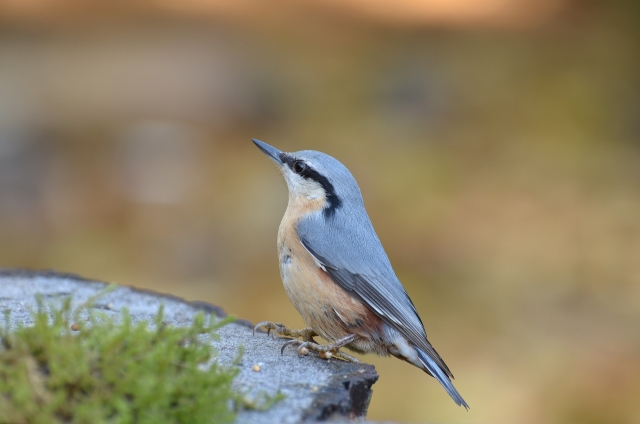
Description
The Eurasian nuthatch reaches a body length of 12 to 14.5 cm. The body is stocky with a large head, very short neck and short tail. The beak is long, pointed and grey in colour. The upperparts are blue-grey and the underparts white to ochre or rusty-red in colour, depending on the subspecies. There are large white spots on the uppertail coverts, which are always reddish brown. The Eurasian nuthatch has a black eye stripe. The cheeks and throat are white. The iris is black and the legs are orange-yellow.
Habitat
Closely tied to forests with old stands of trees.
The text is a translation of an excerpt from Wikipedia (https://de.wikipedia.org/wiki/Kleiber_(Art)). On wikipedia the text is available under a „Creative Commons Attribution/Share Alike“ licence. Status: 17 November 2021
