


Florian Heigl
Black rat
Description
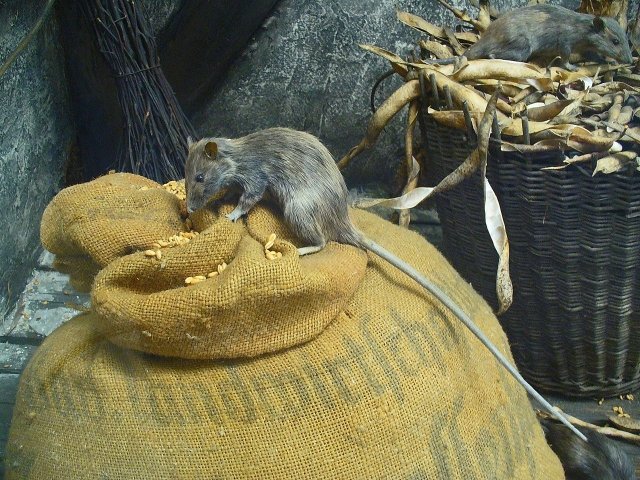
The black rat has a snout-vent length of 17 to 22 cm, a tail length of 18 to 23 cm, the tail has 200 to 260 rings, the weight is about 160 to 210 g.
The snout of the black rat is pointed, eyes and ears are relatively larger than those of the brown rat (Rattus norvegicus). Main colour forms are all grey-black (especially in the subspecies rattus), brown-grey with grey underpart (especially in the roof rat Rattus rattus alexandrinus) and brown-grey with white underpart (especially in the fruit rat Rattus rattus frugivorus). There are transitions and other colour forms in between.
The tail is longer than the body, in contrast to the brown rat, where the tail is shorter than the body.
Habitat
The black rat is only bound to human settlements in colder regions, where it prefers to live in dry residential and storage buildings (especially on upper floors), but also in cellars and stables. In the open, it looks for very different hiding places and builds its nest there.
The text is a translation of an excerpt from Wikipedia (https://de.wikipedia.org/wiki/Hausratte). On wikipedia the text is available under a „Creative Commons Attribution/Share Alike“ licence. Status: 25 August 2021
Nutria
Description
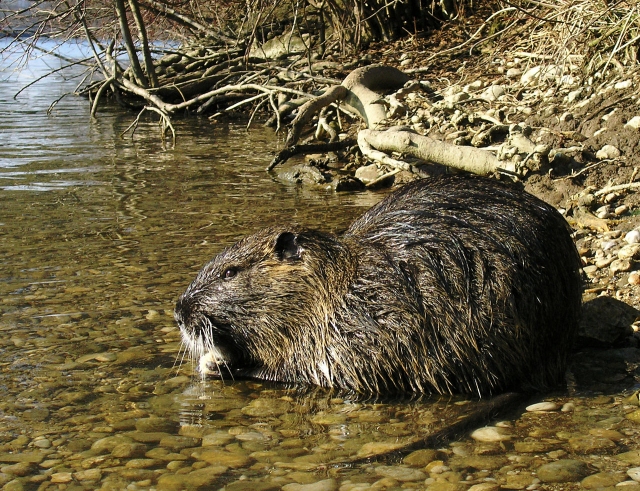
The nutria reaches a body length of up to 65 cm and weighs 8-10 kg as an adult. Its round, scale-covered, barely hairy tail has a length of about 30-45 cm. The animals are thus smaller than adult beavers (maximum snout-vent length about 100 cm, tail length about 35 cm, weight 25-30 kg). On their hind feet they have webbings between the first four toes, the fifth toe is exposed. The orange colouring of the chisel teeth, which is caused by iron deposits, is also conspicuous in adult animals.
The coat colour is reddish brown, slightly greyish on the belly. Animals that have escaped from fur farms also show a number of colour variations. They have light grey, dark grey, black, brown, reddish, yellowish or almost white fur.
Habitat
The original habitat of the nutria, which lives in rivers, lakes, ponds and swamps, is subtropical and temperate South America. In Austria, the population is limited to isolated, usually short-lived populations that regularly do not survive harsh winters. The species is not permanently established there.
The text is a translation of an excerpt from Wikipedia (https://de.wikipedia.org/wiki/Nutria). On wikipedia the text is available under a „Creative Commons Attribution/Share Alike“ licence. Status: 25 August 2021
Brown rat
Description
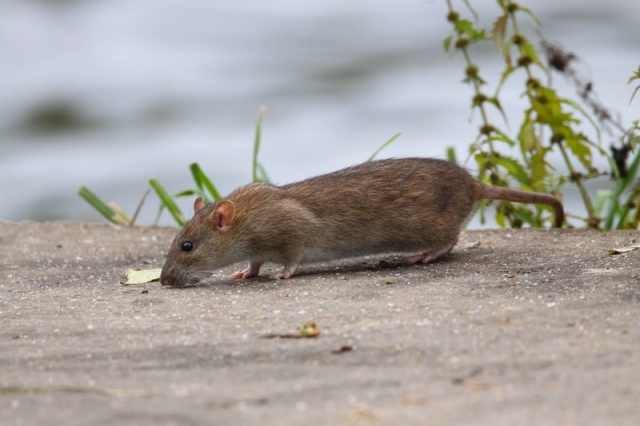
Brown rats are large, strongly built rats with an angular skull, blunt snout and thick tail, the length of which is normally less than the snout-vent length. The snout-vent length is 18-26 cm, the tail length 14-21 cm and the length of the hind foot 38-45 mm. The tail has 163-205 scale rings. The ears are round and small with a length of 17-23 mm; when folded forward they reach at most the posterior edge of the eye. Sexually mature animals weight about 170-350 g.
Depending on age, the coat is dirty grey-brown on top, reddish brown-grey to dark brown-black, the underpart grey-white. Upperpart and underpart colouration are not sharply separated. Rarely monochrome black animals occur. The tail is bicoloured, greyish brown above and lighter underparts.
Habitat
In their original range in north-east Asia, brown rats inhabit forests and bushy terrain. However, introduced populations are mainly restricted to human settlements, inhabiting drains, rubbish dumps, cellars, warehouses, stables, farms and similar habitats, very often near water. In Europe, the species also inhabits semi-natural habitats, especially water margins with dense vegetation and seashores, especially around river mouths.
The text is a translation of an excerpt from Wikipedia (https://de.wikipedia.org/wiki/Wanderratte). On wikipedia the text is available under a „Creative Commons Attribution/Share Alike“ licence. Status: 25 August 2021
Eurasian lynx
Description
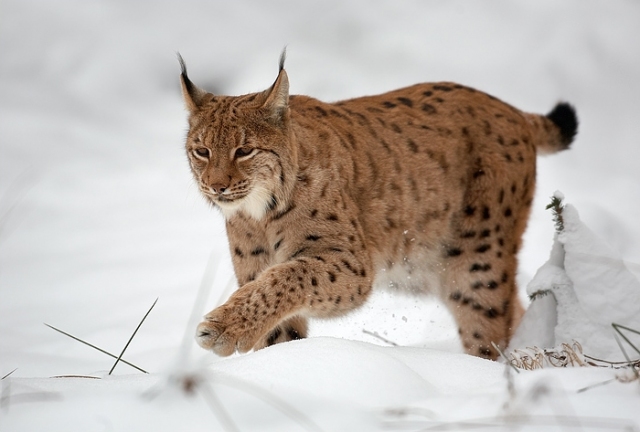
With a snout-vent length of between 80 and 120 cm and a shoulder height of 50 to 70 cm, the Eurasian lynx is the largest cat in Europe after the Persian leopard, which is found in the Caucasus. The length of the back without the head and neck corresponds to the shoulder height, so that the physique appears square. The front legs are 20 percent shorter than the hind legs. The large paws prevent the Eurasian lynx from sinking deep into the snow.
What the Eurasian lynx has in common with the other species of the genus are the brush ears, the broad and roundish head and the very short tail. The tail of the Eurasian lynx is between 15 and 25 cm long and ends in a black tip. The Eurasian lynx is characterised by a very distinctive whisker, which it can spread wide.
The fur tips on the pointed, clearly triangular ears are up to five cm long.
The Eurasian lynx's coat is reddish to yellowish brown on the upperparts during the summer and grey to greyish brown during the winter months. The chin, throat, chest, belly and the inside of the legs are whitish grey to creamy white. The spotting of the coat varies from individual to individual, but it can also be almost completely absent.
Habitat
The Eurasian lynx prefers large forest areas with dense undergrowth as its habitat and uses open landscapes and human settlements only marginally and temporarily. Ideal conditions for hunting are provided by forests with a strong small-scale structure of old-growth islands, clearings, rocky slopes and marshland zones. However, Eurasian lynx can also be found in the rocky mountain zone up to an altitude of 2500 m. These habitats offer a large number of cover opportunities between rocks and bushes. Telemetric studies accompanying a number of reintroduction projects in recent decades have shown that Eurasian lynx hunt a large part of their prey in the fringes of forests, rarely entering agricultural land. During the day, Eurasian lynx stay in their hiding places and tolerate the proximity to humans. In the Vosges Mountains as well as in the Bavarian Forest, female Eurasian lynx raise cubs not far from places that are heavily frequented by tourists.
The text is a translation of an excerpt from Wikipedia (https://de.wikipedia.org/wiki/Eurasischer_Luchs). On wikipedia the text is available under a „Creative Commons Attribution/Share Alike“ licence. Status: 25 August 2021
Wildcat

Description
In appearance, the wildcat is more massive and muscular than the domestic cat and it has longer legs in relation to its body. Adult male wildcats have a snout-vent length of 55 to 65 cm, a tail of 27 to 32 cm and a weight of 3.8 to 7.3 kg. Females are much smaller with a snout-vent length of 47 to 57.5 cm and a tail length of 25 to 32 cm and a weight of 2.4 to 4.7 kg.
The basic colouring of the coat varies from yellowish-brown to reddish-grey to silver-grey. On the back there is often a typical, continuous black dorsal stripe ending at the root of the tail. The back and sides of the body are more or less heavily patterned with washed-out stripes. The stripe pattern is usually more pronounced in the west of the range than in the east. The tail is thick and relatively short, has a typical ringing with three to five dark rings and ends bluntly, always with a black tip. The skull is similar to that of the domestic cat, but with room for a larger brain. The eyes are wide apart. There is a small black spot on the sole. Another distinguishing feature is the light-coloured nose leather (pink).
Habitat
European wildcats live mainly in forests. Large populations occur in deciduous or mixed forests that are not disturbed by humans. They also live along coasts, at the edge of marshes, in riparian forests and in the Mediterranean maquis. They avoid areas with intensive agricultural use, pure coniferous forests, very high mountains, coastal regions without cover or areas that are more than 50 % snow-covered in winter, where the average snow depth is more than 20 cm or where the snow cover remains for a period of 100 days or longer.
In Austria, wildcats were formerly widespread in the Alpine foothills of northern, eastern and southern Austria. In the second half of the 19th century, populations were severely decimated and since then only a few specimens have been recorded. They were considered extinct, extirpated or lost in Austria, and only a few years ago there was no evidence of a resident reproducing population in Austria. However, in recent years there have been increasing reports of sightings south of the Danube and evidence of an occurrence in the Thayatal National Park was found.
The text is a translation of an excerpt from Wikipedia (https://de.wikipedia.org/wiki/Europäische_Wildkatze). On wikipedia the text is available under a „Creative Commons Attribution/Share Alike“ licence. Status: 25 August 2021
Domestic cat
Description
The characteristics of the domestic cat vary according to the area of distribution. In the bred forms they depend on the breed standards, in the synanthropic domestic cats they are subject to the respective selection pressure, which depends on the natural environmental conditions.
Domestic cats average about 50 cm in length (snout-vent length) and 4 kg in weight with a wide range of variation from about 2.5 kg to about 8 kg. Males are slightly larger than females. The length of the tail is about 25 to 30 cm. The shoulder height is 30 to 35 cm. In areas of distribution with colder climates, the cats are generally heavier and larger, in warmer areas they are lighter.
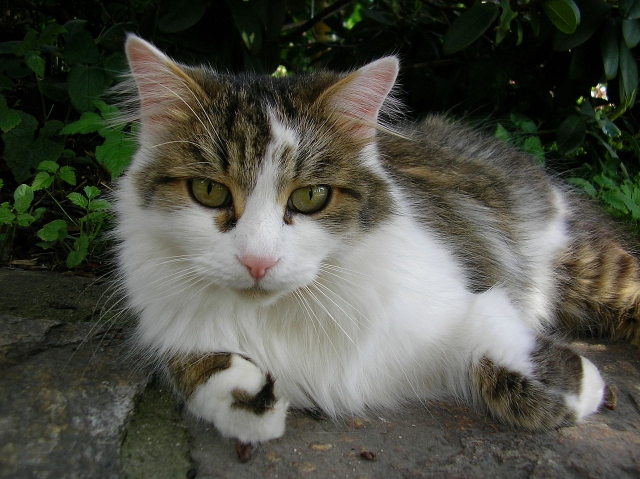
The domestic cat in the wild type has an m-shaped pattern on the forehead, " kajal " lines going from the eyes to the side, a dark dorsal stripe and dark horizontal stripes (or also spots) on the sides of the body. Legs and tail are also dark banded. Their colour varies from grey-black to warm brown tones. Besides the wild type described above, other markings and a variety of coat colours have evolved. In Europe, North America and Australia, the tabby pattern predominates, often combined with a partial white colouring.
The ears of the domestic cat stand upright, are broad at the base, triangular in shape and slightly rounded at the tips. They can be turned independently in different directions as well as laid completely flat against the back of the head. The eyes are directed forward and thus enable spatial vision.
Habitat
As a pet or domestic animal, the domestic cat is found worldwide in almost all areas populated by humans. As a wild or feral animal, however, it can only live in climatically warm or temperate zones independent of supporting human influences. It is considered as a synanthropic animal.
The text is a translation of an excerpt from Wikipedia (https://de.wikipedia.org/wiki/Hauskatze). On wikipedia the text is available under a „Creative Commons Attribution/Share Alike“ licence. Status: 27 August 2021
Raccoon dog
Description
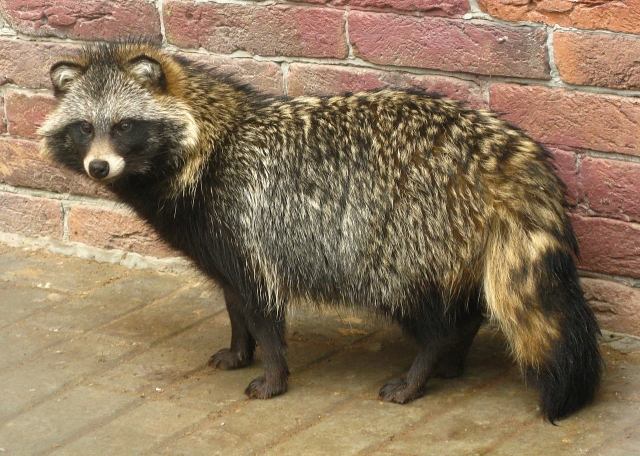
In appearance, the raccoon dog resembles the raccoon, but differs in particular in the divided face mask. The head length of adult animals is about 50 to 68 cm, plus a tail of 13 to 25 cm. With a shoulder height of 20 to 30 cm, the raccoon dog reaches a total height of 38 to 51 cm and a weight of between four and ten kg. The soft fur is beige-grey on the flanks and black-brown on the belly and back. Raccoon dogs undergo a seasonal coat change; the winter coat and the summer coat are similar in colour, but the winter coat is much thicker and heavier.
Habitat
The raccoon dog is a very shy and nocturnal inhabitant of forests and regions with a lot of undergrowth. It´s original range includes eastern Siberia, northeastern China, the Korean peninsula and Japan. In Europe, it is a newcomer (neozoon), which was originally released in order to exploit the raccoon dog fur economically.
In Austria, the first raccoon dog is reported to be spotted in 1954 in Karlstift in the municipality of Bad Großpertholz (Lower Austria). After further sightings, the first definite record was in 1983, when an animal was caught in a trap, also in the Waldviertel in Lower Austria. It has become firmly established above all in Lower and Upper Austria as well as in northern Burgenland. Evidence is increasing towards the Danube. In the mid-1990s, it was found that the distribution limit had shifted southwards. Since 2010, the distribution has been scientifically investigated. After the first raccoon dog was shot in Vorarlberg in 2014, Tyrol is the only province from which no records have been reported.
The text is a translation of an excerpt from Wikipedia (https://de.wikipedia.org/wiki/Marderhund). On wikipedia the text is available under a „Creative Commons Attribution/Share Alike“ licence. Status: 27 August 2021
Red fox

Description
The body measurements of the red fox are geographically and seasonally dependent on strong fluctuations.
The coat is reddish on top, white underpart; depending on the distribution area, the colour varies between reddish yellow to deep reddish brown on top and between pure white to slate grey underpart. The lower parts of the legs and the back of the ears are black. Overall, the coat colouration varies greatly. The most common colour variation is the black fox with a yellow-red upper side, white throat and white tail tip. Despite its name, the species often produces individuals with other colourings, including leucistic and melanistic individuals. The cross fox has a dark stripe across the shoulders and along the back. The silver fox is dark grey to black. The red fox undergoes two changes of coat per year. In spring, from the beginning of April, it loses the dense winter coat and at the same time the light summer coat develops. This becomes visible on the lower legs from the end of April and covers the legs, belly and flanks by the end of June. The coat change continues over the face to the back to the tip of the tail, which is reached in late August. The summer coat is not complete until September. As early as October, the winter coat forms again from the legs to the tail, back and face.
Habitat
The red fox, a food opportunist, does not make any special demands on its habitat. Forests, grassland, fields and, in recent times, increasingly also settlement areas are suitable habitats for the red fox.
The text is a translation of an excerpt from Wikipedia (https://de.wikipedia.org/wiki/Rotfuchs). On wikipedia the text is available under a „Creative Commons Attribution/Share Alike“ licence. Status: 27 August 2021
Golden jackal

Description
The golden jackal is between 80 and 95 cm long; its tail length is 20 to 30 cm and the shoulder height is about 35 to 50 cm. It weights about 8 to 10 kg. The coat is usually golden yellow in colour, but there are regional differences. In the mountains, golden jackals have a more grey coat.
Habitat
The golden jackal prefers open landscapes for its habitat. The animals inhabit the savannah as well as semi-deserts and rocky areas, they are absent in dense forests. In Austria, it was sighted for the first time in Styria in 1987, the first offspring was recorded in the Lake Neusiedl area in 2007.
The text is a translation of an excerpt from Wikipedia (https://de.wikipedia.org/wiki/Goldschakal). On wikipedia the text is available under anz „Creative Commons Attribution/Share Alike“ licence. Status: 27 August 2021
Brown bear

Description
Brown bears have the stocky, powerful build of all bears, but their skeleton is usually more strongly built than that of other members of their family. A species-specific feature is the muscular hump over the shoulders, which gives the front legs additional strength. The snout-vent length of these animals is between 100 and 280 cm, the shoulder height is about 90 to 150 cm. The tail is only about 6 to 21 cm long. The weight varies greatly depending on the distribution area, but in all populations the males are clearly heavier than the females.
Brown bears, like all bears, have a heavy, massive head with a protruding snout. The ears are prominent and rounded, while the eyes are very small. Accordingly, the sense of sight is underdeveloped, the sense of hearing is average, but the sense of smell is very well developed.
The limbs are long and strong, with the fore and hind extremities being approximately equal in length. The bones of the forearm (ulna and radius) and lower leg (tibia and fibula) are separated, which leads to a strong rotatability. The feet are large and have heavy, furry pads on the underpart. The front and hind feet each have five toes, which end in non-retractable claws up to 8 cm long. When moving, the whole sole of each foot is placed on the ground, so brown bears, like all bears, are sole-walkers.
The fur of brown bears is usually dark brown, but can take on a variety of shades. The variations range from yellow and grey-brown to different shades of brown and almost black. The coat of brown bears is generally characterised by a dense undercoat, the covering hairs are long. The coat is subject to seasonal changes, the winter coat, which is laid down for the cold months, is dense and rough and gives a shaggy impression.
Habitat
Brown bears inhabit a variety of habitats. The remaining animals in Europe live mainly in forested mountainous regions, even in Siberia they are more likely to be found in forests than in open terrain. As long as there is enough food and places to hibernate, they are not too choosy about their habitat. However, even in open terrain they need sufficiently densely vegetated areas as resting places.
The text is a translation of an excerpt from Wikipedia (https://de.wikipedia.org/wiki/Braunbär). On wikipedia the text is available under a „Creative Commons Attribution/Share Alike“ licence. Status: 31 August 2021
