


Florian Heigl
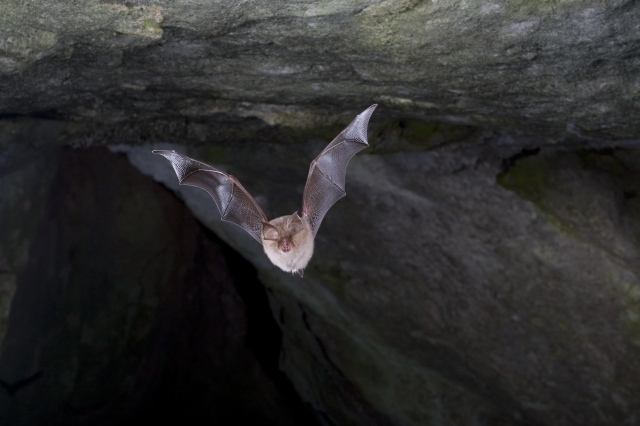
Lesser horseshoe bat
Description
The lesser horseshoe bat, with a length of about 40 mm and a maximum wingspan of 250 mm, is much smaller than the greater horseshoe bat, which it otherwise closely resembles. Its upperparts are greyish brown without a reddish tinge, the underparts grey to greyish white. The young are dark grey. The species is distinctive in that it is the smallest European Rhinolophus species and its nostril has a wedge-shaped saddle.
Habitat
The heat-loving lesser horseshoe bat prefers structurally rich areas at the edges of settlements in the low mountain ranges and also occurs in wooded areas. Small tunnels or tree hollows serve as summer roosts. Like all representatives of their species, the animals always hang freely, i.e. they are never hidden in crevices or holes. The highest known weekly roost of this species in Switzerland is at 1,177 m above sea level. Especially in the north of their range, they are often found in attics, near chimneys or in boiler rooms.
They prefer to hunt at night in deciduous forests and semi-open landscapes such as parks, avenues, orchards and on areas next to woody plants near water bodies and buildings. Almost gap-free structures of copses and hedges are important for orientation in flight. "Open areas of more than 200 m are hardly ever flown over."
The text is a translation of an excerpt from Wikipedia (https://de.wikipedia.org/wiki/Kleine_Hufeisennase). On wikipedia the text is available under a „Creative Commons Attribution/Share Alike“ licence. Status: 09 August 2021
Serotine bat
Description
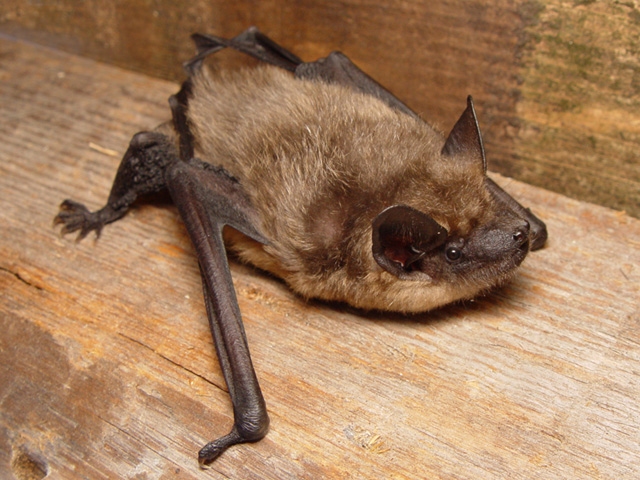
The serotine bats are characterised by a black-brown to black face, dark ears and patagium. The dorsal fur colouration varies from light smoky brown to dark blackish brown. The belly fur is slightly lighter and often yellowish brown.
With a snout-vent length between 6 and 8 cm, broad-winged bats belong to the larger European bat species. They have a wingspan of 32 to 38 cm and weigh between 14 and 35 g. They are called broad-winged bats because of their broad wings.
This species owes its name to its broad rounded wings, which make its flight silhouette characteristic and enable it to be distinguished from other species such as the noctule bats.
Habitat
Serotine bat groups have up to several dozen roosts. These are changed frequently, with the optimal temperature of the roost playing a major role. Other factors are disturbance and probably droppings and parasites.
The serotine bat prefers warm crevices on and in buildings as summer habitats. These roosts may be located behind façade cladding, gutters, attics or similar.
Adult males are often found alone or in small groups in roosts. Females are usually found in the company of other females in groups of up to a few dozen. The young are usually born and nursed in the company of other females in so-called nursery roosts. When changing roosts, the bat offspring cling to their mothers. In the known large bat hibernacula (e.g. cellars, bunkers or attics), where for example Daubenton's bats (Myotis daubentonii) or noctule bats (Nyctalus) hibernate, only single or few serotine bats are found. Little is known about the winter habitats of broad-winged bats. There are indications that some summer habitats are also used for hibernation.
The serotine bat is a dispersing species. It does not undertake long migrations.
They start hunting at dusk 20-30 minutes after sunset when they leave their roosts. The bats can cover a distance of up to 8 km to their hunting grounds on individual routes. They fly slowly (15 km/h) and at a height of 3-5 m. They often hunt in groups. They often hunt in groups, the hunting grounds include gardens, forest edges, street lamps, meadows, large individual trees or even bodies of water.
The text is a translation of an excerpt from Wikipedia (https://de.wikipedia.org/wiki/Breitflügelfledermaus). On wikipedia the text is available under a „Creative Commons Attribution/Share Alike“ licence. Status 09 August 2021
Northern bat

Description
The northern bat is a medium-sized bat species.
As in the serotine bat, the long and silky upper fur is dark to blackish brown at the base, but the tips of the hairs in adult northern bats are coloured ochre to leathery or golden from the crown to the base of the tail, contrasting with the ground colour. This effect occurs especially in the shoulder area towards the middle of the back. The nape of the neck is darker and the underpart is very light yellow-brown in colour, the transition from the dark upperpart to the light underpart being very sharply defined, especially on the sides of the neck. The snout, the cheeks, the ears and the patagium are black. The young are darker coloured and have no golden, but at most silvery fur tips, the belly is grey in them.
The ears are small compared to other bats and reach a length of 11.5 to 17.3 mm. Compared to the serotine bat, however, they are proportionally larger.
The wings are medium in width and length with a rounded wing tip, the fifth finger being almost 10 mm longer than the forearm. The tip of the tail is exposed at 3 to 4 mm with the last caudal vertebra.
In Europe, the northern bat is comparatively easy to distinguish from other bat species. Compared to the closely related serotine bat (Eptesicus serotinus), it is clearly smaller. It differs from other similar species, especially the leather-winged bat (Vespertilio murinus) and the Savi's pipistrelle (Hypsugo savii), mainly by the colour of its fur as well as features of the skeleton, especially the skull, and the shape of the penis bone.
Habitat
Northern bats prefer loose scrub and coniferous forests at altitudes of 200 to over 2,000 m, especially in Europe. They are also bound to more humid habitats and the vicinity of water bodies. In addition, they are bound to human settlements, as especially the nursery roosts are very often found in roofs of heated houses. Although most winter habitat finds are made in remote caves and cellars, it can be assumed that a large proportion of bats may hibernate in inaccessible places in wall coverings and roofs.
The text is a translation of an excerpt from Wikipedia (https://de.wikipedia.org/wiki/Nordfledermaus). On wikipedia the text is available under a „Creative Commons Attribution/Share Alike“ licence. Status: 09 August 2021
Leather-winged bat

Description
Its chirping calls, which remind us of birds, can be heard especially in autumn during the mating season. It has a maximum body size of 6.4 cm with a wingspan of 27 to 33 cm and a weight of 12 to 23 g. It got its name from its short-haired, two-coloured back fur. It got its name from its short-haired, dense bicoloured dorsal fur. It is reddish to dark brown and silvery white at the tips of the fur. The belly is also white to greyish. The ears, wings and face are blackish brown. Their wings are narrow in relation to the body and the last caudal vertebra protrudes freely from the uropatagium. The ears are short, broad and roundish.
A characteristic of the leather-winged bat is the presence of four teats in the female. No other European species has this feature.
Habitat
The leather-winged bat prefers four types of landscape, namely wooded mountains, steppes and farmland, the shore regions of lakes and, in Europe, especially the vicinity of cities.
The text is a translation of an excerpt from Wikipedia (https://de.wikipedia.org/wiki/Zweifarbfledermaus). On wikipedia the text is available under a „Creative Commons Attribution/Share Alike“ licence. Status: 09 August 2021
Common noctule
Description
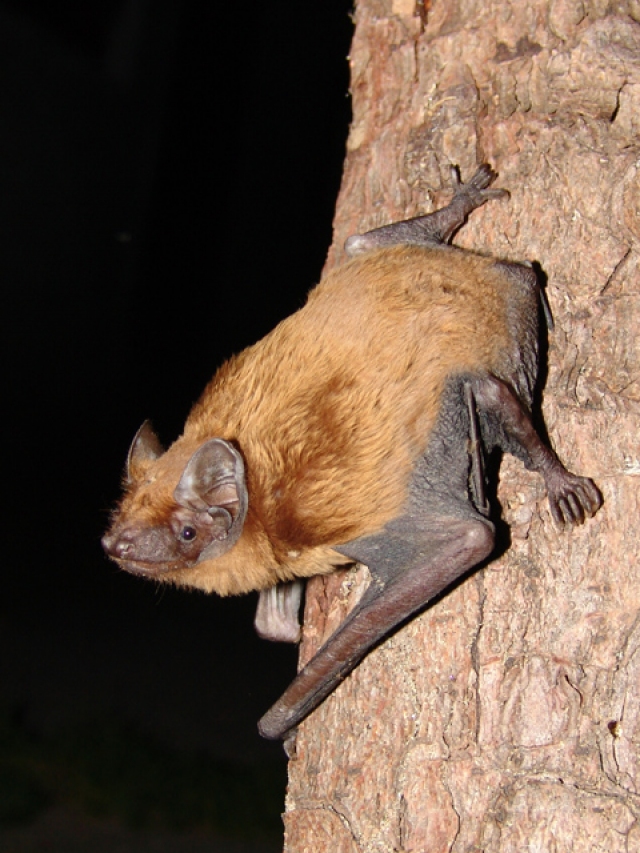
The short coat is close-fitting and shiny rusty brown over the entire body. With a maximum body length of 8.2 cm and a wingspan of 40 cm, it is between the size of its two relatives on the European continent. Very noticeable are the distinct glandular bulges in the corners of the mouth, which can be seen when the mouth is open.
Habitat
As a typical tree bat, it inhabits old (woodpecker) cavities in trees in small groups, sometimes in larger groupings; however, it also uses buildings and sometimes nest boxes as roosts.
The text is a translation of an excerpt from Wikipedia (https://de.wikipedia.org/wiki/Großer_Abendsegler). On wikipedia the text is available under a „Creative Commons Attribution/Share Alike“ licence. Status: 09 August 2021
Soprano pipistrelle
Description
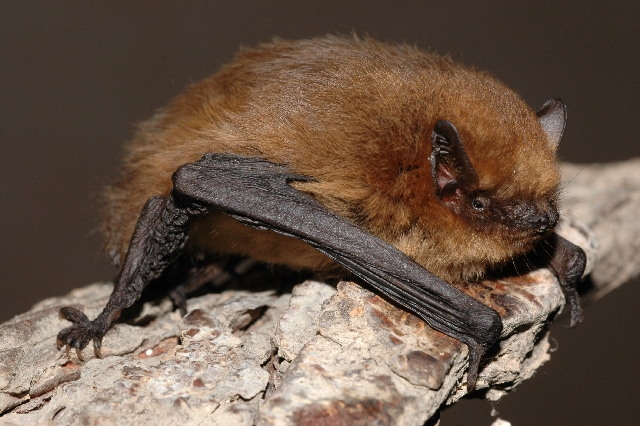
The soprano pipistrelle is a sibling of the common pipistrelle.
It differs from the common pipistrelle in that it is slightly smaller and thus represents the smallest Central European bat species. Also, its echolocation sounds are not at the usual 45 kHz, but have a final frequency of about 55 kHz.
The text is a translation of an excerpt from Wikipedia (https://de.wikipedia.org/wiki/Mückenfledermaus). On wikipedia the text is available under a „Creative Commons Attribution/Share Alike“ licence. Status: 13 August 2021
Nathusius's pipistrelle
Description
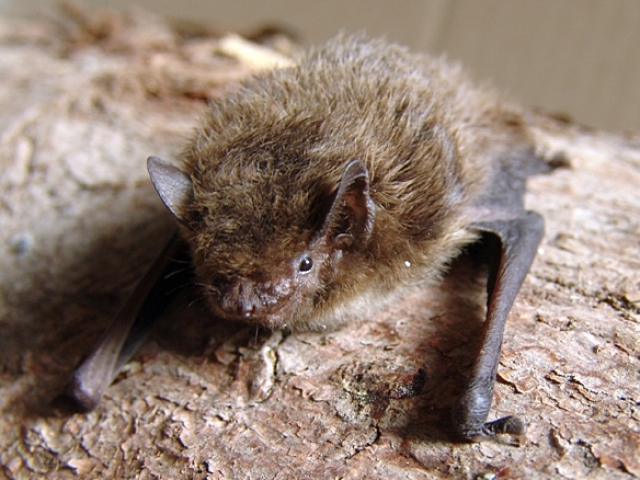
It achieves a maximum body size of around 5 to 6 cm and a wingspan of up to 25 cm with a weight of 6 to 10 g. Its appearance makes it easy to confuse with the other pipistrelle bats. A good distinguishing feature from the common pipistrelle and soprano pipistrelle is the 5th finger, which is usually longer in the Nathusius's pipistrelle.
Habitat
The Nathusius's pipistrelle summer habitats are crevice roosts such as trunk cracks, tree hollows and rock crevices, but they can also be found on buildings, e.g. behind wooden panelling. In winter, the species often occupies wood piles or tree hollows.
The text is a translation of an excerpt from Wikipedia (https://de.wikipedia.org/wiki/Rauhautfledermaus). On wikipedia the text is available under a „Creative Commons Attribution/Share Alike“ licence. Status: 13 August 2021
Kuhl's pipistrelle

Description
With a size of up to 4.7 cm, it is only slightly larger than its sister species, the common pipistrelle. Its wingspan is around 22 cm and it weighs 5-10 grams.
When the wings are open, it is easy to see that there is a 1-2 mm wide, light-coloured fringe between the last phalanx and the foot on both sides, which gave the Kuhl's pipistrelle its name.
Habitat
It inhabits forests and grasslands of temperate climates, but also rural gardens and urban areas.
The text is a translation of an excerpt from Wikipedia (https://de.wikipedia.org/wiki/Weißrandfledermaus). On wikipedia the text is available under a „Creative Commons Attribution/Share Alike“ licence. Status: 13 August 2021
Common pipistrelle
Description
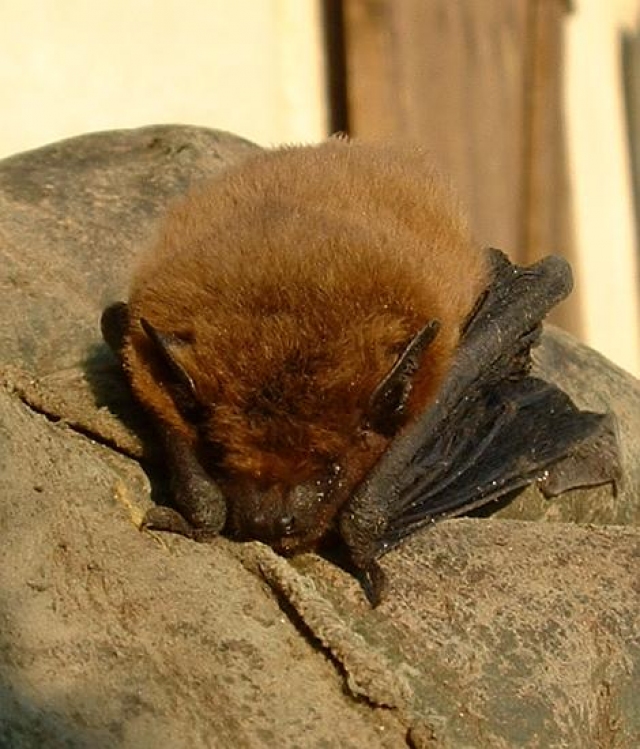
The common pipistrelle is the most widespread bat species in Europe. It is one of the smallest representatives of the mammals with a wingspan of up to 25 cm. Along with the soprano pipistrelle bat, it is one of the smallest within its genus.
It reaches a body size of 4.5 cm and a wingspan of up to 25 cm with a weight of 3.5 to 7 g. It thus weights only a little more than sugar cube and is the size of a matchbox when its wings are folded. Its fur colouration is reddish brown to dark brown, the underpart yellowish brown to greyish brown.
Habitat
Common pipistrelle bats prefer to hunt along vegetation structures. Their main food is insects, especially dipterous insect such as chiggers. Preferred hunting habitats are flown over and hunted for a longer period of time. Unlike other light-shy bat species, common pipistrelle bats also hunt in urban areas around street lighting.
The text is a translation of an excerpt from Wikipedia (https://de.wikipedia.org/wiki/Zwergfledermaus). On wikipedia the text is available under a „Creative Commons Attribution/Share Alike“ licence. Status: 13 August 2021
Savi's pipistrelle
Description
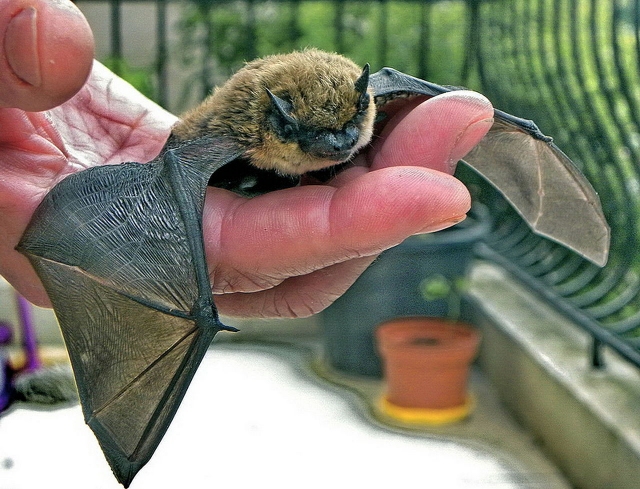
The Savi's pipistrelle achieves a snout-vent length of 4.0 to 5.4 cm with a tail length of 3.1 to 4.3 cm and a wingspan of 22 cm. Its weight is 5 to 10 g. This makes it one of the smaller bat species in Europe. Its fur is relatively long and yellowish to dark brown on the upperparts with a black-brown hair base and shiny hair tips. The underparts are whitish-yellow to greyish-white, clearly distinguishing them from the upperparts. The ears and snout are almost black, the wings dark brown. The young, which are able to fly, are somewhat darker than the adults and still have hardly any or no light fur tips.
Compared to the European pipistrelles (Pipistrellus), the ears are broader and rounder, they have four ear folds. The ear length is 10 to 15 mm. The tragus is short and widens slightly towards the top, it has two opposing teeth at the base and the rounded tip is turned inwards. The forearm has a length of 30.0 to 36.5 mm. The arm patagium attaches to the toe root. The last two caudal vertebrae are free at 3 to 5 mm in length.
Habitat
Foraging usually takes place at higher altitudes over open woodland and over pasture and wetland areas. However, they also live in inhabited areas and, especially in southern Europe, in cities, where they catch insects around lighting systems, among other places. They also hunt near rock faces or above treetops.
They find their roosts and resting places in rock crevices, but also in cracks in buildings or under tree bark. Very rarely they are found in underground habitats and caves.
The text is a translation of an excerpt from Wikipedia (https://de.wikipedia.org/wiki/Alpenfledermaus). On wikipedia the text is available under a „Creative Commons Attribution/Share Alike“ licence. Status: 13 August 2021
