


Florian Heigl
European grass frog
Description
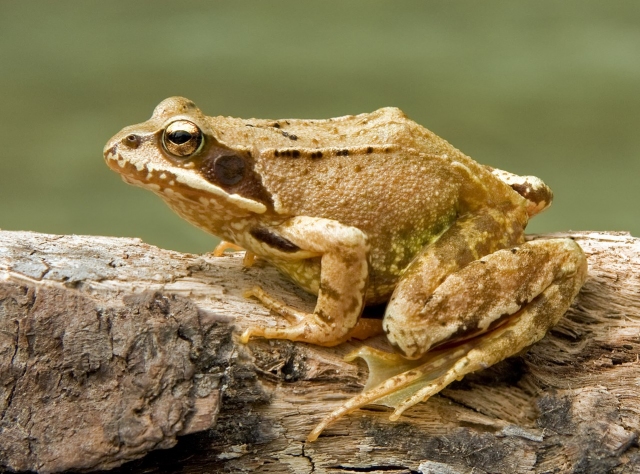
The snout-vent length of adults reaches a maximum of eleven cm, with females growing slightly larger on average than males due to the slightly later onset of sexual maturity. Most specimens, however, are between seven and nine cm in size and appear quite plump. The upperparts can be yellow, red or dark brown in colour. In some animals it is only slightly marked, others have irregular black spots that can occasionally almost obscure the ground colour. The two dorsal gland bars approach each other a bit in the shoulder area. The characteristic triangular temporal spot on both sides with the tympanic membrane in it is distinctly dark brown, as in all brown frogs. The transverse striation of the hind legs is also a characteristic of all brown frogs. The male's underpart is whitish-grey and mostly unspotted, while the female's is often yellow with a reddish marbling. The tip of the snout is bluntly bevelled and rounded in plan view, the pupil is elongated and horizontally aligned. The inner metatarsal tubercle on the sole of the foot appears small and soft in this species.
The forelegs of the males are much more strongly built than those of the females. This is due to the reproductive behaviour, as the animals have to hold on to the females' backs in an axillary clasp (amplexus), sometimes for days. At spawning time, the males sometimes appear slightly "flabby" due to accumulations of lymph fluid and may even appear slightly bluish (but not as intensely as moor frog males). They develop dark, rough rutting calluses on their respective inner fingers during this phase. In females, a so-called breeding tubercles of whitish "spots" on the flanks and hind legs can be observed at spawning time.
Habitat
Spawning waters include a wide range of standing or slow-flowing waters. However, shallower, sunlit still waters such as small ponds and pools (also garden ponds) are preferred, although they are rarely allowed to dry out, or also cattle watering places in grassland areas. Floodplain grasslands, for example from the floodplain swath, are particularly popular as spawning substrates. After laying their eggs, the animals usually leave the watercourse very quickly and go over to terrestrial life. Habitats now include grassland, fringe biotopes, bushes, water banks, forests, gardens, parks and moors. At night, the frogs hunt for insects (e.g. beetles and grasshoppers), isopods, worms, spiders and slugs, during the day they hide in damp places between vegetation or under stones or deadwood. Hibernation sometimes takes place at the bottom of water bodies (then often collectively), but mainly terrestrially in holes in the ground and similar frost-free shelters. Before that, in autumn, the animals have usually already migrated some distance towards the spawning water or even use it for hibernation in cold torpor - summer habitat and hibernation quarters are therefore not necessarily identical.
The text is a translation of an excerpt from Wikipedia (https://de.wikipedia.org/wiki/Grasfrosch). On wikipedia the text is available under a „Creative Commons Attribution/Share Alike“ licence. Status: 29 June 2021
European green frog
Description
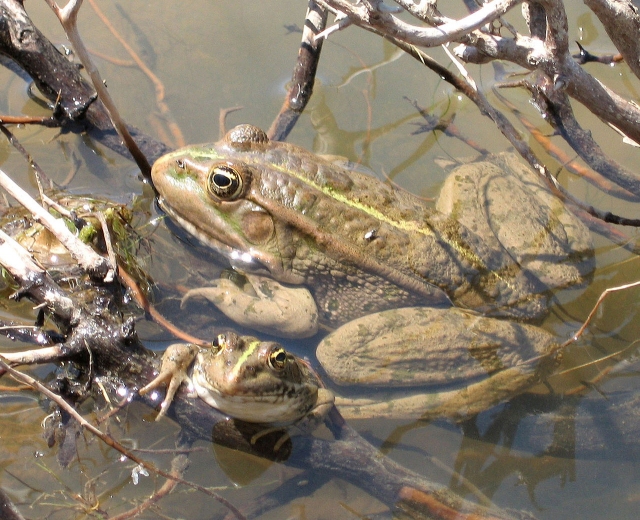
The snout-vent length ranges from 10 to 16 cm; specimens over 10 cm are mostly females. The upperparts are mostly olive green or olive brown, in Central Europe barely grass green, with distinct dark spots. The green dorsal midline typical of water frogs is usually present. The inner sides of the thighs are white-grey and black marbled (yellow parts are usually absent); the paired vocal sacs of the males are dark grey. The body structure is similar to that of its relatives, the pool frog and the common water frog, but with different proportions. The hind legs or lower legs are very long in relation to the torso. The metatarsal tubercle is small and flat.
Habitat
The European green frog has a very close relationship to water bodies. Even juveniles only move a few m away from the water. European green frogs prefer larger, eutrophic water bodies in the floodplain area, such as lakes, oxbow lakes, flood channels, calm river sections, larger ponds and quarry ponds, sometimes also canals and wide ditches. A rich aquatic and riparian vegetation is advantageous, but there should be no shading by woody plants. There, the animals like to sit on the shoreline and sunbathe. In case of danger or disturbance, they immediately jump into the water. Unlike most other frogs, they overwinter mainly aquatically in the water sediment. The species is therefore dependent on oxygen-rich waters that rarely freeze over completely or for long periods.
The text is a translation of an excerpt from Wikipedia (https://de.wikipedia.org/wiki/Seefrosch). On wikipedia the text is available under a „Creative Commons Attribution/Share Alike“ licence. Status: 29 June 2021
Pool frog
Description
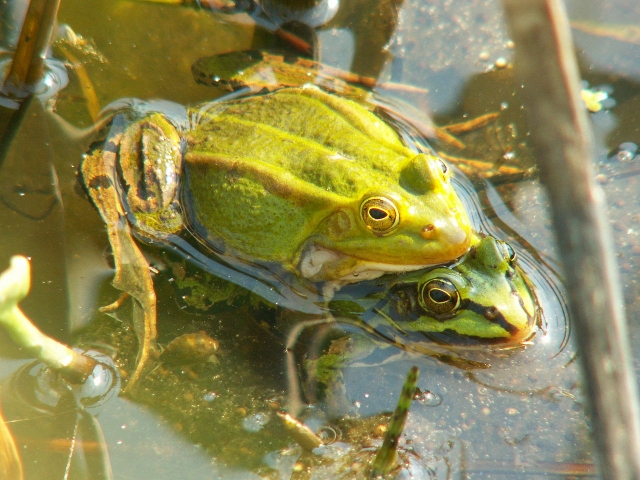
The snout-vent length of the males is 4.5 to 5.5 cm - so they are only slightly larger than a European tree frog - the females are 5.5 to 6.5 cm long. The upperparts are predominantly grass-green in colour and speckled with rather regular black or brown spots. In addition, there is the typical water frog mid-dorsal line and reddish glandular ridges on the dorsal sides. Individuals with black-brownish colour pattern parts are also quite common, especially in female specimens. The iris is intensely yellow in males at mating time, as yellow body colours dominate at this time elsewhere; their vocal sacs are white. The lower legs are remarkably short in relation to the trunk; the metatarsal tubercle is large and semicircular.
Habitat
The pool frog is not as strictly bound to water bodies as its relatives, the common water frog and theEuropean green frog. Typical habitats in northern Germany are e.g. bog biotopes within wooded areas. Adults and juveniles often move far away from the water bodies. Preference is given to smaller, vegetated ponds, pools and ditches as well as marshes and bogs in their vicinity. The species is rarely found in large lakes and rivers. A closer connection seems to exist regionally - especially in the north of the distribution area - to boggy, mesotrophic habitats. Due to these requirements, the species is absent from certain habitats that are strongly influenced by anthropogenic activities.
The text is a translation of an excerpt from Wikipedia (https://de.wikipedia.org/wiki/Kleiner_Wasserfrosch). On wikipedia the text is available under a „Creative Commons Attribution/Share Alike“ licence. Status: 29 June 2021
Alpine newt

Description
During the mating season in spring, the males, up to nine cm long, have a blue dorsal colouration; their flanks are spotted black and white and bordered by a blue stripe towards the belly. The flat, straight (not serrated) dorsal crest is alternately yellowish-black spotted. The females, up to twelve cm long, are dark grey-brown-greenish marbled in aquatic habitat and show somewhat weaker flank spotting. The central ventral side of both sexes is bright orange to cinnamon red in colour and - in contrast to other newt species - usually unspotted. After the end of the spawning season in May, the adults leave the water again and gradually develop a more inconspicuous land costume. This is characterised by a dark, almost black, granulated, dull and water-repellent skin on top. The belly remains slightly orange, but is less colourful than in the aquatic display.
Habitat
The Alpine newt is a typical inhabitant of water-rich forests in hilly to mountainous landscapes - it is often associated with the palmate newt, which is, however, rarer overall. It is usually absent in sparsely wooded areas. In addition to dense deciduous forests, it also inhabits park-like areas and semi-natural gardens. Outside the spawning season, the Alpine Newt is a nocturnal land animal. During the day it hides in many shady places, for example under stones or wood. At night, it hunts for beetles, earthworms and other small animals. Its main enemies are trout, other fish and larvae of the blue-green damselfly, which prey mainly on newt larvae. After "awakening" from their winter torpor in February/March, Alpine newts immediately migrate to nearby bodies of water - especially forest ponds and lakes, firewater ponds, wildlife ponds and water-filled wagon tracks on forest roads. These may well be cool, shady and devoid of vegetation.
The text is a translation of an excerpt from Wikipedia (https://de.wikipedia.org/wiki/Bergmolch). On wikipedia the text is available under a „Creative Commons Attribution/Share Alike“ licence. Status: 29 June 2021
Danube crested newt

Description
The Danube crested newt is a rather graceful, slender newt compared to other crested newts. At 12-14 (males) or 13-16 cm (females) in total length, the species remains slightly smaller than the other crested newt species; in addition, its limbs are relatively short. The dorsal colouration is often brown rather than blackish with round, dark spots; males from the Danube Delta also show a brick-red dorsal colour. As in Triturus cristatus, there are some white spotted areas on the coarsely granulated flanks. Females sometimes have an orange-yellow longitudinal line on the back. The ventral side is orange-red to yolk-yellow and patterned with smaller, sharply defined dark spots, which may also merge to form longitudinal bands. The throat and the head area are grey to black and covered with white spots.
During the mating season, the males develop a particularly high, deeply serrated, flexible dorsal crest. At the root of the tail, this is separated from the skin edges of the ruddy tail, although not always as clearly as in other great crested newts. The dorsal and caudal crests are regressed in the terrestrial habitat.
Habitat
The Danube crested newt prefers terrestrial habitats with riparian forests and structurally rich forest edges near spawning waters. For breeding, the species needs standing waters with shallow zones, which are as free of fish as possible.
The text is a translation of an excerpt from Wikipedia (https://de.wikipedia.org/wiki/Donau-Kammmolch). On wikipedia the text is available under a „Creative Commons Attribution/Share Alike“ licence. Status: 29 June 2021
Italian crested newt
Description
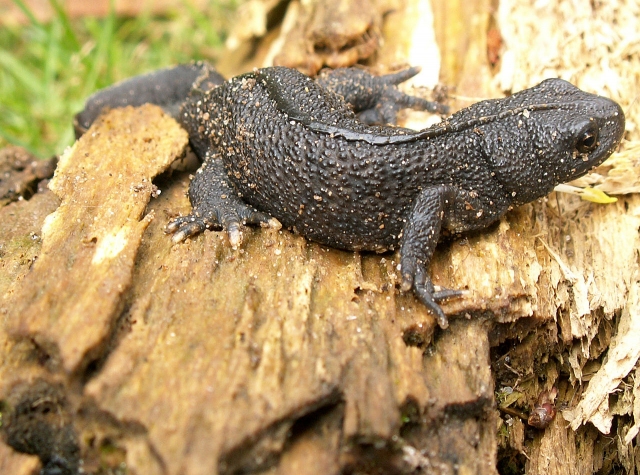
It is a broad-headed, quite large newt. It reaches similar body lengths to the Northern crested newt (Triturus cristatus) - on average about 12 to 13 cm; in females at most over 20 cm. During the mating season, the males develop a dorsal crest that is not as high or as strongly serrated as in the Northern crested newt or the Danube crested newt. The dorsal crest is separated from the caudal margin by an incision - as in all crested newts (but compare: common newt). The upperpart appears light brownish-grey to dark brown, with dark round spots and is relatively smooth-skinned. Females in terrestrial display and juveniles often have a yellowish longitudinal line on the back. The throat is white spotted, the belly yellow or orange with dark, particularly "washed out" looking, not sharply defined spots. In contrast to the other crested newt species, the flanks are barely spotted with white. Especially the washed-out spotting and the lack of white dotting on the sides are considered the most important external identification features.
Habitat
During the mating season in spring and sometimes also during the summer, the animals stay in perennial, herbaceous pools and ponds. Crested newts in general are more seasonally bound to the water body than other newts.
The text is a translation of an excerpt from Wikipedia (https://de.wikipedia.org/wiki/Alpen-Kammmolch). On wikipedia the text is available under a „Creative Commons Attribution/Share Alike“ licence. Status: 29 June 2021
Northern crested newt

Description
The Northern crested newt is a rather large, powerful newt with a broad head. The males reach a length of ten to a maximum of 18 cm, the females from eleven to a maximum of 20 cm. The upperparts are grey-black in colour, with indistinct darker spots or patches; the skin appears slightly warty-grained. The flanks are intensely whitish granulated at the transition to the ventral side. The belly is yellow or orange with black spots. This pattern of spots even makes it possible to distinguish the animals individually in field biology studies. During the mating season, males develop a high, strongly serrated skin crest on the back and tail, which is interrupted at the root of the tail (in contrast to the common newt). Males also have a characteristic pearly-silvery band ("milk stripe") on the sides of the tail and a more bulging, black cloaca. The females have only a low caudal fin fringe. Their orange belly colouring continues over the cloaca on the lower edge of the tail. After spending time in the water, the aquatic display, especially the conspicuous skin fringes of the males, is largely regressed in late summer, giving way to a more inconspicuous terrestrial display.
Habitat
Spawning waters are mostly perennial, i.e. permanently water-bearing small ponds and pools in rather loamy, rarely sandy soils, which are exposed to sunlight for at least several hours a day. They often have both an open water zone and a richly weedy reed and submerged vegetation and are eutrophic (but not excessively eutrophic!). As this structure is also preferred by other amphibians, water bodies where the Northern crested newt occurs are often characterised by particularly species-rich amphibian communities (associations of different species).
In the vicinity of the water bodies, suitable terrestrial habitats must be available in good spatial interlocking, for example grassland interspersed with field copses, fens, deciduous forests and fringe biotopes such as riparian strips, hedges and similar. Sometimes very valuable habitat structures develop in abandoned soil mining pits. The animals like to seek shelter under stones and lying deadwood and spend the day resting there.
The text is a translation of an excerpt from Wikipedia (https://de.wikipedia.org/wiki/Nördlicher_Kammmolch). On wikipedia the text is available under a „Creative Commons Attribution/Share Alike“ licence. Status: 29 June 2021
Common newt
Description
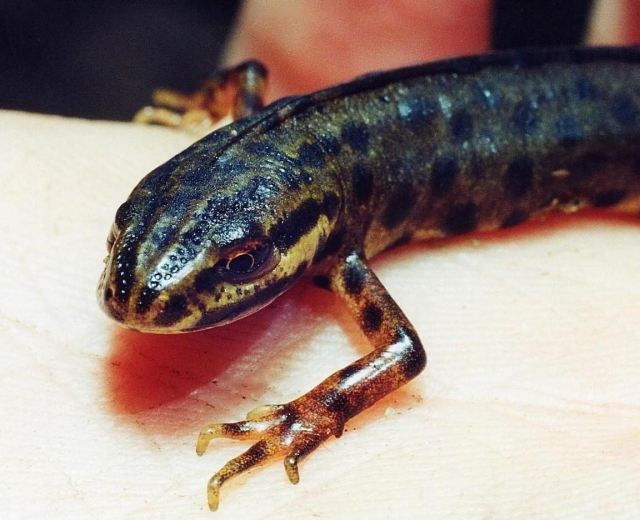
The common newt is a small caudate with a maximum body length of 11 cm (less in southern Europe). The upperparts are with smooth skin and yellow-brown to black-grey colouration. The males have coarse, roundish, dark spots on it - especially conspicuous during the mating season. Both sexes have alternating light and dark stripes on the sides of the head (hence the name "striped newt"); there are three longitudinal furrows on the upperpart (compare cover photo). The underpart is orange in the middle, becoming lighter towards the sides and also with dark markings - in the males these are large dots, in the females fine spots.
In their aquatic phase, the males develop a high, wavy to serrated (in southern subspecies also smooth-edged), flexible skin crest, which - in contrast to the great crested newt - runs from the back of the head to the end of the tail without an indentation at the root of the tail. Their fin seam on the underpart of the laterally flattened tail shows a bluish tinge. The hind feet show blackish swimming fringes at this stage. The cloaca of males is much more prominent and darker in colour than that of females. The females look much more inconspicuous overall and usually have a slightly lighter, rather brownish basic colouration. For the non-expert, they are difficult to distinguish from those of the palmate newt. Among other things, however, the throat is usually also spotted, in contrast to that of the palmate newt. In addition, yellow pads can be seen under the soles of the feet of female newts, which are usually absent in common newts. In the terrestrial habitat, the skin becomes dry, fine-grained and water-repellent; the colouration is now very muted.
Habitat
The common newt prefers semi-open to open landscapes, but does not completely avoid densely forested mountainous regions. In such areas, however, the Italian crested newt and, especially in the west, the palmate newt are found much more frequently. In the lower altitudes of Central Europe, the common newt is by far the most common caudate and, along with the common toad and the grass frog, one of the still almost ubiquitous amphibian species. During "toad migration" campaigns along roads to protect migrating amphibians, it is not uncommon for hundreds, in extreme cases even several thousand common newts to be registered.
Land habitats include grassland areas with hedges, forest edges, semi-natural gardens and parks, abandoned gravel pits and the banks of water bodies. The common newt is considered a very adaptable amphibian and a synanthropic species. It feeds on insects, worms and other small animals at night; during the day and in dry periods it hides under stones, leaves or roots. In spring and early summer, it feeds mainly on small crustaceans, but also on frogspawn, tadpoles and even eggs and larvae of its own species. Smaller, at least temporarily sunny pools, ponds and ditches with rich underwater weeds are preferred as spawning waters. Thanks to their tail, the newts move as swiftly as fish under water. They regularly swim to the surface to gasp for air. In case of danger, they flee in a flash to the bottom of the water or between water plants. By July, most common newts have left the water to live on land. Some, however, remain more or less permanently aquatic (compare: Northern crested newt). In October or November (Central Europe), the animals retreat to frost-proof terrestrial shelters; some also hibernate in the water.
The text is a translation of an excerpt from Wikipedia (https://de.wikipedia.org/wiki/Teichmolch). On wikipedia the text is available under a „Creative Commons Attribution/Share Alike“ licence. Status: 29 June 2021
Alpine salamander
Description
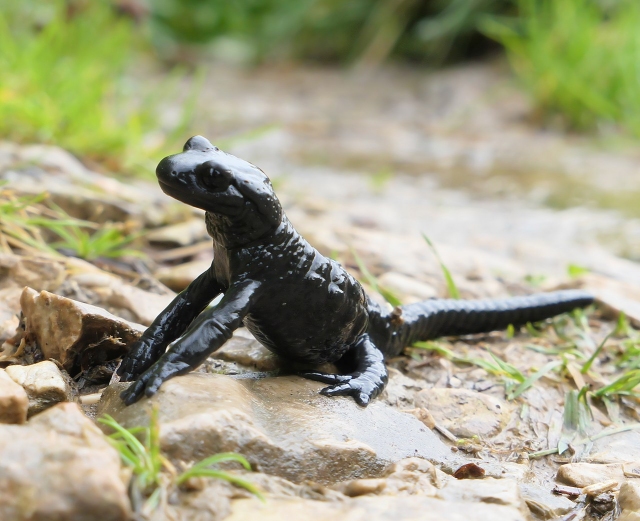
The males of the Alpine salamander remain on average slightly smaller than the females, which grow up to about 15 cm long. On average, the animals grow to a length of 11-12 cm.
The animals are uniformly black in colour and appear somewhat less stocky than fire salamanders (Salamandra salamandra). When healthy, the animals are shiny. The underparts are lead-grey and a longitudinal groove runs down to the tail. The male can be distinguished from the female externally by a slightly more protruding cloaca.
The black eyes and the prominent ear glands (paratoid glands) are clearly visible on the head, which is broader than long and has a rounded snout. Along the flanks of the body, the animals have a series of warty and roundish elevations containing glandular exits. The trunk is segmented laterally by eleven to thirteen costal furrows. The tail is not as long as the trunk and is almost quadrangular in cross-section; it ends relatively pointed.
Habitat
The habitats of the Alpine salamander include karst areas and high mountain ravines. In the Alps, it usually occurs from altitudes of 1000 m, regionally also from 800 m; only rarely are specimens found at lower altitudes. Sometimes such finds can also be due to the drifting of animals with torrential streams. Predominantly moist deciduous and mixed mountain forests near mountain streams are colonised, above the tree line biotopes such as moist alpine pastures, dwarf shrub heaths and scree slopes. Here the Alpine salamander can be found under stones or deadwood.
Favourable habitats for dense populations are stabilised boulder and scree slopes, greasy meadows, forest edges and mountain forests. Within the forests, pure coniferous forest areas are rather avoided, deciduous-coniferous mixed forests and especially deciduous forest areas are preferred. The highest densities are found along small forest streams or in spray zones at the foot of waterfalls. Ravines also offer good living conditions.
The Alpine salamander tends to occur at sites with a basic soil reaction and high pH values. This also explains why sites with acidic soil reaction are problematic for it. This also explains why it occurs more frequently in deciduous forests than in coniferous forests with low pH values. Fertilisation has a positive effect on its occurrence, as fat meadows are moister than lean meadows. The Alpine salamander is site-faithful; its habitat is only a few square meters in size.
The text is a translation of an excerpt from Wikipedia (https://de.wikipedia.org/wiki/Alpensalamander). On wikipedia the text is available under a „Creative Commons Attribution/Share Alike“ licence. Status: 29 June 2021
Northern white-breasted hedgehog
Description
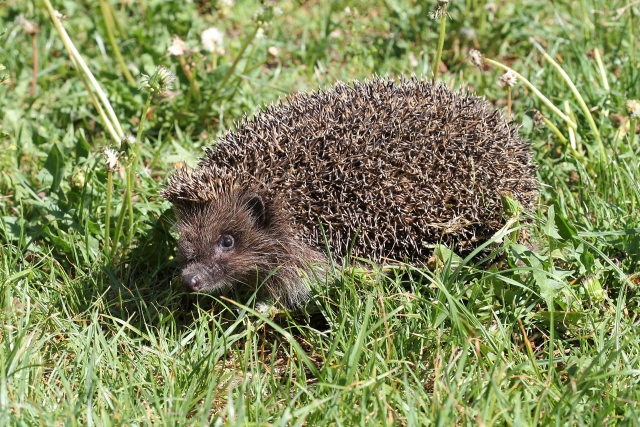
It differs from the European hedgehog mainly in the lighter colouring of the chest, which stands out clearly from the brown or brown-grey surroundings. The pale sections of the underpart are almost white, and the middle of the chest is always white. The back and the top of the head are covered with spines. If attacked, it can curl up into a ball.
Habitat
The Northern white-breasted hedgehog inhabits farmland, parks and gardens in rural and urban areas, and moderately overgrown forest edges. Like the related European hedgehogs, the Northern white-breasted hedgehog is a synanthropic species and occurs more frequently in cultivated landscapes rather than natural environments. The animals are nocturnal solitary animals, spending the day in a nest to forage at night. Their diet consists mainly of insects, earthworms, millipedes and ants.
The text is a translation of an excerpt from Wikipedia (https://de.wikipedia.org/wiki/Nördlicher_Weißbrustigel). On wikipedia the text is available under a „Creative Commons Attribution/Share Alike“ licence. Status: 22 July 2021
