


Florian Heigl
Sand lizard
Description
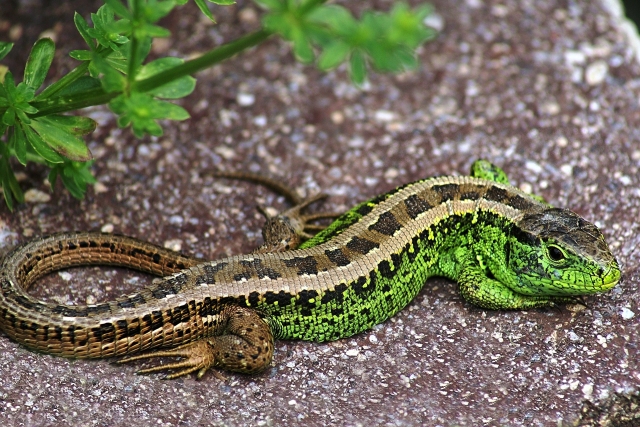
In German-speaking countries, sand lizards reach total lengths of about 24 cm. Particularly large animals here have snout-vent lengths of about 9.5 cm and tail lengths of about 14 cm. The largest known snout-vent length of 11.5 cm comes from a sand lizard from the Caucasus. In general, females have longer trunks, while males have longer heads and slightly longer tails. Compared to the common lizard and the European wall lizard, the animal appears plumper and much stronger. The sides of the snout are steep and high, ending blunted forward. The top of the head is flattened and separated from the sides by a ridge extending from the eyes to the nostrils. The back of the head is slightly broader than the neck and therefore set off from it. The tail is much higher than broad at its root and gradually tapers; the tip is not extended very long. (A regrown, regenerated tail is usually much shorter and less marked).
Coloration and markings are highly variable depending on the individual, sex, age stage, and season (males!). Often a "ladder-like" pattern of markings consisting of light lateral lines (parietal bands) and dark brown "transverse sprouts" (dorsal spots) with brown interspaces runs down the middle of the back and tail. In the middle as well as laterally over the dorsal spots mostly whitish, interrupted longitudinal lines (occipital line as well as parietal lines) run. The ground color of the upper head, tail and limbs is also brownish and the spots of the flanks are also white-cored. During the mating season (until June/July), the males show green colored head, rump and belly; especially in southwestern Germany, there are also animals that appear almost entirely green. Red-backed specimens are another distinctive feature. The underparts are yellowish and spotless in females, green with black spots in males. Juveniles have brownish coloration, often with conspicuous eye spots on the back and sides.
Habitat
Sand lizards are anthropogenically oriented species with respect to their habitat structures. They inhabit lean biotopes such as dry forest edges, railroad embankments, heathlands, dunes, quarries, gravel pits, wildlife gardens, and similar habitats with an alternation of open, loosely vegetated sections and more densely vegetated areas. In cooler areas, occurrences are limited to sites favored for warmth. Elements such as dead wood and old grass are also important.
The text is a translation of an excerpt from Wikipedia (https://de.wikipedia.org/wiki/Zauneidechse). On wikipedia the text is available under a „Creative Commons Attribution/Share Alike“ licence. Status: 26 May 2021
European green lizard
Description
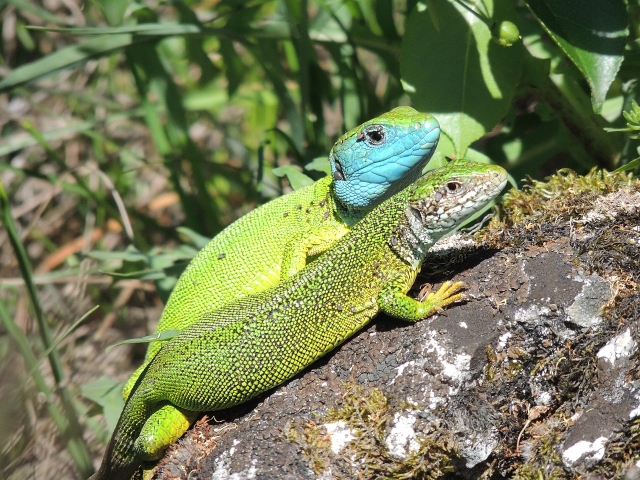
It is a large, but still quite slender looking lizard with a pointed head and a, especially in males, quite long tail. Its dimensions can reach 1.6 to 2.3 times the snout-vent length, which is up to 13 cm. However, the maximum total length is often difficult to quantify, since many older animals no longer have an intact tail, but have lost and (incompletely) regenerated it in the meantime in contact with predators or in mating fights. However, up to about 40 cm total length is reached. The extremities are relatively long in relation to the body.
The back and large parts of the body are light to dark green in both sexes. However, the green coloration develops gradually during the first years of life; the young show brown tones. While the slightly more robust-looking, large-headed males usually have small black speckles, sometimes arranged in an ornamental pattern, on the green ground color, the females often have a patterns with dark markings arranged in rows and whitish-yellow lines that may merge to form longitudinal bands. However, depending on the region and season, the sexes cannot always be distinguished by markings. The belly and throat are spotless white, greenish, or yellow in color. With the first molt after hibernation, the chin, throat and neck region become greenish blue to "cornflower blue" in both males and some females. This "mating dress" appears more contrasting and colorful in the male.
Habitat
European green lizards prefer sun-warmed, south/southwest/southeast exposed terrain slopes with a sufficient degree of moisture and a mixture of open structures and mosaic vegetation. Particularly suitable are, for example, drier forest edges, grassy vineyards, semi-arid grasslands (but not shrubless dry grasslands!), broom and steppe heaths, blackberry thickets, railroad and road embankments, meadows with sloe bushes and sparse orchard meadows. In the south of the distribution area, however, the occurrences are often restricted to damp locations or mountainous regions. The diurnal animals take extensive sunbaths, especially in the morning and evening; otherwise they climb around in the plant undergrowth in search of food. In case of danger, they scurry very nimbly into protective vegetation as well as into crevices and cavities.
The text is a translation of an excerpt from Wikipedia (https://de.wikipedia.org/wiki/Östliche_Smaragdeidechse). On wikipedia the text is available under a „Creative Commons Attribution/Share Alike“ licence. Status: 26 May 2021
Horvath's rock lizard
Description
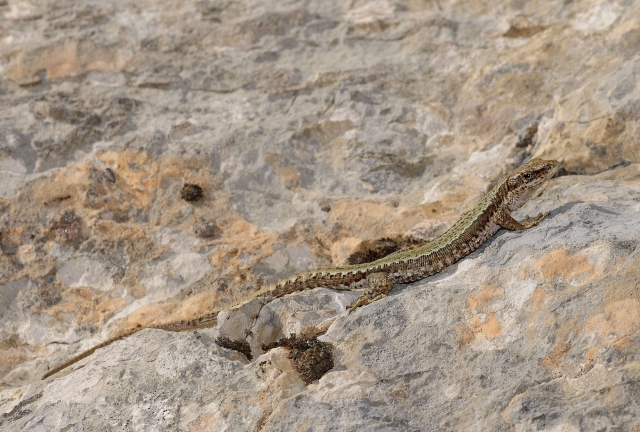
The total length of this small, slender lizard species is a maximum of 18 cm, the snout-vent length is about 6.5 cm. In appearance, the species resembles the European wall lizard (Podarcis muralis). The collar closes smoothly to the back. The dorsal scales are relatively large, roundish to hexagonal, flat and not keeled. On the middle of the back they are arranged in distinct transverse rows, on the flanks more irregularly. The head, back and upper side of the tail are light brownish, gray-greenish to whitish-gray. In oblique light, the species may have a greenish iridescence. Beginning at the nostril, a broad, dark to reddish-brown longitudinal band extends over the temporal region and the upper half of the flanks, the upper edge of which is distinctly serrated. This band also extends over the sides of the tail, where it forms characteristic rhomboids strung together. Occasionally the pale dorsum is patternless, but usually it is covered with numerous small dark spots. Relatively often there is a narrow brown line on the middle of the back, but it may be incompletely developed. The throat region is whitish-gray, the ventral side straw to greenish-yellow colored. The underpart is unspotted, only on the outer row of the ventral shields there may be black or even rust-colored spots. Juveniles closely resemble adults in coloration and markings, but have conspicuously chip-green or greenish-gray tails.
Habitat
The Horvath's rock lizard is a mountain species found from 250 m above sea level upwards. The highest occurrence is at 2000 m altitude on Visoka Ponca (Slovenia). Preference is given to damp, cool altitudes of 800-1200 m, especially stony terrain, cliffs, karst rocks, stone bridges and road embankments. They usually stay directly on rock faces, near crevices, or in scree that is sometimes overgrown with moss, grasses, and small ferns. The animals also stay on ungrouted retaining walls and in their crevice system. At lower altitudes, the species is often associated with the European wall lizard. There the well climbing species prefers smooth and steep rock surfaces, on which it still finds sufficient hold as the lighter species in contrast to the heavier European wall lizard.
The text is a translation of an excerpt from Wikipedia (https://de.wikipedia.org/wiki/Kroatische_Gebirgseidechse). On wikipedia the text is available under a „Creative Commons Attribution/Share Alike“ licence. Status: 26 May 2021
Common lizard
Description
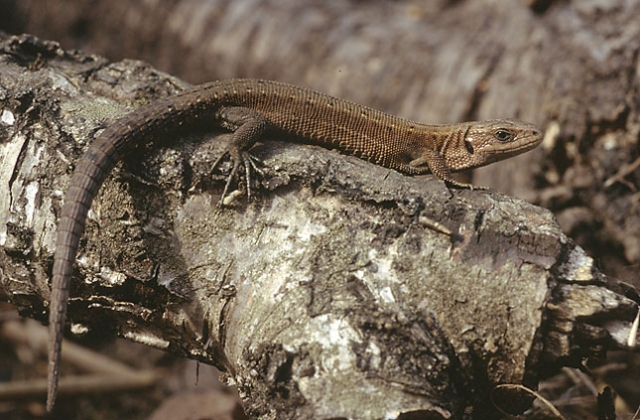
The common lizard has a maximum total length of 18 cm. Of this, the head and trunk account for up to 6 cm, and up to 7 cm in females. The strong tail reaches 1.25 to 2 times the snout-vent length (maximum value in males). The species is slender, short-legged, and has a small, rather flattened head - compared to the sand lizard, for example - even more so in females than in males. The so-called collar is strongly toothed and the dorsal scales, which are only 25 to 37 in the transverse direction, are very rough and usually keeled. The basic coloration is brown, sometimes also gray. In addition, many animals show a dark "dorsal stripe" on the back, broken up into single spots, dark sides as well as light, line-shaped spots on the upperparts (very variable). The throat is whitish or bluish, the belly light or dark yellow; in males at mating time orange or more rarely reddish and then often covered with dark spots. Sometimes also completely black colored adults occur, so-called "Blacklings".
The young are very dark - almost blackish - and bronze colored. They measure 3 to 4 cm after birth.
Habitat
Habitats include bogs, heaths, grasslands, abandoned quarries and sand pits, dunes, and wooded areas and edges in lowlands, hills, bogs, and uplands. Vegetation-rich fringe structures, slopes and clearings are preferred. The species is more in need of moisture than other lizard species. In case of danger, it also flees into the water and swims through it. The lizard is diurnal and usually faithful to its habitat. Occasionally, however, so-called "pioneers" decide to migrate. They are responsible for colonizing new habitats.
The text is a translation of an excerpt from Wikipedia (https://de.wikipedia.org/wiki/Waldeidechse). On wikipedia the text is available under a „Creative Commons Attribution/Share Alike“ licence. Status: 26 May 2021
European wall lizard
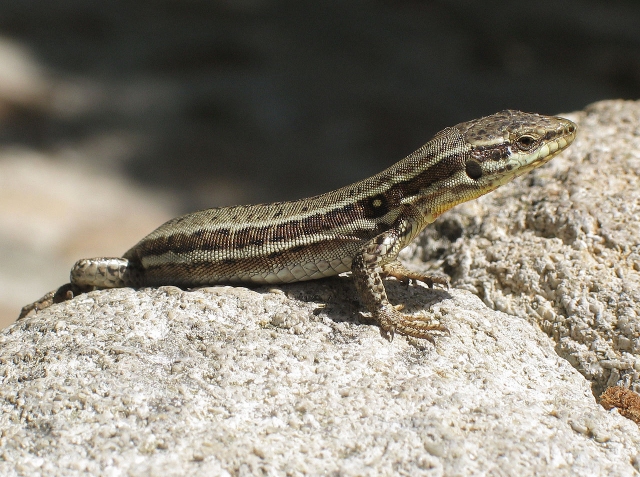
Description
The European wall lizard reaches a total length of 25 cm. It is slender and often appears relatively flattened in the dorsal region due to its body length. The collar is usually smooth-edged, and the dorsal scales are slightly keeled. The tail can reach twice the snout-vent length. Dorsal coloration is light to medium brown or gray, sometimes greenish. An irregular blackish mottling, sometimes forming a reticulated pattern, is conspicuous. The underparts are very variably colored, ranging from whitish to yellowish to red and from unspotted to heavily spotted or spotted. Depending on their origin, the animals can vary greatly in body coloration and pattern of markings, making them sometimes difficult to identify.
Habitat
The European wall lizard inhabits a wide range of biotopes. Preferably, the animals are found on areas exposed to the southeast or southwest. In these biotopes there is an optimal utilization of the morning and afternoon sun, respectively.
The lizards that live in the cavities of the walls use this shelter both for protection against the cold at night and for protection against the extremely high temperatures during the midday heat in midsummer. In general, rocks and walls with evenly distributed open joints and crevices are favorable. On the one hand, the animals prefer wall surfaces with a variety of vegetation, which attract abundant insects, and on the other hand, they prefer unvegetated areas to bask in the sun. Low wall vegetation can be compensated by adjacent natural vegetation at the base of the wall. An influence of the wall height on the colonization by the lizards is not known. European wall lizards living at castle ruins in principle use the entire wall surface. The same applies to the colonization of rock walls and scree surfaces. As a typical synanthropic species, the European wall lizard can also be found in vineyards, on railroad and road embankments, and on buildings in settlements and cities. Occasionally, the species also occurs on open, vertical rock surfaces of quarries.
The text is a translation of an excerpt from Wikipedia (https://de.wikipedia.org/wiki/Mauereidechse). On wikipedia the text is available under a „Creative Commons Attribution/Share Alike“ licence. Status: 26 May 2021
European grass snake
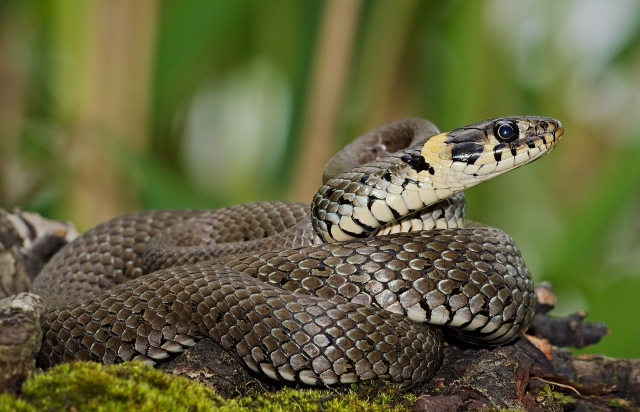
Description
European grass snake males reach an average total length of about 75 cm, females are significantly longer with 85-152 cm. However, lengths of more than 110 cm are very rarely reached by females. On the back of the head there are two yellow to orange crescent-shaped spots. On the mostly gray, sometimes also brownish or greenish upperpart there are often four to six rows of small black spots. Black animals occur, and can be recognized by typical features of scaling and markings: The dorsal scales of the European grass snake are keeled (unlike those of the similar-looking Aesculapian snake), and the shield in front of the eye (preoculars) is undivided. The head is covered on top with large shields and is individually distinct (sometimes barely pronounced) from the neck or body. The pupils are round.
Habitat
European grass snakes inhabit a very wide range of open to semi-open habitats. These are characterized by the presence of water bodies and biotope mosaics with diverse vegetation structures. Dry winter habitats, oviposition and basking sites, as well as hunting grounds for the different age classes are sometimes located in close proximity to each other, and in some cases the snakes have to cover greater distances (≫ 1 km) during the course of the year. In the latter cases, separate wetland (e.g., marshes, floodplains) and terrestrial habitats (forests and their edges, gardens, and many others) can often be identified in the overall habitat (as is the case for some amphibians).
Typical sites include streams, rivers, ditch systems, ponds and lakes, wet meadows, bogs, swamps, and their respective environments. European grass snakes are also regularly observed in deciduous and pine forests, along railroad embankments, on natural (upland) and artificial (slag heaps) slopes, parks and gardens.
The text is a translation of an excerpt from Wikipedia (https://de.wikipedia.org/wiki/Ringelnatter). On wikipedia the text is available under a „Creative Commons Attribution/Share Alike“ licence. Status: 26 May 2021
Dice snake
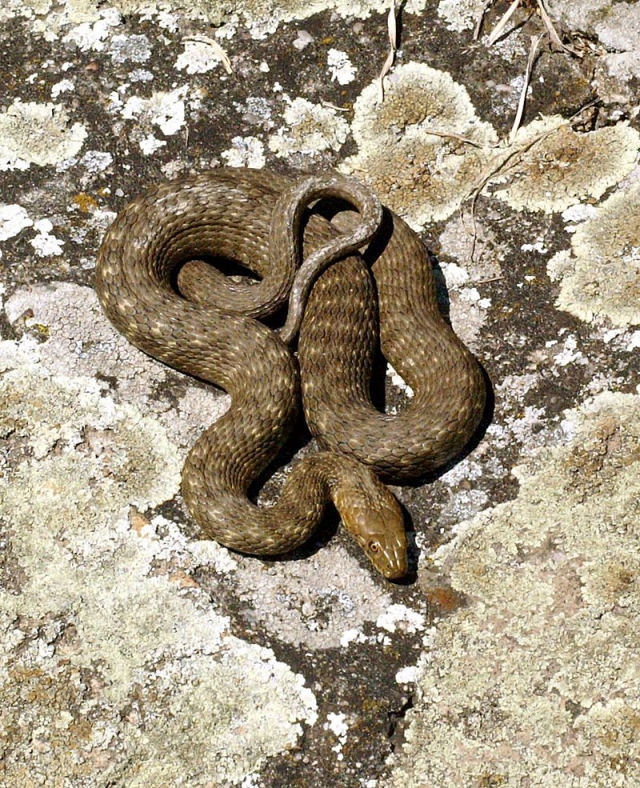
Description
Dice snakes are snakes of slender, laterally somewhat flattened shape and with a narrow, pointed head. Females grow larger than males, sometimes reaching a total length of 130 cm in southeastern Europe; a maximum of 102 cm has been recorded in Germany. Males, on the other hand, rarely grow longer than 80 cm. The coloration of the upperpart varies - also regionally different - between different shades of gray, brown and olive and can appear very light to very dark. As a drawing pattern, there are usually four to five rows of mostly square spots, after which the snake species is named. These are either alternately arranged or can merge into longitudinal bands or transverse bands. The underpart of the animals is colored white to yellow and has a pattern of (blue)black, square, contrasting spots.
Juveniles have a lighter ground color and exhibit a bold v-spot on the nape of the neck. Otherwise they are more or less vividly spotted like the adults.
The eyes of the dice snake have round pupils and an inwardly yellow, unspotted iris; outwardly this darkens with brown or black coloration. The tongue, which ends in two narrow, long tips, is flesh-colored. The dorsal scales are strongly keeled. There is a very high degree of variation in the scale characteristics. Usually the head area has two to three preocularia (anterior eye shields), two to five postocularia (posterior eye shields), seven to eight supralabialia (upper lip shields), and eight to ten sublabialia (lower lip shields). The number of blackish caudal subshields varies from 54 to 78, with males having longer tails and correspondingly more caudal shields.
One of the ways the dice snake differs from the closely related European grass snake is the lack of moon-shaped light spots on the back of the head.
Habitat
This snake inhabits climatically favored river courses and lakes in floodplains with high fish populations. The riparian zones should be structured close to nature and should have herbaceous vegetation as well as open rinsing margins and banks of gravel or gravel stones. Furthermore, shallow, current-calmed zones with high solar radiation are important, as well as slopes near the banks with dry grassland and rocks, dry stone walls or similar rich in shelters.
The dice snake is the snake with the strongest connection to the water habitat in Central Europe. It can swim and dive excellently and often spends many hours in shallow water. Only for sunbathing, reproduction and hibernation it leaves the water. But it also sometimes goes to the river bank to devour bulky prey, which consists almost exclusively of small to medium-sized fish. If disturbed, it regurgitates the prey and escapes into the water.
Dice snakes are diurnal with a focus on the morning and afternoon hours. While the morning is used for sunbathing, foraging takes place in the afternoon. Thereby the available species spectrum of fish is used.
The text is a translation of an excerpt from Wikipedia (https://de.wikipedia.org/wiki/Würfelnatter). On wikipedia the text is available under a „Creative Commons Attribution/Share Alike“ licence. Status: 26 May 2021
Smooth snake
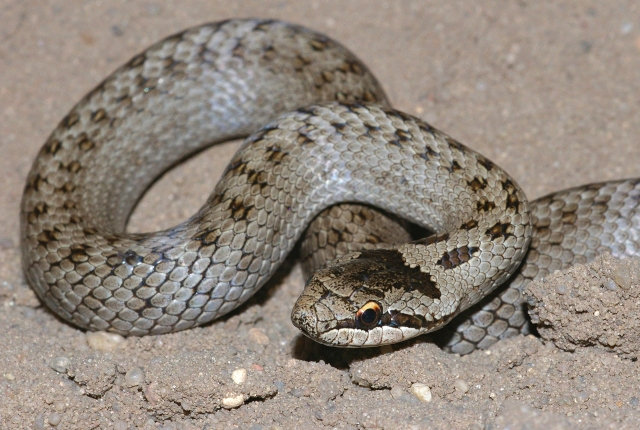
Description
Smooth snakes are delicate, slender snakes; they reach a body length of 60 to 75, occasionally 80 cm (in isolated cases specimens of about 90 cm total length have been observed). There is no significant difference in size between the sexes. The tail accounts for 12 to 25 % of the total length. It tapers evenly and ends pointedly. Body weights of average animals range from 50 to 80 g; weights over 100 g are rarely reported. Higher weights are attained by large pregnant females. The body is cylindrical (roundish in cross-section), with the anterior and posterior sections having smaller diameters than the middle. The transition from the narrower neck to the broader head is smooth. The top of the head is flattened, and the sides and tip of the snout are rounded. The eyes are relatively small with round pupils (an important distinguishing feature from the European adder); the iris is brownish. A longitudinal furrow runs between the eye and the nostril. There are 12 to 16 teeth in the upper jaw, which increase slightly in length toward the throat, while the same number of lower teeth are all similar in length.
Regarding the head and body scaling, the following characteristics are to be mentioned: There are seven upper lip shields (supralabialia) and eight to nine lower lip shields (sublabialia) on each side. The rostral shield is large and reaches between the nostrils. In contrast to the Girondian smooth snake, it is wedge-shaped between the internasalia, which gives them a butterfly shape. The nostrils are located centrally in the nasals. The largest shields of the upper head are the two elongate parietalia. The body scales are smooth without keels. Directly behind the head they are rather roundish and small, tailward they become elongated and end pointed. On the tail they have a pentagonal to hexagonal shape, on the sides of the body they are broader than on the back. In the middle of the body, the transverse rows consist of 19 scales each. Ventral bars are present between 150 and 190, tail shield pairs between 40 and 70. The anal shield is usually divided.
The basic coloration of the upperpart is gray, gray-brown, brownish or reddish-brown. Males are dominated by brown to reddish tones, while females are often more gray. However, coloration is not a completely clear differentiator between the sexes (only the protrusion of the hemipenes of males can serve this purpose). On the sides of the head there is a characteristic dark brown stripe, which runs from the nostril over the eye to the corner of the mouth. Often it continues to the side of the neck, from where it changes into small single spots. On the top of the head a heart- or horseshoe-shaped dark spot is noticeable (the "coronet"), which often continues in two longitudinal stripes on the back, to finally dissolve mostly in two (rarely four) rows of spots. Towards the tail these spots become more and more indistinct. Occasionally, the spots may merge into transverse stripes. However, for all the variability of the dorsal spot pattern, the smooth snake does not exhibit a zigzag band like European adders have. However, movements of the snake can create such an impression.
Habitat
The smooth snake is a drought- and heat-loving species that colonizes a fairly wide range of habitat types, depending on the region. While in northern Germany, the Netherlands and southern England, for example, sandy heaths, rough grasslands and dry upland moorland and forest edges are important habitats, in the central European low mountain ranges it is mainly warmth-favored slopes with rough and dry grasslands, scree slopes, dry stone walls and abandoned vineyards. In higher low mountain ranges, in eastern Bavaria or in southern Sweden, sunny forest edges in the vicinity of extensively cultivated meadows, shrub heaths, hedgerows, woodland slopes, rock heaths, semi-shrubby rough grasslands and embankments form the biotope spectrum of the smooth snake. In the alpine region, a variety of open to semi-open habitats in warmth-favorable locations are colonized. In addition, anthropogenic special sites such as railroad embankments and quarries are found everywhere. Occasionally, smooth snakes can also be found at near-natural settlement edges of villages and cities.
Common to all habitats is a mosaic-like, small-scale alternation of open, low-vegetated and partly wood-dominated sites and a high density of small structures and shelters. In the same habitat, there are usually also many lizards (especially sand lizards, regionally also common lizards or common wall lizards) and slow worms. Occasionally, the European adder also occurs syntopically.
The text is a translation of an excerpt from Wikipedia ( (https://de.wikipedia.org/wiki/Schlingnatter). On wikipedia the text is available under a „Creative Commons Attribution/Share Alike“ licence. Status: 26 May 2021
Aesculapian snake
Description
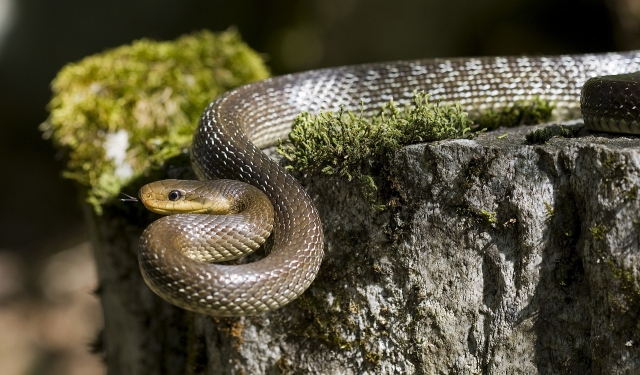
The Aesculapian snake reaches an average body length of 1.40 to 1.60 m, but can also grow up to two meters long and is powerfully built. Males generally grow slightly larger than females.
The basic coloration of the snake ranges from a yellowish brown to olive green and grayish brown to grayish black, with a smooth and shiny surface. Many of the scales are outlined in white, creating a light longitudinal striation along the body. In some animals there is an additional dark longitudinal stripe along the sides of the body. The belly is light or greenish yellow to whitish in color. However, in very dark individuals the ventral side of the body may be blue-black in color. While the 23 (rarely 21) rows of dorsal and lateral scales are smooth, the ventral scales have slight keels that facilitate climbing.
The head is only slightly separated from the body and normally has no markings. A dark temporal band may be developed above the eyes, extending backward to the neck. The eyes are medium sized with a round pupil. The head has eight, rarely nine, upper lip shields or supralabialia and a fore-eye shield called a praeoculare in herpetology.
The young animals are clearly more conspicuously marked. They have a bright basic coloration with dark staining on the back as well as a clear dark transverse band over the snout and a v-drawing in the neck directed to the back. In addition, there is a dark temporal band and a light yellow spot behind it on both sides. These spots can lead to confusion with the European grass snake (Natrix natrix), in which these spots are typical.
Habitat
The Aesculapian snake prefers warm and sunny areas, which should not be too dry. Accordingly, the snakes are found mainly in warm, humid, sun-exposed places in the lowlands and on sunny slopes in the mountains. It is also often found on the banks of water bodies and in riparian forests, as well as in forest clearings or in scree and bushes with ivy and brambles. Also popular are stone walls, old quarries, ruins and the edges of agricultural land, such as scrubby slope meadows. The highest occurrences are at about 1500 to 2000 m, but mostly it lives below 1000 m altitude.
The text is a translation of an excerpt from Wikipedia ( (https://de.wikipedia.org/wiki/Äskulapnatter). On wikipedia the text is available under a „Creative Commons Attribution/Share Alike“ licence. Status: 24 June 2021
European adder
Description
The European adder reaches an average length of between 50 and 70 cm, but can grow to about 90 cm in extreme cases. Females are typically much longer than males, which do not usually exceed a body length of 60 cm. The tail length, on the other hand, is greater in males than in females in proportion to body length. The weight of the animals averages 100 to 200 g with maximum values up to about 300 g in pregnant females.
The body of the snake is stoutly built, the head comparatively little distinctly set off from the body for a viper. The snout is rounded in front and merges into a flat top of the head, the canthus rostralis is also rounded. The head is oval when viewed from the top and slightly broadened at the back of the head due to the venom glands. As an adaptation to cool habitats, it is able to widen its body by actively spreading its ribs to provide a larger surface area for heat absorption while basking, thus making more effective use of smaller amounts of radiant heat.
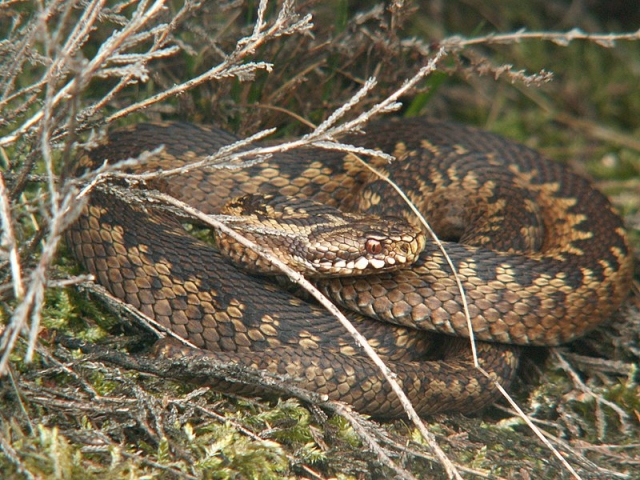
The basic coloration of the adder is highly variable, ranging from silver-gray and yellow to light and dark gray, brown, blue-gray, orange, reddish-brown, copper-red, and black. Coloration is highly variable within the species, and different colorations may appear even within the same population. In much of the range, the animals exhibit sexual dichromatism. Males usually have different shades of gray from whitish gray to almost black, moreover the contrast between the ground color and the markings is usually more pronounced in them than in females. In females, various shades of brown, red, or beige predominate, and the contrast between light ground color and dark zigzag band is usually somewhat less.
The most conspicuous feature of the pattern is a dark zigzag band on the back. Like the ground color, the dorsal pattern can be very variable. The variations range from broad or narrow zigzag lines to wavy and rhombic bands to single transverse bands, as they are especially developed in the subspecies V. b. bosniensis. Especially in Austria and Slovenia there are populations with a dark ground color with light or light bordered markings. On the flanks there is also a row of dark, round spots. Not infrequently, smooth snakes are mistaken for European adder snakes.
In addition to the marked color varieties, monochromatic specimens of the adder also exist. The black adder, also known as the mountain viper in the Alpine region, is a melanistic colored European adder. Just like the black adder, the "copper adder", a pure copper color variant, was once thought to be a separate species. Most specimens of the black (mountain) viper or "copper viper" are not black or red from birth, but darken or redden gradually in the first two years of life. The black coloration seems to occur more frequently in cooler areas, for example in northern Europe, in moor areas or in mountains, than in warmer areas. Locally, more than 50% or even 70 to 95% of the population may be melanistically colored. Partially melanistic and also albinotic animals are very rare, however, also documented.
The head usually shows the same basic color as the body, especially in females the rostral and Canthus rostralis can be slightly yellowish brown. On the back of the head, the animals have an x-shaped or a v-shaped marking with the tip pointing to the head, which is separated from the zigzag band of the back. A broad temporal band extends over the eyes to the neck. Typical for vipers are the vertically slit pupils, which are surrounded by a rust-red iris. The ventral side is grayish brown, blackish brown or black in color and often has lighter spots, especially on the throat and in the chin region. The underside of the tail tip may be yellow, orange, or brick red.
Habitat
The European adder prefers habitats with strong day-night temperature variation and high humidity. It inhabits dwarf-shrub-rich forest aisles and forest edges, bogs, moors, wet lowlands, alpine scree fields and mountain meadows near the tree line. In the mountains, the snake can be found up to altitudes of 2500 to 3000 m.
The text is a translation of an excerpt from Wikipedia (https://de.wikipedia.org/wiki/Kreuzotter). On wikipedia the text is available under a „Creative Commons Attribution/Share Alike“ licence. Status: 24 June 2021
