


Florian Heigl
Barbastelle
Description
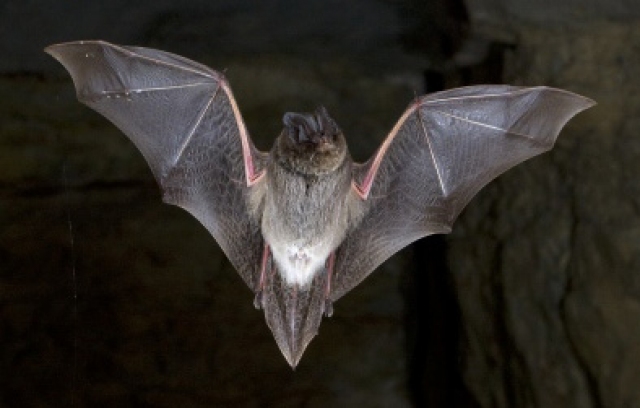
The size is between 4.5 and 5.8 cm with a wingspan of 26 to 29 cm and a weight of 6 to 13 g. It got its name from the pug-like snout. Their fur and flight skins are almost black, the ventral side dark grey. Barbastelle bats also have white tips on their backs, giving them a frosted appearance. The ears are broad (trapezoidal) and fused at the base.
Habitat
The roosts of the barbastelle bat are usually in forests. In particular, hiding places behind bark and in cracks in the trunk are used. Tree hollows, on the other hand, are of lesser importance. The bat species most frequently uses roosts in old and deadwood-rich oak and beech forests. Habitat trees in young oak forests are also frequently used. The stands, which are at the end of the differentiation phase, usually have large amounts of weak, standing deadwood. In addition to natural habitats, anthropogenic roosting opportunities such as bat flat boxes or window shutters are also accepted.
The text is a translation of an excerpt from Wikipedia (https://de.wikipedia.org/wiki/Mopsfledermaus). On wikipedia the text is available under a „Creative Commons Attribution/Share Alike“ licence. Status: 17 August 2021
Brown long-eared bat
Description
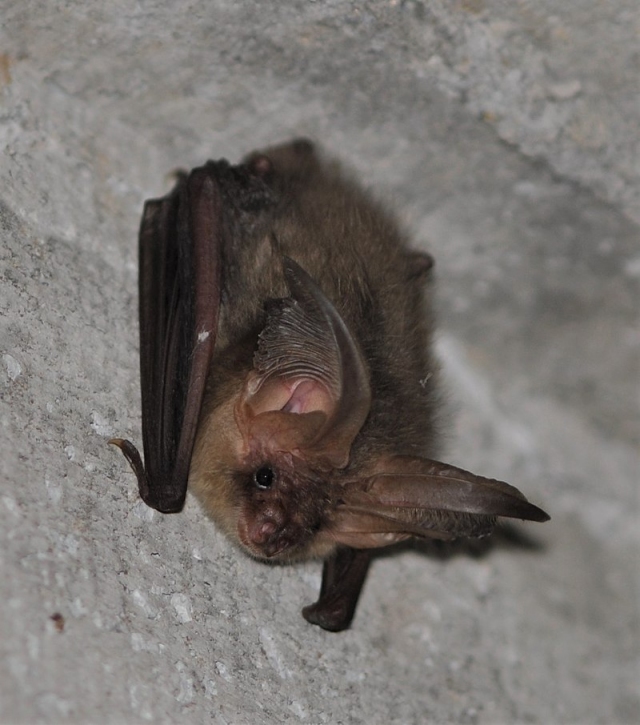
The fur of the brown long-eared bat is long and loose and has a grey-brown colour, the underpart and the neck are clearly lighter grey and bear a yellowish spot. The most striking feature are the ears, which at about 4 cm long are almost as long as the body. The front edge of the ears is heavily ciliated. The ears are upright at the beginning of the flight and remain upright during the flight itself. During daytime lethargy (torpor) and hibernation they are folded back under the wings. Especially in winter, the snout is significantly enlarged due to the glands on the nose. Brown long-eared bats reach a body length of around 42 to 53 mm, a wingspan of 24 to 29 cm and a weight of 5 to 11 g.
Habitat
Brown long-eared bats are forest dwellers to a greater extent than other long-eared species. They prefer loose deciduous and coniferous woodland or parkland, often flying in dense undergrowth, their broad wings helping with manoeuvrability. They are also capable of shaking flight, in which the position remains unchanged in relation to an earth-fixed point. They use trees as roosts, sometimes bird or bat boxes or buildings. For winter habitats during hibernation, they use caves or mines.
The text is a translation of an excerpt from Wikipedia (https://de.wikipedia.org/wiki/Braunes_Langohr). On wikipedia the text is available under a „Creative Commons Attribution/Share Alike“ licence. Status: 17 August 2021
Gray long-eared bat
Description
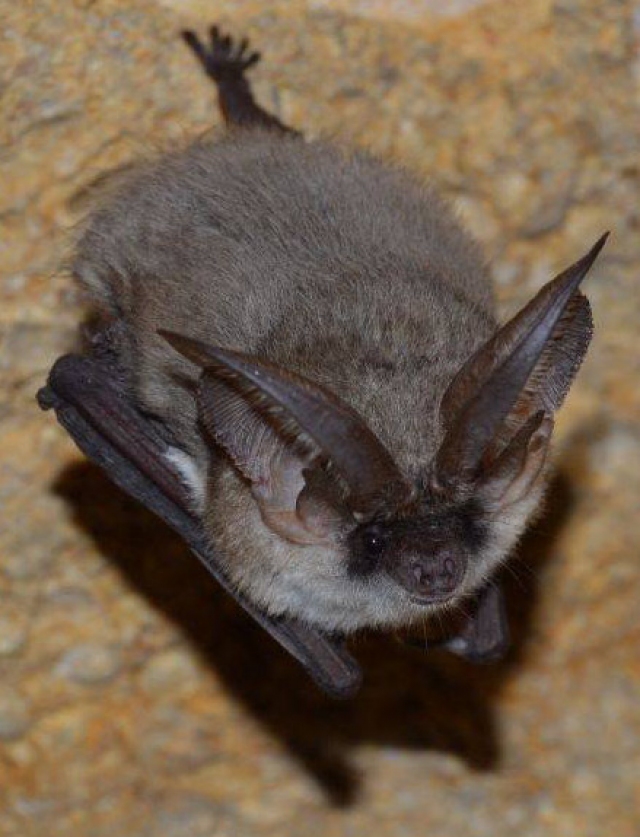
The gray long-eared bat reaches an average snout-vent length of 41 to 58 mm, maximum lengths of up to 60 mm can occur. The tail is 37 to 55, maximum 57 mm long, and the wingspan is 255 to 292 mm. Like other long-eared bats, the particularly pronounced ears stand out, reaching lengths of 31 to 41 mm and showing about 22 to 24 transverse folds. The body weight is 5 to 13 g.
In appearance and size, the gray long-eared bat resembles the brown long-eared bat (Plecotus auritus), but the colour of the relatively long coat is slate-grey at the base of the hair, so that the upperparts are rather grey and only rarely show a slight brownish tinge. The underparts are also grey. The grey mask around the relatively large eyes is striking, and the animal's snout is also slightly longer and more pointed. Other differences are found in less conspicuous features such as the shorter toe fur, the thickened end of the penis and the length of the penis.
As in the brown long-eared bat, the wings are relatively broad and the arm patagium attaches to the base of the toes.
Habitat
During the summer, bats stay in their summer habitats or nursery roosts, which are usually located in buildings. They are mainly found in roofs, where they sometimes live freely in the roof ridge or crevices or spaces between beams. The roosts are sometimes also inhabited by other species, such as the greater mouse-eared bat (Myotis myotis) or the lesser horseshoe bat (Rhinolophus hipposideros). Individuals are also found in caves and rarely in bat boxes. Summer habitats serve as a starting point for hunting and as a resting place during the day.
The gray long-eared bat hunts during the night. The departure from the summer habitat takes place with the onset of darkness. Prey is caught mainly in the open air, and long-eared bats are considered to be skilful flyers with fluttering flight. They fly at speeds of 10 to 30 km/h and at heights of between 0.5 and 10 m. They also collect prey from the ground. In addition, they also collect prey from leaves, which they can detect with the ultrasonic system.
The text is a translation of an excerpt from Wikipedia (https://de.wikipedia.org/wiki/Graues_Langohr). On wikipedia the text is available under a „Creative Commons Attribution/Share Alike“ licence. Status: 17 August 2021
Alpine long-eared bat

Description
The species is slightly larger than the common brown long-eared bat, which is also common in Central Europe. The snout-vent length is 46-55 mm, the forearm length 37-46 mm, the tail length 41-53 mm and the ear length 34-38 mm. The animals weight 6-10 g. The upperpart is light grey, light reddish brown or light brown-grey depending on the distribution, the underpart is yellowish white or greyish white to almost white. The head is predominantly whitish, a dark face marking extends from the corners of the mouth to in front of the eyes. Obviously characteristic for the species is a triangular, grey, hard field at the tip of the lower jaw.
Habitat
Information on the habitat of the species is scarce. Like the other species of long-eared bats, it is likely to feed on insects and spiders collected from vegetation or the ground. The nursery roosts are often located in churches and contain up to 50 individuals. Winter habitats have not been found so far.
The text is a translation of an excerpt from Wikipedia (https://de.wikipedia.org/wiki/Alpen-Langohr). On wikipedia the text is available under a „Creative Commons Attribution/Share Alike“ licence, Status: 17 August 2021
Brandt's bat
Description
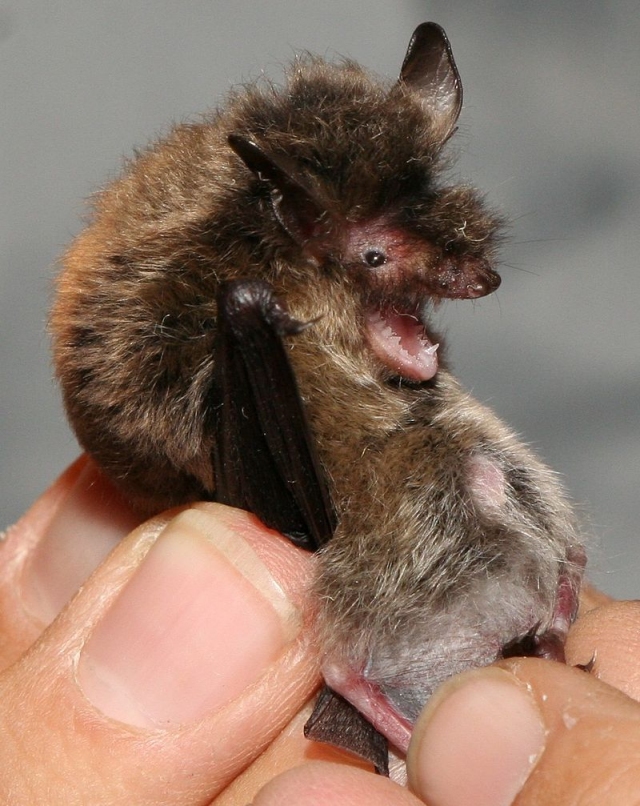
The Brandt's bat is a rather small bat species. Its snout-vent length is only about four to five cm, its wingspan is between 19 and 20 cm, and its forearm length is between 32 and 39 mm. An adult Brandt's bat weights between 4 and 10 g. The rather long fur is dark brown.
The rather long coat has dark brown fur roots, on the upperpart it is golden brown. The belly is grey, sometimes with a yellowish tinge. The ears are moderately long, the tragus is narrow, pointed and about half as long as the ear. The ears, snout and patagium are light brown, the base of the inner auricle and the tragus usually lighter.
Habitat
The Brandt's bat is strongly bound to forests and often to water bodies. It lives in mixed forest, deciduous forest and sometimes in coniferous forest. It is less common than the whiskered bat in the vicinity of human settlements. In summer it usually hibernates in tree hollows, but also in buildings and nest boxes, in winter in caves, tunnels, mines and cellars.
Brandt's bat are crepuscular. Fast and agile in flight, they hunt small non-aquatic insects at low altitudes near water bodies.
The text is a translation of an excerpt from Wikipedia (https://de.wikipedia.org/wiki/Große_Bartfledermaus). On wikipedia the text is available under a „Creative Commons Attribution/Share Alike“ licence. Status: 17 August 2021
Whiskered bat
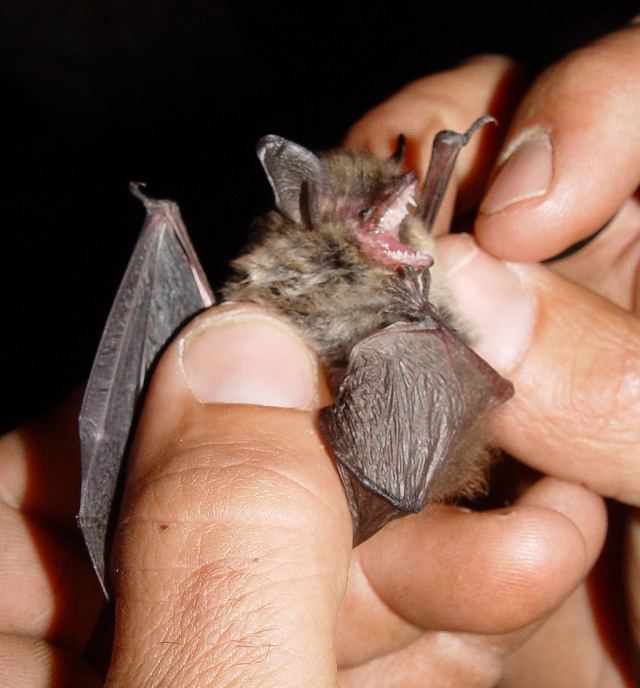
Description
With a snout-vent length of about four cm, a wingspan of about 20 cm and a forearm length of 32 to 36.5 mm, the whiskered bat is one of the smallest European myotis species. Adults weight four to seven g. Whiskered bats are darkly coloured, especially on the face, the fur is nut-brown to grey-brown on the upperpart, the underparts are grey. The ears, snout and patagium are blackish brown. Overall, the whiskered bat looks very similar to the Brandt's bat, the Alcathoe's bat and the steppe whiskered bat.
Habitat
The whiskered bat is not as dependent on water bodies and forests as its larger relative, the Brandt's bat. It also occurs in semi-open to open landscapes as well as in villages. Summer habitats are found both in buildings and in other crevices, such as behind tree bark. Winter habitats are mainly in caves, tunnels and cellars. The whiskered bat usually hunts structurally at forest edges or along other vegetation. More open landscapes such as orchards or water bodies are also used for hunting.
The text is a translation of an excerpt from Wikipedia (https://de.wikipedia.org/wiki/Kleine_Bartfledermaus). On wikipedia the text is available under a „Creative Commons Attribution/Share Alike“ licence. Status: 18 August 2021
Bechstein's bat
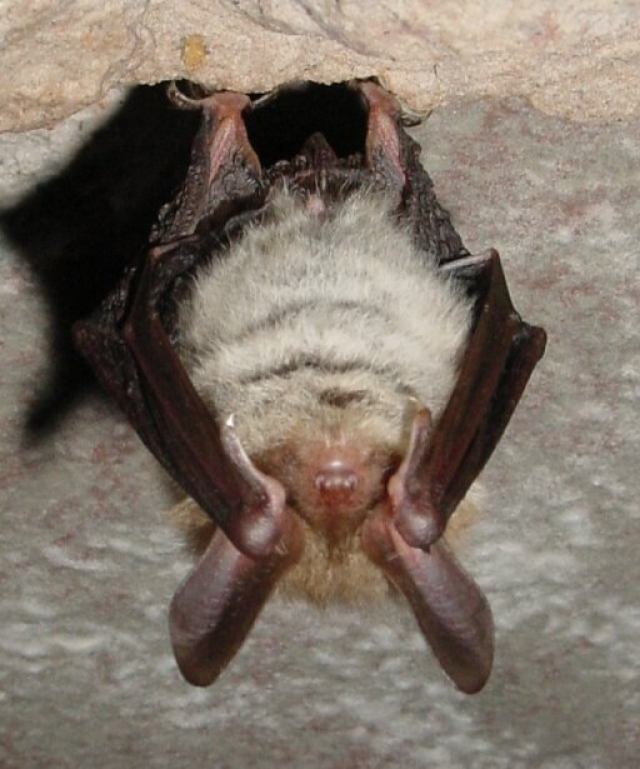
Description
The relatively long and broad ears of the Bechstein's bat have a pointed ear cover, which is typical for all species of mouse ears (Myotis). They have a wingspan of between 25 and 29 cm and weigh between 7 and 14 g.
Habitat
This forest-dwelling species prefers tree hollows as summer habitats. As a substitute, however, bird nesting boxes are also accepted time and again. However, bird nesting boxes are not a sufficient alternative, as the Bechstein's bat frequently changes its habitat and is therefore dependent on a habitat network, such as exists in a cave-rich forest with many old trees and a corresponding proportion of deadwood.
Like other bats, the Bechstein's bat feeds on small insects such as flies, midges and moths. Since this species has mastered shaking flight and can perceive the crawling sounds of its prey, it also picks up, for example, spiders and caterpillars directly from the vegetation. Its hunting grounds include the forest, especially the insect-rich forest layers close to the ground.
The text is a translation of an excerpt from Wikipedia (https://de.wikipedia.org/wiki/Bechsteinfledermaus). On wikipedia the text is available under a „Creative Commons Attribution/Share Alike“ licence. Status: 18 August 2021
Greater mouse-eared bat
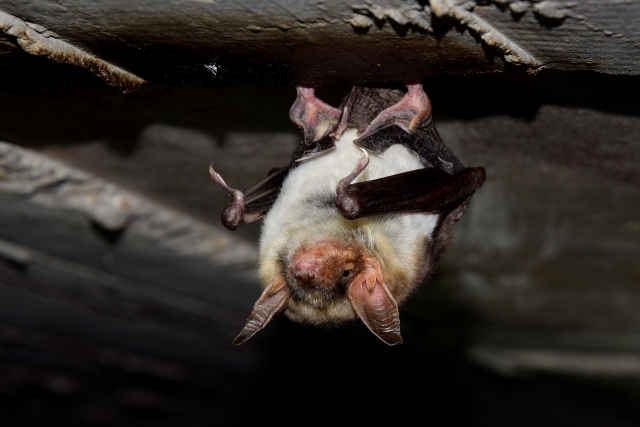
Description
With a snout-vent length between 6.7 and 8.4 cm and a wingspan between 35 and 43 cm, the greater mouse-eared bat is the largest European species of Myotis. An adult weighs between 28 and 40 g. The greater mouse-eared bat has a very short and broad snout, the ears are long and wide. The short fur of adults is blackish-brown at the hair roots and light brownish-grey on the upperpart. The belly is white-grey, the neck sometimes slightly yellowish. Juveniles are more grey than brownish. The snout, ears and wings are grey-brown. In contrast to the adult greater mouse-eared bat, the lesser mouse-eared bat is dark grey in colour, and its body measurements are usually smaller than those of the greater mouse-eared bat. The number of ear folds (7-8 in the greater mouse-eared bat, 5-6 in the lesser mouse-eared) is also a distinguishing feature.
Habitat
The habitat of the greater mouse-eared bat is mainly open terrain, such as meadows, fields and open woodland, but also human settlements. Summer habitats are in roof trusses and church towers, also in bridges. The animals hang freely here.
When foraging, they like to fly between trees at low (1-2 m above the ground) and medium altitudes, listening to the rustling sounds of prey running on the ground (passive detection). The sense of smell probably also plays a greater role in finding prey, with echolocation taking a back seat. The animals are also capable of so-called shaking flight for a short period of time. 4 to 17 km can lie between the roost and the hunting habitat. The main food is ground-dwelling arthropods, especially large ground beetles (Carabus), arachnids (Arachnida) and centipedes (Chilopoda).
The text is a translation of an excerpt from Wikipedia (https://de.wikipedia.org/wiki/Großes_Mausohr). On wikipedia the text is available under a „Creative Commons Attribution/Share Alike“ licence. Status: 18 August 2021
Lesser mouse-eared bat
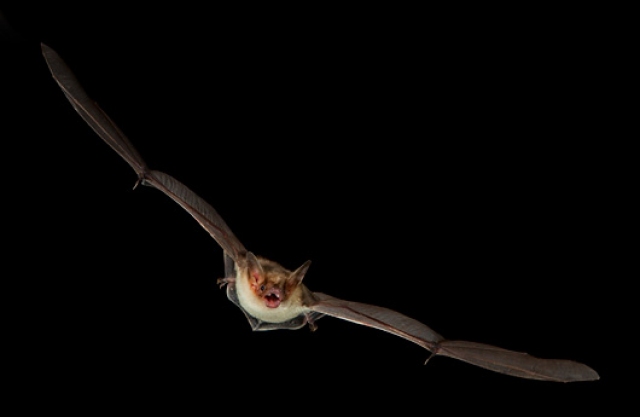
Description
The lesser mouse-eared bat is very similar to the somewhat larger greater mouse-eared bat. It reaches a snout-vent length of 62 to 71 (rarely from 54, or up to 76) mm and a weight of 15 to 28 g. The wingspan is 380 to 400 mm and the condylobasal length 17.2 to 18.5 mm. The wingspan is 380 to 400 mm, the condylobasal length 17.2 to 18.5 mm. The tail is 53 to 59 (maximum 60) mm long, the ears 19.8 to 23.5 (maximum 26) mm and the forearm 52.5 to 59 (maximum 62.5) mm. The ears are narrow and shorter than those of the greater mouse-eared bat. The anterior edge of the ears is not so strongly curved backwards and the ears taper more pointedly. The tragus is narrower at the base, lanceolate and becomes almost half as long as the ear. The outer edge of the ear has 5 to 6 transverse folds. The snout is narrower and more pointed compared to the greater long-eared bat, making it appear longer. The coat is short and the base of the fur is dark grey. The upperpart is grey with a brownish tinge, while the underpart is greyish white. Ears, snout and patagium are light grey-brown. The tragus is pale yellowish white. The patagium of the arms attaches to the base of the toes. The spur is about half as long as the uropatagium and has a narrow skin margin.
Habitat
The lesser mouse-eared bat is found in warmth-favoured areas in loose stands of trees and bushes, parks, karst areas, but also in towns and villages. The species has been recorded up to altitudes of 1000 m.
They hunt in the dark or late twilight. Their flight is steady and slow, they are more agile in confined spaces than the greater mouse-eared bat. Food is probably also taken from the ground. Prey are beetles and moths.
The text is a translation of an excerpt from Wikipedia (https://de.wikipedia.org/wiki/Kleines_Mausohr). On wikipedia the text is available under a „Creative Commons Attribution/Share Alike“ licence. Status: 18 August 2021
Geoffroy's bat

Description
The Geoffroy's bat is a medium-sized species and reaches a snout-vent length of about 41 to 53 mm with a wingspan of 22 to 24.5 cm and a weight of 7 to 15 g. The tail reaches a length of 38 to 46 mm. The tail reaches a length of 38 to 46 mm. The long and woolly dorsal fur is tricoloured with a grey base, straw-yellow centre and rust-brown to foxy-red tips. The ventral side is yellowish-grey and the snout is reddish-brown. Juveniles of the Geoffroy's bat are distinctly darker in colour than adults and have a smoky grey to brown-grey dorsal coat. The ears of the species are dark grey-brown and medium-sized, with an almost right-angled indentation on the outer edge of the upper third and six to seven pronounced transverse folds. The outer side is covered with numerous conspicuous papillae. The tragus is lanceolate and notched on the outer margin, almost reaching the indentation of the outer margin in height.
The patagium is also greyish-brown in colour. The forearm is 36 to 41 mm long and the wings are relatively broad. The hand flight skin (plagiopatagium) attaches to the toe root of the relatively small feet. The tail flight skin (uropatagium) has a straight calcar that reaches about half the length of the uropatagium. The bat got its name from sparse fine hairs on the dorsal side of the uropatagium, which overhang the free edge of the uropatagium.
Habitat
Summer habitats are often very bright compared to those of other species, in attics they prefer temperatures between 25 and 30 degrees Celsius and hang freely from roof battens or the ridge.
They hunt their prey in flight like other bats, but also prey on caterpillars. The flight out to hunt begins about 40 to 45 minutes after sunset. The hunting grounds are usually close to the hunting grounds at about 500 m, and are reached via flight paths along hedges or paths. The bat hunts close to the ground at a height of one to five m and over water surfaces at a height of about two m. In the area of hedges and vegetation edges it flies slowly and collects prey, otherwise it is an agile flyer. In addition, Geoffroy's bats also like to hunt in livestock sheds, where they collect insects and spiders from walls and ceilings in pendulum flight.
The text is a translation of an excerpt from Wikipedia (https://de.wikipedia.org/wiki/Wimperfledermaus). On wikipedia the text is available under a „Creative Commons Attribution/Share Alike“ licence. Status: 18 August 2021
