


Florian Heigl
European hedgehog
Description
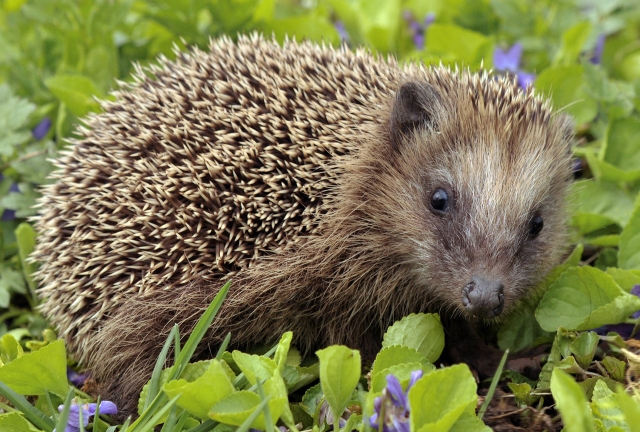
The most striking feature of the European hedgehog are the spines that cover the top of the head and the back. European hedgehogs have short limbs, with the hind limbs being slightly longer than the front limbs. Each foot ends in five toes, which are provided with claws. The second, third and fourth toes are approximately the same length, the first and fifth are smaller and also have smaller claws. The head of the European hedgehog has a long, mobile snout. The eyes are round and small, the ears are also small with a length of one cm and almost completely hidden in the fur.
Habitat
European hedgehogs prefer a richly structured field with a varied vegetation of hedges, bushes, ground covers, pastures, field margins with old grass or shrub thickets, small woody plants with dead wood and ruderal areas. They can also be found at the edges of deciduous forests. They avoid coniferous forests, treeless and shrubless agricultural areas and excessively wet habitats such as bogs. Bushes and hedges, but also hollow tree trunks and rock crevices serve them as resting places. Sometimes they also occupy abandoned burrows of other mammals. Today, European hedgehogs are mainly found in meadow orchards, near-natural gardens, parks and cemeteries, as well as in green settlements on the outskirts of towns and villages. They have been able to compensate for the loss of their original habitat - namely a richly structured field landscape - at least in part by increasingly entering the human settlement area as synanthropic species.
The text is a translation of an excerpt from Wikipedia (https://de.wikipedia.org/wiki/Braunbrustigel). On wikipedia the text is available under a „Creative Commons Attribution/Share Alike“ licence. Status: 22 July 2021
Crowned shrew

Description
The crowned shrew is very similar to the Eurasian shrew in size and colouration, a reliable differentiation is only possible on the basis of certain measuring sections on the lower jaw as well as on biochemical and chromosomal characteristics. The snout-vent length is up to 79 mm, the tail length up to 47 mm and the weight up to 9.8 g. Like the Eurasian shrew, the upperparts are blackish brown, the flanks are light brown and the underparts are grey.
Habitat
Like the Eurasian shrew, the crowned shrew inhabits woods, hedgerows, extensively used meadows and edges of wetlands.
The text is a translation of an excerpt from Wikipedia (https://de.wikipedia.org/wiki/Schabrackenspitzmaus). On wikipedia the text is available under a „Creative Commons Attribution/Share Alike“ licence. Status: 06 August 2021
Eurasian shrew

Description
The snout-vent length is 65 to 85 mm, the tail length 35 to 47 mm and the weight 6.5 to 14.3 g. The upperparts are blackish brown, the flanks are light brown and the underpart is grey. In young animals the upperparts are lighter and the transition to the light flank colouration is smooth.
The closely related crowned shrew, which is also widespread in western Central Europe, is slightly smaller on average. The dark brown colouration on the back is usually narrower and contrasts more clearly with the light brown colouration on the flanks. In both species, however, the body size and colouration of the specimens varies considerably and so there are ultimately no reliable external distinguishing characteristics. They can only be identified by genetic examination and minor differences in the skeletonised skull. The Eurasian pygmy shrew is smaller, the upperpart colouration is not clearly bicoloured, but grey-brown, the tail is proportionally longer and quite conspicuously thickened. Their eyes are proportionally even smaller.
The Alpine shrew, Eurasian water shrew and Mediterranean water shrew have black to black-grey fur, the latter two species are also significantly larger and stronger. The only distantly related native white-toothed shrews, i.e. the bicoloured shrews, European white-toothed shrews and lesser white-toothed shrews, differ from the Eurasian shrew, among other things, in that their auricles are not covered by hair, the tips of their teeth are white instead of dark brown, and there are occasional long, protruding hairs on their tails.
Habitat
The Eurasian shrew reaches its highest densities in damp forests and wet meadows, but also inhabits almost all other terrestrial habitats, including rock crevices and sand dunes.
The text is a translation of an excerpt from Wikipedia (https://de.wikipedia.org/wiki/Waldspitzmaus). On wikipedia the text is available under a „Creative Commons Attribution/Share Alike“ licence. Status: 06 August 2021
Eurasian pygmy shrew
Description
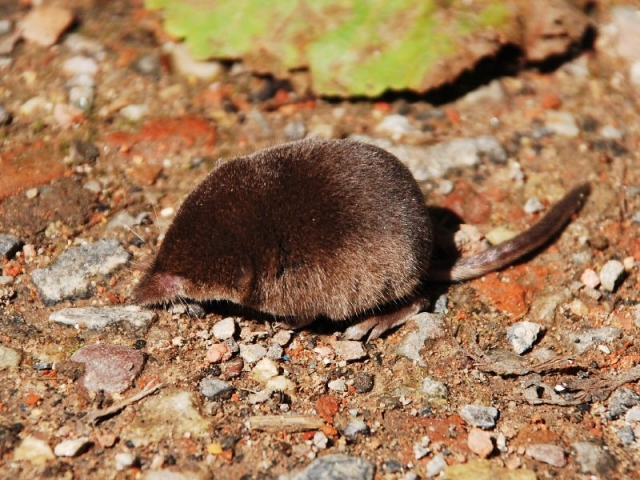
The Eurasian pygmy shrew is one of the smallest land-dwelling mammals in Europe. The snout-vent length is 42 to 66 mm, the tail length 35 to 46 mm and the weight 2.6 to 5.9 g. The upperparts and the flanks are plain brown, the underpart is grey.
The Eurasian pygmy shrew resembles the Eurasian shrew, a relative of the red-toothed shrew genus, but it is much smaller than the latter. Compared to the Eurasian shrew, it has a thicker and longer tail. Another distinguishing feature is the colouration of the Eurasian shrew, which appears bicoloured due to a dark dorsal colouration with distinctly lighter flanks.
Alpine, Eurasian water shrew and Mediterranean water shrew have black to black-grey fur. The latter two species are significantly larger and more robust than the Eurasian pygmy shrew. The only distantly related native white-toothed shrews, i.e. the bicoloured shrews, European white-toothed shrews and lesser white-toothed shrews, differ from the Eurasian pygmy shrew, among other things, in that the auricles are not covered by hairs and the tips of the teeth are white instead of dark brown, as well as in that longer hairs occasionally stick out from the tail.
Habitat
The Eurasian pygmy shrew inhabits wet meadows, moors and mixed forests.
The text is a translation of an excerpt from Wikipedia (https://de.wikipedia.org/wiki/Zwergspitzmaus). On wikipedia the text is available under a „Creative Commons Attribution/Share Alike“ licence. Status: 09 August 2021
Mediterranean water shrew
Description
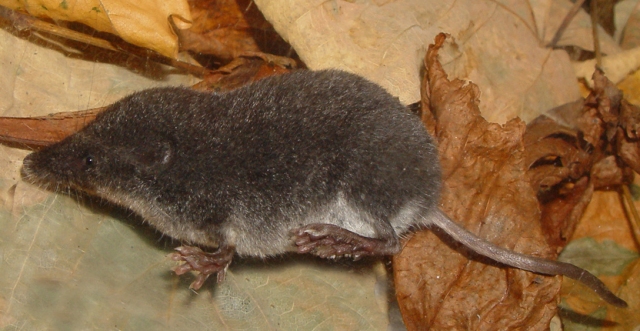
The snout-vent length is 65-86 mm and the tail length 40-56 mm. The animals weight 6-16 g, rarely up to 18.5 g. The fur is slate black on the upperparts, the underpart is grey to white. The species shows less strong adaptations to life in water than the similar Eurasian water shrew, a bristle fringe on the tail and hind feet is only indicated.
Habitat
The Mediterranean water shrew inhabits eutrophic riparian vegetation on stillwaters, slow-flowing streams and rivers, and marshes from lowland to 1850 m altitude. Habitat use is apparently significantly influenced by competition with the water shrew. Where the Eurasian water shrew is absent, the Mediterranean water shrew lives more aquatically and also increases in size.
The text is a translation of an excerpt from Wikipedia (https://de.wikipedia.org/wiki/Sumpfspitzmaus). On wikipedia the text is available under a „Creative Commons Attribution/Share Alike“ licence. Status: 09 August 2021
Eurasian water shrew

Description
The species is the largest shrew in Europe. The snout-vent length is 70-96 mm and the tail length 47-77 mm. The animals weight 15-20, rarely up to 25 g. The coat is glossy black on top, the underpart is variably silvery white to blackish brown, often with a rusty brown overcoat. The species is well adapted to life in water. The fur is long and dense, the underpart of the tail has a bristled keel along its entire length, which serves as a rudder, and the hind feet have bristles that aid propulsion. The water shrew is one of the few poisonous mammals in Central Europe. The secretion produced by venom glands located under the tongue is lethal in animals up to mouse size.
Habitat
The Eurasian water shrew inhabits near-natural shore areas of all kinds of water bodies including seashores, but also swamps, wet forests and meadows and in the north of its range even fields. The species occurs from the lowlands up to 2500 m altitude.
The text is a translation of an excerpt from Wikipedia (https://de.wikipedia.org/wiki/Wasserspitzmaus). On wikipedia the text is available under a „Creative Commons Attribution/Share Alike“ licence. Status: 09 August 2021
Lesser white-toothed shrew
Description
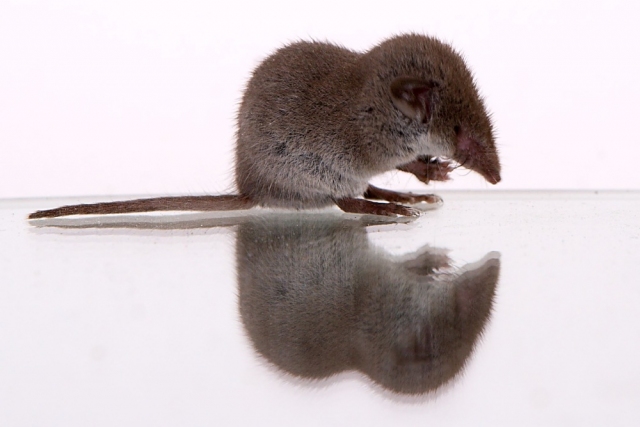
The lesser white-thoothed shrew is the smallest of the three species of white-toothed shrews (genus Crocidura) found in Europe. The snout-vent length is 50 to 75, rarely up to 80 mm, the tail length 25 to 40 mm and the weight 4.0 to 7.5 g. The upperparts are brown-grey, the flanks and the underparts are grey and occasionally have a yellowish tinge. The colouration of the under- and upperparts is not sharply separated.
Habitat
The lesser white-toothed shrew inhabits woodland-free, extensively used and warm open habitats such as fallow land, field and path margins, sedimentation vegetation, gardens, scree slopes and dry stone walls from lowland to about 700 m altitude. The species often lives - and in the north of its range almost exclusively - near human settlements. From September onwards, the animals increasingly migrate into buildings to hibernate there.
The text is a translation of an excerpt from Wikipedia (https://de.wikipedia.org/wiki/Gartenspitzmaus). On wikipedia the text is available under a „Creative Commons Attribution/Share Alike“ licence. Status: 09 August 2021
Bicoloured shrew

Description
The snout-vent length is 65 to 85 mm, the tail length 28 to 43 mm and the weight 7 to 15 g. The upperparts are brown-grey, the flanks and the underparts are sharply contrasting white-grey.
Habitat
The bicoloured shrew inhabits woodland-free, extensively used open habitats such as fallow land, abandoned grassland, roadsides, fields and gardens from lowland to about 700 m altitude. At certain times of the year, the animals move to areas with more cover and humid terrain. Especially in the area of the northern range limit, the species is closely tied to human settlements; in Poland, for example, it is much more common in larger towns than in small towns and villages. In the rest of the species' range, houses are visited mainly for hibernation.
The text is a translation of an excerpt from Wikipedia (https://de.wikipedia.org/wiki/Feldspitzmaus). On wikipedia the text is available under a „Creative Commons Attribution/Share Alike“ licence. Status: 09 August 2021
Northern mole

Description
The Northern mole reaches a snout-vent length of 11.3 to 15.9 cm, the tail becomes 2.5 to 4.0 cm long. The weight varies from 72 to 128 g. The Northern mole is well adapted to the underground burrowing way of life. The body shows a cylindrical shape, the neck is short and the conically shaped head ends in a pointed snout. The short tail retracts at the base, usually held upright. The broad forelimbs are short, broad and laterally oriented. All five fingers bear extraordinary claws. The hands are turned outwards, forming an effective digging tool. In contrast, the hindlimbs, which grow to 1.7 to 2.8 cm in length, appear rather graceful, the claws on each of the five toes appear much less developed.
Externally visible ears are not present. The eyes lie in a palpebral fissure. Their size is greatly reduced, but they have not completely lost their function. The soft fur, which does not have a stripe and thus does not offer any resistance during locomotion in the corridors and tunnels, is usually dark grey to black in colour with a slightly lighter tone on the underparts. However, colour anomalies occur in individual animals, ranging from white-grey silver to piebald, cream and yellow to orange and coffee brown. The limbs are hairless, as is the tail.
Habitat
They inhabit a variety of different habitats, but all have in common a thick soil layer, deep enough to create burrows and tunnels, with an abundant food supply. In general, the presence of the Northern mole is positively linked to the regional abundance of earthworms. As a result, it avoids acidic soils; the threshold value is reached at a pH value of 4.5 or higher, as the density of earthworms decreases rapidly here. It also avoids heavily industrialised regions with sometimes considerable pollution combined with a decline in soil quality. The altitudinal distribution covers the areas from sea level up to around 2700 m altitude. Originally, the Northern mole colonised deciduous forest landscapes, but today it can also be found on pastures, fallow land, in parks and in gardens. It also spreads into urban areas, whereby green spaces with a minimum area of about 10 ha are required for a permanent settlement, while the density of urban settlement around plays only a rather minor role. Accordingly, however, too small green islands with poor vegetation prevent a settlement of the mole, since on the one hand the density of prey is too low, and on the other hand parts of the urban infrastructure such as roads and kerbs often represent insurmountable barriers.
The text is a translation of an excerpt from Wikipedia (https://de.wikipedia.org/wiki/Europäischer_Maulwurf). On wikipedia the text is available under a „Creative Commons Attribution/Share Alike“ licence. Status: 09 August 2021
Greater horseshoe bat

Description
The greater horseshoe bat is the largest European horseshoe bat species with a maximum length of seven cm (without tail) and a wingspan of up to 40 cm. The weight is 17 to 30 g. On the upperparts it has a grey-brown, slightly reddish tinge to its fur, which changes to greyish-white on the underparts. The size of the horseshoe bat and the shape of the nose on its head make it easy to identify.
Habitat
Summer habitats are warm, draught-free attics, church towers, ruins and caves. The entrance and exit openings must be large enough for the animals to fly through freely. From the beginning of October to the end of April, frost-proof, draught-free and sufficiently humid (min. 95 % relative humidity) mine tunnels, rock caves and underground vaults are used as winter quarters. The preferred ambient temperature is 7 to 10 degrees Celsius, the minimum temperature 4 degrees, the maximum temperature 12 degrees. During hibernation, horseshoe bats wrap their bodies with their patagium.
The animals show a high degree of site fidelity. The winter and summer roosts are never more than 50 km apart.
The text is a translation of an excerpt from Wikipedia (https://de.wikipedia.org/wiki/Große_Hufeisennase). On wikipedia the text is available under a „Creative Commons Attribution/Share Alike“ licence. Status: 09 August 2021
