


Florian Heigl
European horned viper
Description
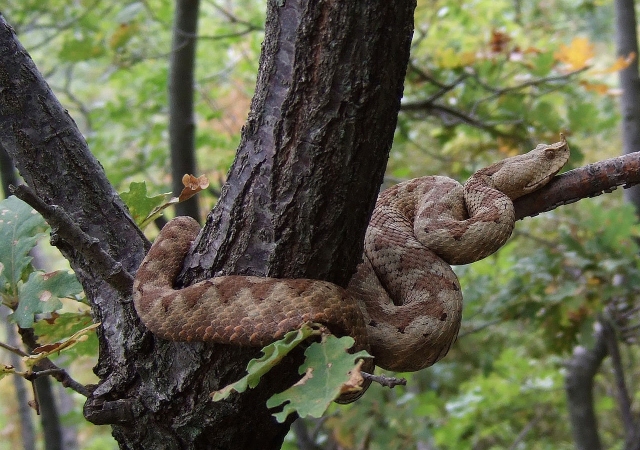
This powerfully built viper is a relatively large snake by European standards, measuring up to 95 cm in length; longer lengths have not been secured. Most individuals have lengths between 70 and 80 cm, with males generally growing larger than females. However, individuals of some populations sometimes remain significantly smaller. For example, European horned vipers on the Aegean Islands often reach a body length of only forty to fifty cm.
Coloration varies greatly; most individuals are gray, yellowish, or reddish brown with darker zigzag or diamond bands on the back, the color of which also varies from light brown to black. Males are usually slightly lighter in color than females and have more pronounced head and body markings. The underside of the tail is often yellowish, reddish or greenish in both sexes. Occasionally, completely black (melanistic) animals occur similar to asp vipers and European adder.
The triangular head is clearly separated from the trunk. On the top of the head are many small scales without large shields. The conspicuous horn on the snout, covered all around with small scales, gives the animal its name. Above the eyes, as in most viper species, there are strongly developed ridges, which give it a look perceived by humans as "threatening". The pupils are vertically slit-shaped. Around the middle of the body, European horned vipers have about 21 to 23 keeled dorsal scales. The tail is relatively short, and the anal shield is undivided.
Habitat
It lives in dry, stony scrubland and sparse forests. It is especially common on dry, sunny rocky slopes and stone walls. However, its habitat also includes sparse deciduous forests with sunny clearings, overgrown gardens, and scrubby scree. Contrary to what its occasionally used trivial name sand otter suggests, it is very rarely found on sandy areas.
The text is a translation of an excerpt from Wikipedia (https://de.wikipedia.org/wiki/Europäische_Hornotter). On wikipedia the text is available under a „Creative Commons Attribution/Share Alike“ licence. Status: 24 June 2021
Fire-bellied toad
Description
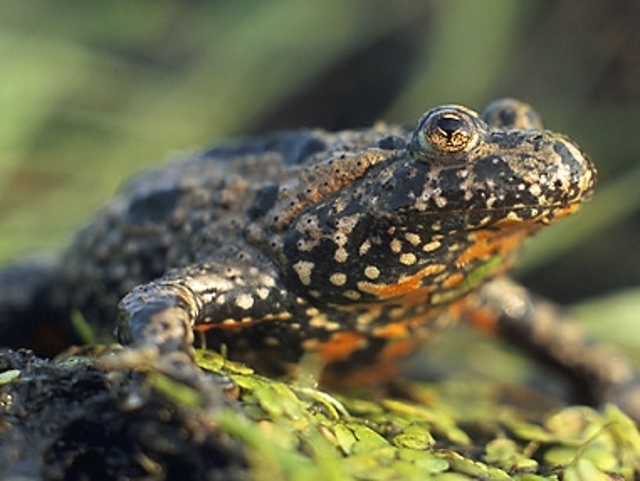
The snout-vent length of males and females reaches only 45 (53) mm, with the Central European animals usually remaining smaller. This makes toads the smallest frogs in Central Europe, along with the European tree frog and the more closely related common midwife toad. The flat head with eyes relatively close together, the overall flattened body, the absence of externally visible tympanic membranes and ear glands (parotids) as well as the heart-shaped to triangular pupils are conspicuous in comparison to true Bufonidae. At mating time, males can be distinguished from females by dark nuptial padss on the forearm and first two fingers, and they also possess large throat bladders (unlike the yellow-bellied toad) that are visible when calling.
The upperparts of the body are covered with flat tubercles that have small black horned spines (not as distinct as in the yellow-bellied toad), light to dark gray or grayish brown with dark spots. Many individuals also have green neck spots. The underparts, including the insides of the arms and legs, are dark gray to black with conspicuous orange to red spots, sometimes occupying only one-fifth of the surface, but in extreme cases occupying the largest proportion. Most often, the proportion of reddish spots is slightly less than 50 percent. The darker areas are covered with many white spots. Five types of glands occur in the skin, including venom and mucus glands. The density of glands is greatest in the head area and decreases toward the end of the body. Fire-bellied toads have a color change and can adapt their dorsal coloration to light or dark backgrounds. The color change occurs only in the base coloration, the dark spots do not change.
The innermost fingers and toes, and overall the tips of the limbs, are not spotted with color, unlike the yellow-bellied toad. The ventral pattern of markings is individual like a fingerprint. When threatened, the fire-bellied toad forms a hollow back and bends its arms and legs upwards so that the red coloring of the underside is partially revealed. This so-called "barge position" or toad reflex is intended to serve as a warning signal to predators ("Caution, poisonous/inedible!").
Habitat
Preferred biotopes are sunny, vegetation-rich, fish-free shallow waters with strong seasonal water level dynamics (seasonal flooding); these are colonized from spring to fall. In September/October, the return migration to the wintering grounds takes place over distances of up to one kilometer. Wintering sites are mainly woody plants with dead wood and foliage and occasionally reading stone piles. Reproductive success is subject to strong annual fluctuations, depending on temperature and precipitation.
The text is a translation of an excerpt from Wikipedia (https://de.wikipedia.org/wiki/Rotbauchunke). On wikipedia the text is available under a „Creative Commons Attribution/Share Alike“ licence. Status: 25 June 2021
Yellow-bellied toad
Description
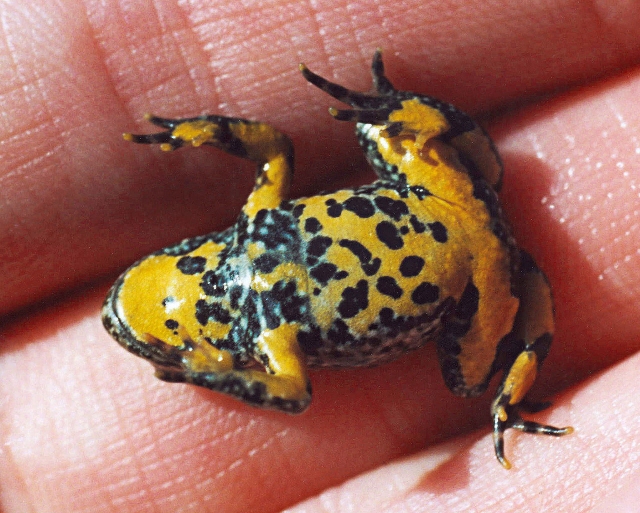
The size of males and females ranges from 35 to 56 mm; however, snout-vent lengths of more than 45 mm are rarely observed in Central Europe. The upper parts are clay to grayish brown, with narrow darker glandular complexes and washed-out light spots sometimes visible in the nape area. The underparts, including the inner sides of the limbs and the fingers and toes, are intensely colored light yellow to orange and interspersed with lead-gray to black spots or areas. Mostly the yellow part is more than half of the surface (occasionally also animals with almost completely yellow belly side occur; but also completely black ones were observed). Because the pattern of the underparts are different in each animal, this allows an individual differentiation - for example in the context of zoological investigations. Yellow-bellied toads have a stocky body, which is not quite as flattened as in the related fire-bellied toad (Bombina bombina), and a rounded snout. The pupil is heart-shaped, and the tympanic membrane is not externally visible. The upperpart has numerous tubercles with raised black horn spines.
Habitat
The yellow-bellied toad is one of the amphibians with a close aquatic relationship. Originally, the species was a typical inhabitant of stream and river floodplains. Here, it colonized the temporary small water bodies that were constantly being created depending on the dynamics of the floodplain. Also in its civilized replacement biotopes it prefers temporarily water-bearing small and very small bodies of water on clayey ground, such as tractor tracks, puddles and small water ditches. Usually these are low in vegetation and free of competing species and predators. Rapid warming of the waters ensures rapid development of spawn and larvae. Today, this pioneer species is mainly found in quarries, clay or gravel pits, and military training areas.
The high mobility of the juveniles favors the spontaneous colonization of newly developing habitats. On land, the animals seek hiding places under stones, dead wood and in gap and crevice systems of rocks. Predominantly crepuscular and nocturnal, they hunt insects (beetles, ants, bipeds, etc.). Their predators include backswimmers, water boatman, large dragonfly larvae, newts and sticklebacks (for the tadpoles), and birds such as magpies and also blackbirds (for the juveniles and adults).
The text is a translation of an excerpt from Wikipedia (https://de.wikipedia.org/wiki/Gelbbauchunke). On wikipedia the text is available under a „Creative Commons Attribution/Share Alike“ licence. Status: 25 June 2021
European common spadefoot
Description
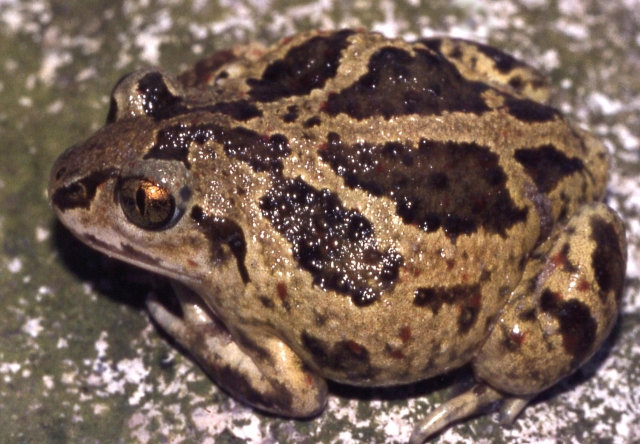
Adult males reach a maximum body length of 6.5 cm, females a maximum of about 8 cm; on average, however, both sexes remain slightly smaller. The coloration of the European spadefoot toad varies depending on the way of life, regional occurrence and sex. Mostly the animals show irregular dark brown, often elongated spots on a light gray to beige-brown ground. Almost every animal is thereby individually distinguishable. In addition, reddish or brown warts can appear, on the flanks also red spots. Females are usually more reddish brown in color, males tend to be more gray or clay yellow. In addition, the latter exhibit thickened upper arm glands at mating time. Some specimens lack the spotted pattern almost completely. While in the water, many individuals darken and thus have temporarily lower contrast markings.
The belly is whitish in color, often with light to dark gray speckles. Occasionally, albinotic forms also occur. Other distinctive external features are a helmet-like "parietal hump" on the back of the head and the vertical slit-shaped pupils, which are otherwise only found in the common midwife toad among Central European frogs. The metatarsal tubercle (callus internus) on the soles of the feet, which is present in all frogs, is particularly enlarged, sharp-edged and hardened in the spadefoot toad. It serves the animal as a "digging shovel" (digging callus).
The garlic odor, which gives this frog its name, is at most perceptible during a strong startle reaction. The secretion emitted serves as a defense against the predator. The behavioral repertoire of defense against predators is said to include active attacking and biting of the opponents as well as emitting a cry of fright similar to a toddler's scream. However, passive behaviors such as inflating the body or crouching are much more regularly observed in threatening situations.
Habitat
Adult toads are ground-dwelling terrestrial animals, except during the spawning season. They particularly prefer landscapes with loose, sandy to sandy-loamy topsoil (e.g. heaths, inland dunes, rough grasslands, steppes). Here, the animals can burrow quickly by means of their metatarsal tubercle " shovels" on the hind feet and the specially adapted leg musculature. The burrows dug are used several times by the animals. Under optimal environmental conditions, the subterranean daytime hiding places are literally turned into living caves, as the walls are mechanically stabilized and strengthened by the European spadefoot toad. In very dry summers, there may occasionally be prolonged periods of inactivity during which the toads rarely leave their burrow.
As soon as evening dusk falls, they dig themselves free from their underground hiding place to forage on the surface.
Agriculture and its tendency to increase acreage have benefited European spadefoot toads in some ways. The more open, tilled soil areas with loose grains are present, the more frequently the animals migrate into these habitats. European spadefoot toads are particularly fond of colonizing sandy potato and asparagus fields ("potato toad").
Small to medium-sized, eutrophic still waters such as ponds and pools with a minimum depth of about 30 cm are preferred as spawning biotopes. They also like to colonize so-called secondary biotopes such as gravel, sand or clay pits, but also extensively managed carp pond areas. A riparian zone rich in vegetation, for example overgrown with swath reed, cattail reed or flood lawn, meets the needs of the animals. More often, spawning sites are located near or even in the middle of cultivated farmland. For hibernation, European spadefoot toads burrow up to one meter deep into the ground. Found earth cavities, such as mouse holes or mole tunnels, are preferably accepted as winter habitats and remodeled according to their own needs. Topsoil in fens and floodplains is usually avoided by European spadefoot toads - unless the floodplain is interspersed with drifting sand dunes, geest islands or fluviatile sand deposits.
The text is a translation of an excerpt from Wikipedia (https://de.wikipedia.org/wiki/Knoblauchkröte). On wikipedia the text is available under a „Creative Commons Attribution/Share Alike“ licence. Status: 25 June 2021
European toad
Description
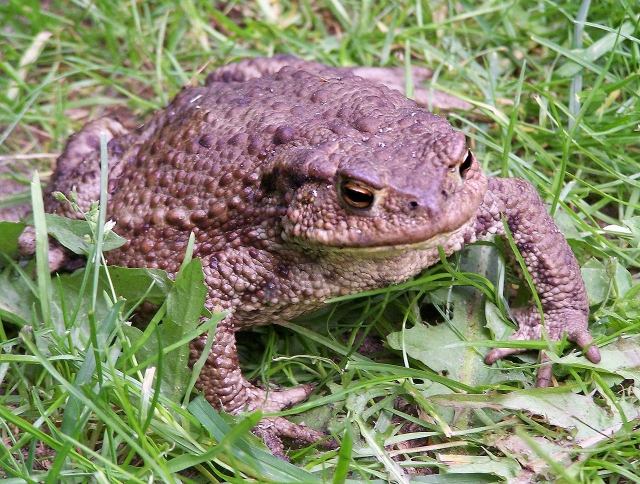
The body length of males in Central Europe is up to nine cm, females grow up to twelve cm long. Most adult European toads weight between 30 and 50 g (males) and between 50 and 100 g (females). The relatively plump animals have a stocky body, covered with warty skin glands on the upperpart, with a broad, short-nosed rounded head. On the back of the head there are prominent, paired, bean-shaped glands (parotids), which contain skin toxins to ward off predators. The upperparts are usually grayish to reddish brown; males are sometimes blackish brown or even light clay-colored, while females are more red. Washed-out dark spots may also be present, primarily in males. The underparts are dirty white in both sexes, with gray-black speckling throughout. The pupils are horizontally elliptical in shape, and the iris appears coppery to reddish gold ("amber"). European toads have rather short hind legs and move forward striding on all fours, but also hopping when disturbed. Males can also be identified at mating time by the brown to black nuptial pads on each of their three inner fingers. They also have stronger front legs, a flatter head, and remain smaller on average than females. Male European toads, unlike European green toads or natterjack toads, for example, do not possess vocal sacs.
Habitat
The European toad is a cold-blooded animal that is generally active at dusk. During the day, the animals rest under stones, crumbled walls, dead wood, foliage, shrubbery, or in burrows they have dug themselves. As terrestrial habitats, they colonize a wide spectrum of biotopes, ranging from forests to semi-open landscapes of meadows, pastures, and hedgerows to semi-natural gardens. Herb-rich forests (especially deciduous and mixed forests) without complete tree canopy closure are particularly preferred; settlement density is somewhat lower in closed upland forests. Floodplains are also not completely avoided, but are less favorable. Compared to other amphibian species, the European toad also occurs more frequently in alternately wet to dry forests. Orchard meadows and park-like landscapes are particularly popular because of the varied structures. The species is also found in drier habitats (e.g. vineyards, sand pits), but avoids very dry warm places.
Its occurrence in residential areas, parks, gardens, allotments, backyards, damp cellars, ruins and cemeteries justifies the designation "synanthropic species". Even in the midst of small towns, European toads can sometimes be found. Unsuitable habitats are, above all, intensively used farmland without field copses, vineyards that have been cleared of vegetation, and large-scale coniferous monocultures. The species also cannot exist where spawning waters are lacking over large areas.
Medium-sized to larger ponds, pools and lakes are mainly used as breeding waters. Still waters in or near the forest are colonized with great consistency. However, shallow and silting small water bodies are avoided by the European toad; a sufficiently large free body of water is a prerequisite for use as spawning habitat. The water depth should not be less than 50 cm; a weak flow is tolerated. Because of the inedibility of the larvae, the European Toad, unlike other amphibians, also spawns successfully in fish ponds.
The text is a translation of an excerpt from Wikipedia (https://de.wikipedia.org/wiki/Erdkröte). On wikipedia the text is available under a „Creative Commons Attribution/Share Alike“ licence. Status: 25 June 2021
Natterjack toad
Description
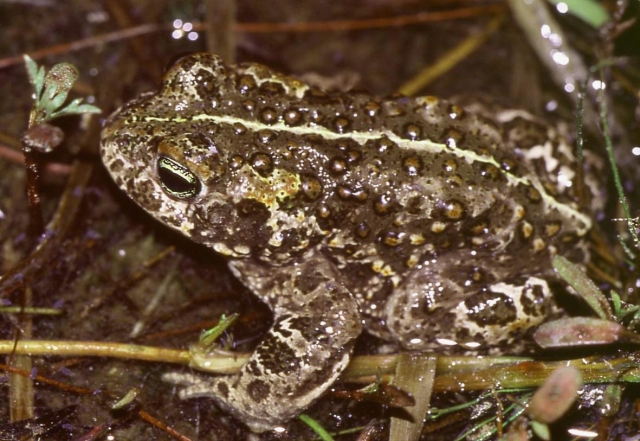
The size of males ranges from four to seven cm, females from five to eight cm. The back is marbled brown or olive on a lighter background. The skin surface is dry and warty. The large tubercles, as well as the parotids on the back of the head, are sometimes reddish in color. A thin longitudinal yellow line usually (but not always) runs across their "cross" (the back). The body is stocky, the head sloping sharply forward, the snout rounded, the pupil horizontally elliptical, the iris lemon yellow to greenish. The hind legs are also particularly short by toad standards, so natterjack toads rarely hop, but characteristically move forward in a mouse-like crawl.
Habitat
Like the European green toad, the natterjack toad is a pioneer species of warm, open habitats in areas with loose and sandy soils. The presence of vegetation-poor to -free biotopes with sufficient hiding places as terrestrial habitat as well as barely vegetated shallow and small waters as spawning sites is a prerequisite for the existence of the natterjack toad.
On the one hand, the preference for very shallow micro-waters for the deposition of the spawning cords involves the danger of drying out before the larvae have completed their metamorphosis. On the other hand, such habitats offer the advantage that they warm up very quickly and there are no predators in the water. The loud call of the natterjack toads is adapted to mating in annually changing waters - the female partner must be attracted not only to the male toad, but also to the corresponding unknown water body. Natterjack toads are found in excavation areas, inland dunes, post-mining landscapes, fallow land, construction sites, military training areas, coastal dunes, salt marshes and ruderal areas in human settlements. The species is sometimes found even in poorly structured agricultural landscapes, provided that suitable spawning habitats are available. The habitats mentioned are secondary biotopes. The natterjack toad is originally a species of floodplain landscapes, which have become very rare today due to straightening and damming of river courses and the construction of dams, where it finds optimal breeding conditions on open, dry-warm, mostly sandy sites.
The text is a translation of an excerpt from Wikipedia (https://de.wikipedia.org/wiki/Kreuzkröte). On wikipedia the text is available under a „Creative Commons Attribution/Share Alike“ licence. Status: 29 June 2021
European green toad
Description
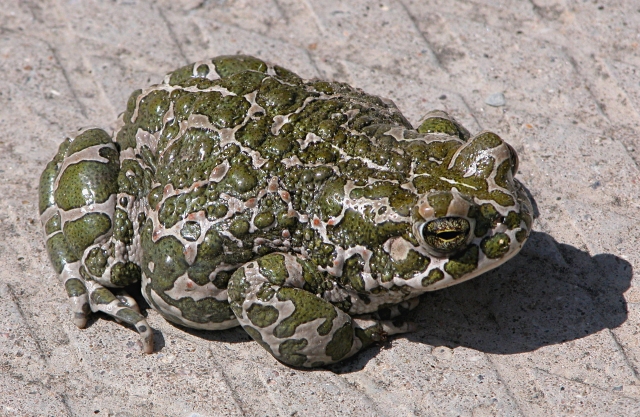
The size of males ranges up to eight, females up to nine (ten) cm. While the basic color of the males is rather light gray, this is almost white in the females. Both are covered with green spots (more "washed out" in the male), which are missing only on the belly. On the flanks of the females are usually reddish warts. For the interpretation of the name "changeable toad" either the changing spot pattern is referred to or the ability of the animals to adapt their basic color from light to dark or vice versa depending on the environment. The pupils are horizontal and the iris is lemon-yellow to greenish. Like all Bufonidae, the species has ear glands (parotids) behind the eyes. There are many warts on the upperparts that are not very pronounced.
Habitat
As an eastern steppe species as well as a Mediterranean faunal element, the European green toad is well adapted to dryness and warmth. It prefers open, sun-exposed, dry-warm habitats with burrowable soils and sometimes lacking patchy grass and herbaceous vegetation. It is therefore found mainly in ruderal sites, in dry fallow land in fields, and in excavated areas. It sometimes moves very far away from open water. European green toads are mainly nocturnal. Spawning waters are shallow and poor in vegetation, for example in quarries. Temporary waters with mineral soil are preferred as spawning waters. The European green toad tolerates a slightly increased salinity of the spawning waters of more than ten per mille. Thus, the larvae are also able to develop in brackish ponds at the Baltic Sea. The ecological requirements of the species are similar to those of the natterjack toad, which has a more Atlantic or western distribution.
The text is a translation of an excerpt from Wikipedia (https://de.wikipedia.org/wiki/Wechselkröte). On wikipedia the text is available under a „Creative Commons Attribution/Share Alike“ licence. Status: 29 June 2021
European tree frog
Description
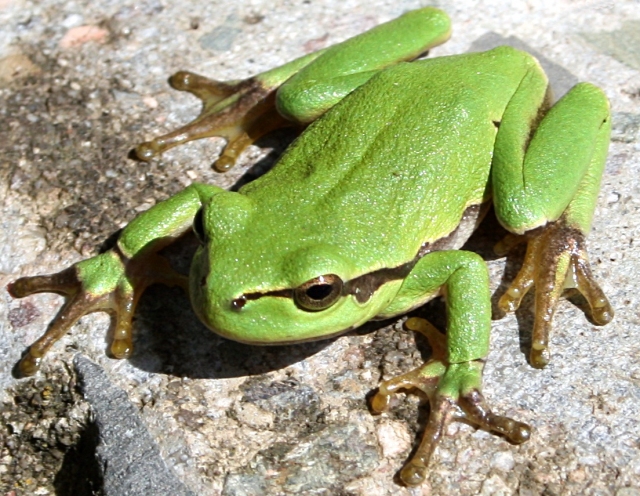
The snout-vent length of the European tree frog is 3 to 4.5 cm, in females also up to 5 cm. Body weight in the male can vary from 3.5 to 7 g, and in the female frog from 6 to 9 g, depending on the season. The head is wider than long; the sides of the head slope steeply, and the snout is correspondingly blunt-angled. The strongly protruding eyes have horizontal elliptical pupils, the sometimes dark speckled iris glows golden yellow. In the dark, the pupils dilate to fill almost the entire visible eyeball. The tympanic membrane is clearly visible and about half the size of the eye. Ear gland bulges (parotids), such as in the common toad, are absent. The front limbs are quite short and have four fingers each with adhesive discs (see below) at the ends, the hind feet have five toes each. The throat of males is yellow to yellow-brown in color and wrinkled, that of females whitish to light gray and slightly granular. Males have a large, yellowish or brownish, throat-shaped vocal sac.
skin, colouration
The skin surface is smooth and may be conspicuously shiny, especially when sunbathing. The upperparts are usually bright green in color. The belly and the inner surfaces of the extremities are predominantly white to light gray and granular. On both flanks, a dark stripe extends from the nostril over the tympanic membrane to the groin region. There it curves upwards and forms a so-called hip loop. Especially in the area of this hip loop, the flank stripe runs a bit differently in each individual. The hip loop is also called a groin loop, because the black lateral stripe ends in the groin region and does not form a loop.
European tree frogs can take on quite a varied color appearance in rapid succession. Variation ranges from light gray to yellowish to dark green.
Habitat
Depending on seasonal activity, tree frogs occupy very different aquatic and terrestrial subhabitats. The following habitat types and structures are relevant for a successful and sustainable life cycle:
aquatic subhabitats - Reproductive habitats
- FFish-free, sunlit small water bodies (pools, ponds, pressure/qualm water areas, bracks, flood depressions and oxbow lakes in river and stream floodplains, temporarily flooded grassland depressions, also water bodies in quarry pits).
- Vegetated, amphibious shallow and alternating water zones (as metamorphosis and maturation habitat for juvenile specimens).
- Aquatic and marsh plant communities of pondweeds (Potamogeton spec.), floodplain grasslands (especially Glyceria fluitans), acid grass fringes (sedges, rushes), and reed beds.
terrestrial habitats - daytime hiding places, feeding habitats
- Extensively managed wetlands and wet meadows as foraging habitat for growing and adult specimens.
- Wooded strips, reedbeds and watercourse-accompanying high herbaceous vegetation as perching and calling sites outside the mating season and as biotope network structures.
- Riparian forests, copses, moist coppice forests with plenty of sunlight, reed beds on sites close to groundwater.
As perching sites, adults and juveniles choose shrubs and even tree tops, especially various herbaceous plant species. In the literature, blackberry bushes are often mentioned; according to our own observations, the large leaves of burdock (Arctium spec.) are also particularly popular for sunbathing. However, it is not clear whether these structures are specifically preferred by the frogs or whether it is just easier to discover them on the large leaf surfaces.
The text is a translation of an excerpt from Wikipedia (https://de.wikipedia.org/wiki/Europäischer_Laubfrosch). On wikipedia the text is available under a „Creative Commons Attribution/Share Alike“ licence. Status: 29 June 2021
Moor frog
Description
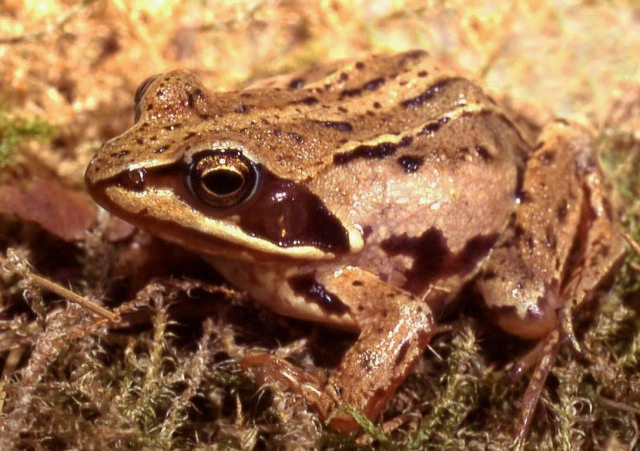
This is a rather slender, delicate brown frog with a pointed snout. The pupils are horizontal, the tympanic membrane is clearly visible within the temporal patch, but quite small (size about 2/3 of the eye diameter) and far from the eye. The metatarsal tubercle is high arched and firm, unlike the sometimes similar looking European grass frog.
The snout-vent length of males and females ranges from 5 to 6, exceptionally up to 8 cm. The upperparts are light to dark brown, but there are also reddish-brown and heavily black-spotted animals. The typical brown frog temple spot behind the eye is dark brown. A broad, light longitudinal band often runs across the middle of the back, which is dark fringed, but this may also be absent. The glandular ridges on the back often have white edges and are distinct. The flanks are sometimes conspicuously marbled in black. The moor frog therefore appears comparatively vividly marked overall; the range of variation is individually very large. Only by combining several identification characteristics is it sometimes possible to distinguish them from other brown frog species. The ventral side is whitish and usually unspotted.
Habitat
The moor frog prefers habitats with high groundwater levels or periodic flood dynamics, especially fens, swampy extensive grassland, wet meadows and softwood floodplains of larger rivers, raised bogs and intermediate bogs. This is also where its spawning waters are located, which are characterised by sun exposure and partial weed coverage with sedge, rush and cotton grass fringes or floodplain grasslands. For hibernation, it visits woody biotopes, among other places.
The text is a translation of an excerpt from Wikipedia (https://de.wikipedia.org/wiki/Moorfrosch). On wikipedia the text is available under a „Creative Commons Attribution/Share Alike“ licence. Status: 29 June 2021
Agile frog
Description
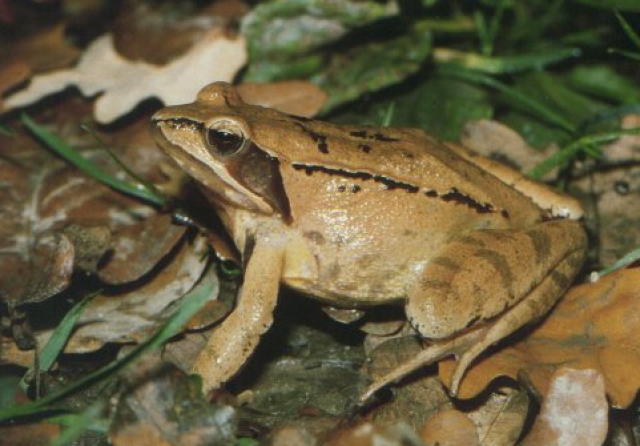
Agile frogs are slender, long-limbed frogs with a pointed snout. The snout-vent length of males rarely exceeds 6.5 cm, that of females up to 9 cm. The upperparts are light brown, reddish brown or light greyish brown ("falllaubfarben") and comparatively poor in markings and contrast. The triangular temple patches with the tympanic membrane, typical for brown frogs, are dark brown. The underparts are whitish and usually completely unspotted. During the mating season, males in the water are often dark brown in colour. Dark transverse bands appear on the thighs and lower limbs, but these are not the only characteristic of the species. The hind limbs are remarkably long, which is why the animals are very agile: they can leap one to two metres. The pupils are horizontal; the iris is lighter golden in the upper third (above the pupil) than laterally and below the pupil. The tympanic membrane reaches about the size of the diameter of the eye and is located very close behind each eye. The glandular ridges on the back are not very pronounced and are interrupted in parts.
Habitat
The agile frog prefers light and water-rich mixed deciduous forests. It also inhabits the surrounding open countryside as long as it is connected to the forest by rows of shrubs. Forest pools, ponds, small ponds and ditches serve as spawning grounds. Fish-free waters with sunny shallow shore zones are ideal. The species often lives far away from water in rather dry-warm forests (coppice and middle forests). Of the three Central European brown frog species, it is the most heat-loving and the most drought-tolerant.
The text is a translation of an excerpt from Wikipedia (https://de.wikipedia.org/wiki/Springfrosch). On wikipedia the text is available under a „Creative Commons Attribution/Share Alike“ licence. Status: 29 June 2021
