


Florian Heigl
Common bent-wing bat

Description
The common bent-wing bat is a medium-sized bat with a snout length of 5.00 to 6.25 cm, a tail length of 5.6 to 6.4 cm, a wingspan of 30 to 34 cm and a weight of 9 to 16 g. The dorsal fur is grey to greyish-brown, sometimes with a purple shimmer. The dorsal coat is grey to grey-brown, sometimes with a lilac tinge, the ventral side is lighter grey. On the head, the coat is short and protruding. The snout, the ears and the patagiums are greyish brown, the tragus yellowish white.
The snout is relatively short and blunt and the forehead arched, the ears are small and triangular in relation to the head, they do not protrude above the crown of the head. The ears have four to five transverse folds and a short tragus, which is curved inwards and rounded at the tip.
The species got its name from the long, dark brown wings that narrow towards the back. The second limb of the third finger is about three times as long as the first. The arm patagium attaches to the heel of the feet, which are comparatively long.
Habitat
It is a cavern species that occurs in the plains as well as in the mountains and in karst areas. Caves, cellars and tunnels with temperatures between 7 and 12 °C are mainly inhabited as summer and winter quarters. They also use roosts on and in buildings. The bats hang freely from walls and ceilings, sometimes in larger groups.
The text is a translation of an excerpt from Wikipedia (https://de.wikipedia.org/wiki/Langflügelfledermaus). On wikipedia the text is available under a „Creative Commons Attribution/Share Alike“ licence. Status: 18 August 2021
European hare
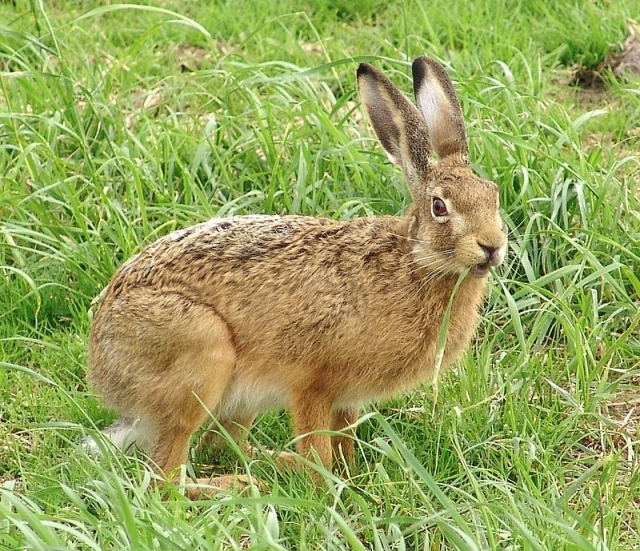
Description
Together with the Alpine hare, the European brown hare is the largest hare in Europe. The snout-vent length is 55 to 68 cm, the tail length 75 to 140 mm, the length of the hind feet 124 to 185 mm and the length of the ears 100 to 140 mm. Adult animals weigh 3.5 to about 5.0 kg.
The coat is long, the outer fur is curved in most of the distribution area. The woolly hairs have a white base. The back is variably coloured and can be yellowish grey, ochre-brown or brown-red with yellow shading and speckled with black. The back is darker than the sides of the body and the face. The flanks are more rusty yellow or reddish brown. The head and neck, the chest and the legs are light brown, the belly is creamy white. The ears are pale grey and show a black, roughly triangular spot at the tip. The tail is black on the underpart and white underneath. In winter coat, the sides of the head including the base of the ears are whiter and the hips more grey.
Habitat
The relatively warmth-loving species inhabits open and semi-open landscapes such as sparse forests, steppes, dunes and the agricultural landscape with hedges, bushes or adjoining forests from sea level up to 2500 m.
The text is a translation of an excerpt from Wikipedia (https://de.wikipedia.org/wiki/Feldhase). On wikipedia the text is available under a „Creative Commons Attribution/Share Alike“ licence. Status: 18 August 2021
Alpine hare
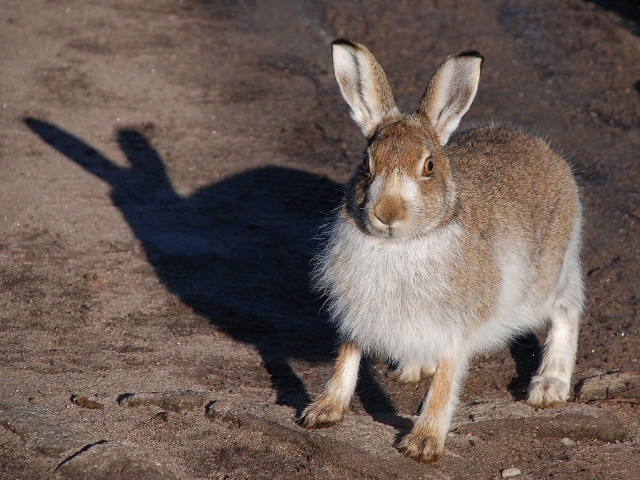
Description
With an average weight of about three kg and a length of just under 40 to 60 cm, it is slightly smaller than the European hare. Its change of coat from a grey-brown summer coat to a white winter coat is well known. However, this depends on the region: In Ireland it never puts on a white winter coat, but wears it for five months in the European part of Russia and for seven months in some North Asian areas. The Alpine mountain hare (Lepus timidus varronis) is white only in winter. From the white winter coat it shows a transitional coat, which is clearly pied. In summer it is grey-brown, around November the coat turns white and only at the outer tips of the ears it continues to show black hairs. The Northern mountain hare (Lepus timidus timidus) is usually white all year round. The fur serves them as camouflage in the white, snowy environment. Of importance is the adaptation of the ear length to the different climatic conditions. Since hares regulate blood circulation with the help of their ears and thus compensate for heat loss, their ears are consequently shorter the colder their habitat is.
The Alpine hare is a medium-sized hare. In winter, its body shape is reminiscent of a well-fed rabbit. In summer, too, it appears plumper than the brown hare and its ears are noticeably shorter. During the winter, the paws are very furry, which increases the contact surface and allows it to cross snow cover without sinking too deeply.
Habitat
The habitat of the Alpine hare is tundra areas, forests and moors. They are mainly nocturnal and spend the day burrowed in the snow or hidden in the ground. Unlike most other true hares, Alpine hares often live socially.
The text is a translation of an excerpt from Wikipedia (https://de.wikipedia.org/wiki/Schneehase). On wikipedia the text is available under a „Creative Commons Attribution/Share Alike“ licence. Status: 19 August 2021
European rabbit
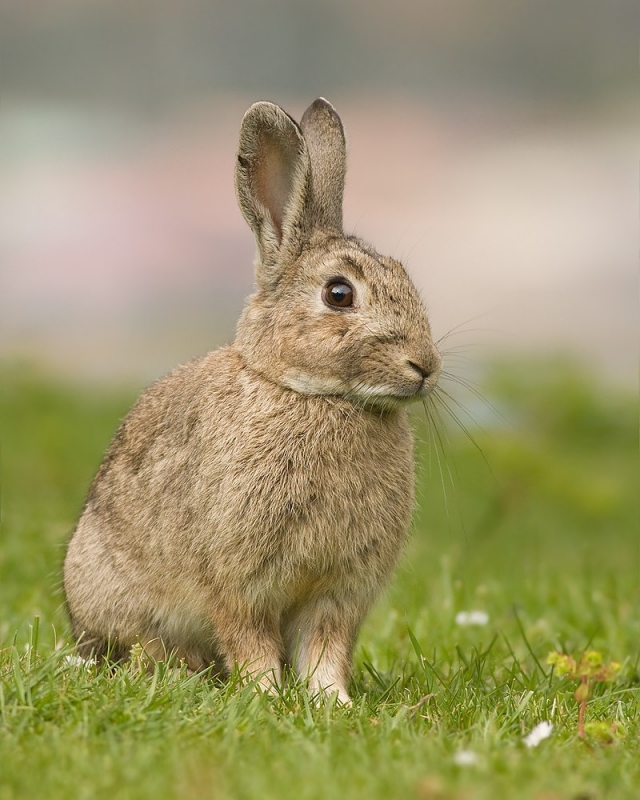
Description
European rabbits have a grey-brown coat. In the neck area it is brown to rust-red in colour. In contrast to the European hare, it has relatively short ears (6-8 cm), is much more delicate (1.3 to 2.2 kg) and has shorter hind legs. The snout-vent length is between 35 and 45 cm, the tail (scut) is four to seven cm long.
Habitat
The ideal habitat of the European rabbit consists of short grassy areas with safe hiding places (e.g. burrows, rocks, hedges, bushes and woodland) near feeding areas. It can stay up to the tree line as long as the ground is well drained and provides shelter.
The text is a translation of an excerpt from Wikipedia (https://de.wikipedia.org/wiki/Wildkaninchen). On wikipedia the text is available under a „Creative Commons Attribution/Share Alike“ licence. Status: 19 August 2021
Squirrel
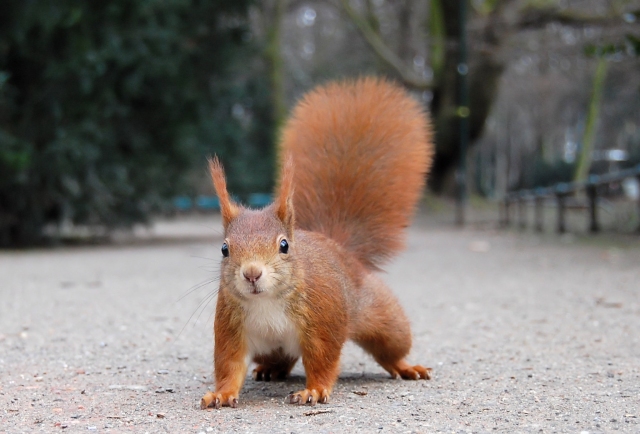
Description
In its body structure, the squirrel is adapted to a tree-dwelling and climbing lifestyle. It weights about 200-400 g. The snout-vent length is 20-25 cm. The two-lined, bushy tail is 15-20 cm long. It serves as a balancing aid when climbing and as a control tail when jumping. When running, the tail is always held in the air. The sexes cannot be distinguished by size and fur colour.
Squirrels are sole-walkers. They have four long, very mobile fingers with long curved claws on the front paws; the vestigial thumbs have a tiny nail attached. The hind legs are disproportionately long and very strong. The long, curved claws provide the squirrels with a good grip even when climbing quickly head over heels on smooth trunks.
The colour of the upperparts varies from light red to brown-black; the underpart is white or cream, neatly separated from the dorsal coat. The winter coat is much denser than the summer coat. In winter, the coat colour often becomes darker and can also take on grey tones. In the winter coat, squirrels have reddish-brown ear tufts up to 3.5 cm long. In the summer coat, these ear tufts are small or absent. In winter, the otherwise bare soles of the feet are also furred.
Habitat
The typical habitats are predominantly boreal coniferous forests. Only in the European part of the range are squirrels also native to deciduous and mixed forests. As a synanthropic species, they can be frequently found in parks and gardens.
The text is a translation of an excerpt from Wikipedia (https://de.wikipedia.org/wiki/Eurasisches_Eichhörnchen). On wikipedia the text is available under a „Creative Commons Attribution/Share Alike“ licence. Status: 19 August 2021
Groundhog

Description
The animals have a snout-vent length of about 40 to 50 cm. The tail length is 10 to 20 cm. The weight varies within the course of the year. Healthy adult males weight at least three kg. The weight of the females is slightly less.
The head is blackish and grey with a light-coloured snout. The ears are small and furry. The coat consists of dense, strong kemps and an undercoat of shorter, somewhat wavy hairs. The coat colour is basically very variable. The back can be slate grey, light brown or reddish brown, the underparts are usually more yellowish. Occasionally there are also individuals with a blackish coat. The coat is changed once a year. Most individuals change it in June.
The muscular and strong shoulder girdle and the pronounced digging paws are striking features of the Alpine groundhog's body. The front legs are a little shorter than the hind legs. The front feet have four toes, the hind feet five. Alpine groundhogs are sole walkers, the soles of their feet have well-developed pads and are not furred.
Habitat
The altitudes where most Alpine groundhogs occur range from the local tree line to about 200 m above it. Groundhogs also use cleared areas below the tree line that have been kept permanently free of trees by humans. However, they do not go below certain altitudes and are generally only observed above an altitude of at least 800 meters. In good groundhog areas, 40 to 80 groundhogs live on one square km.
Alpine groundhogs are able to cope with extreme alpine conditions and colonise alpine mats up to the foot of glaciers. They occasionally reach altitudes of 3000 m. A suitable habitat must have alpine grass, as this is the only place they can find sufficient food plants. It must also offer deep soil that enables the groundhogs to build their extensive burrows. They prefer south-facing slopes, as these are most likely to be free of snow in spring. On such slopes, the growing season also starts earlier and lasts longer.
The text is a translation of an excerpt from Wikipedia (https://de.wikipedia.org/wiki/Alpenmurmeltier). On wikipedia the text is available under a „Creative Commons Attribution/Share Alike“ licence. Status: 19 August 2021
Gopher
Description
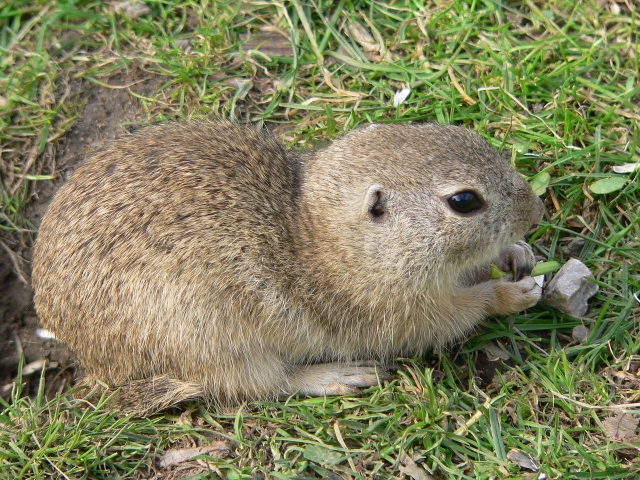
The European gopher achieves a length of 18 to 23 cm without the tail. With the relatively long and densely furred tail, it adds another 5.5 to 7.5 cm. It weighs 200 to 430 g, depending on the season. The legs are relatively short. The yellow-grey fur on top is covered with white-yellow spots, these spots are missing on the sides of the body. Towards the more yellowish belly side the coat lightens slightly. The forehead and crown are shaded slightly darker than the back. The dark eyes are framed by a lighter ring.
Habitat
The gopher mostly lives in steppe areas and grasslands in north-eastern Austria.
The text is a translation of an excerpt from Wikipedia (https://de.wikipedia.org/wiki/Europäischer_Ziesel). On wikipedia the text is available under a „Creative Commons Attribution/Share Alike“ licence: 19 August 2021
Forest dormouse
Description
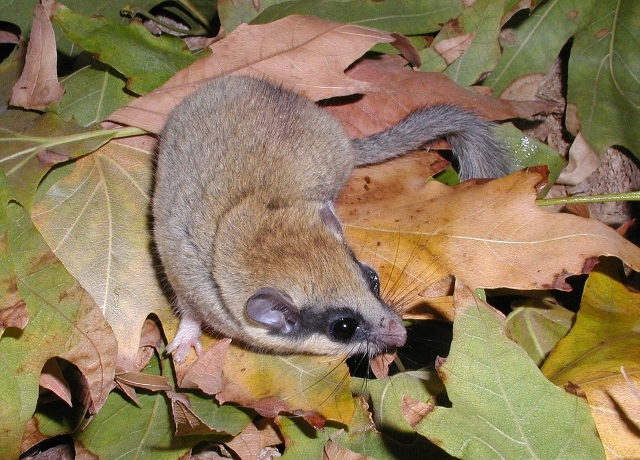
The nocturnal forest dormouse is easily recognised by its black face mask. On a light brown to grey background, it extends from the eyes to the front edge of the ears. Another clear distinguishing feature of the species is the unicoloured bushy tail, which is slightly greyer than the back.
Forest dormice are small dormice with medium-sized eyes and ears and a bushy tail. The snout-vent length is 80-113 mm, the tail length 73-119 mm, the length of the hind feet 19-24 mm and the ear length 10-15 mm. The animals weight 15-60 g. The coat colour on the upperparts ranges from reddish brown to yellowish brown to grey, the underpart is sharply contrasting greyish yellow. The tail, which is about the length of the body, is plain grey and only occasionally has a white tip. Fur length increases on the tail from the base to the tip. All feet have six sole pads.
Habitat
The forest dormouse lives exclusively in forests. In its large range, which extends far into Asia, a variety of forest types are colonised. Only dry pine forests with little undergrowth are avoided (Schedl 1968). In the Eastern Alps, the forest dormouse has been found in damp spruce and spruce-beech forests rich in undergrowth (Spitzenberger 2001).
The text is a translation of an excerpt from Wikipedia (https://de.wikipedia.org/wiki/Baumschläfer). On wikipedia the text is available under a „Creative Commons Attribution/Share Alike“ licence. Status: 19 August 2021
Garden dormouse
Description
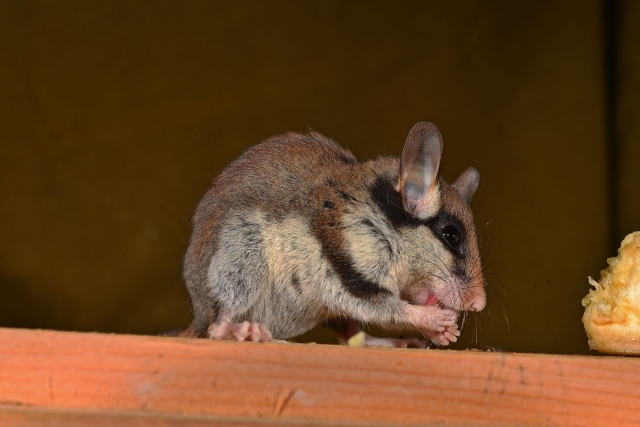
Garden dormice are medium-sized dormice. The snout-vent length is 100-170 mm, the tail length 80-150 mm, the length of the hind feet 22-32 mm and the ear length 20-26 mm. The animals weight 45-140 g, before hibernation up to 210 g. The coat colour on the upperparts ranges from reddish brown to grey with a reddish brown tinge, flanks and underpart are white. A striking black head pattern extends from the rearmost whiskers over the eye area to behind and below the ears. There is a white patch in front of the ears and there is often dark pigmentation on the shoulders. The body-length, hairy tail has a long-haired terminal tassel and is greyish brown on the proximal half and blackish brown on the distal half. The underpart of the tail is white. The front feet have four pads, the hind feet six.
Habitat
Although the German name suggests otherwise, garden dormice live mainly in deciduous and coniferous forests, especially on rocky ground; they also inhabit orchards and home gardens. The animals occasionally inhabit raised hides and isolated buildings.
The text is a translation of an excerpt from Wikipedia (https://de.wikipedia.org/wiki/Gartenschläfer). On wikipedia the text is available under a „Creative Commons Attribution/Share Alike“ licence. Status: 19 August 2021
Hazel dormouse
Description
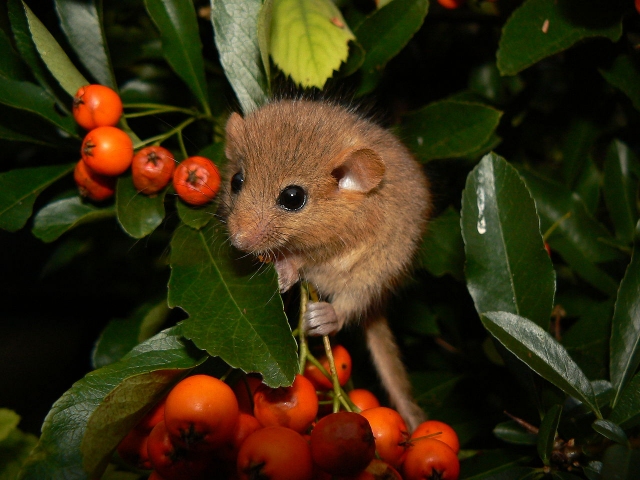
It weights 15 to 40 g and grows to a length of just under 15 cm, with almost half of the length (5.8 to 6.8 cm) being accounted for by the tail. The coat is yellow-brownish to reddish-brown with a white patch on the throat and chest, the tail is usually somewhat darker; pure white or black animals have also been recorded. They live 3 to 4 years in the wild and are sexually mature at one year.
Habitat
Their preferred habitat is dense bushes, hedges, wide forest margins and mixed forests with rich undergrowth. Hazel bushes (Corylus avellana) and bramble hedges are particularly popular. However, it seems to be quite adaptable and tolerant of noise, as individuals and nests have already been found in dividing strips of motorways planted with bushes.
The text is a translation of an excerpt from Wikipedia (https://de.wikipedia.org/wiki/Haselmaus). On wikipedia the text is available under a „Creative Commons Attribution/Share Alike“ licence. Status: 19 August 2021
