


Florian Heigl
Wolf
Description
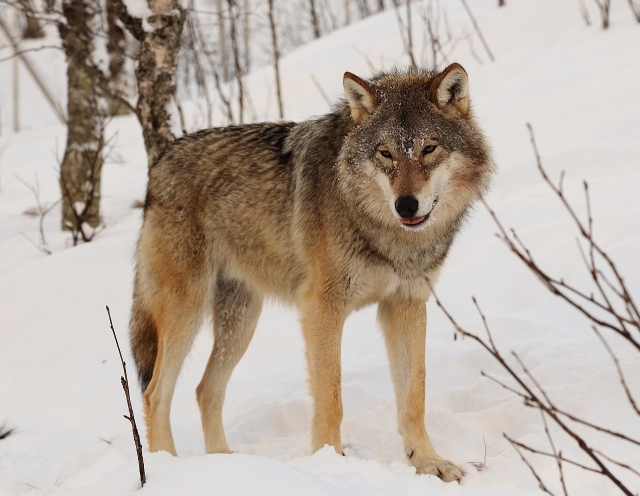
Basically, the wolf resembles a large domestic dog, with a longer rump and a higher but narrower thorax compared to similarly built domestic dogs. Wolves are comparatively slender with long legs. The head is relatively large with a broad forehead, long snout and short, upright carried ears, densely furred on the inside, pointing forward. The eyes are set obliquely and are also oriented forward. The bushy tail is about one third of the snout-vent length.
Body sizes and weights of wolves vary greatly due to their extensive range. Wolves reach snout-vent lengths of mostly 1.0 to 1.6 m and tail lengths of mostly 35 to 56 cm. The weight, which is also very variable within subspecies, is usually in the range of 13 to 78 kg; weights over 60 kg are rare. The shoulder height measures 66 to 91 cm.
Colouration is very variable, there are white, cream, yellowish, reddish, brown, grey and black wolves. In the temperate zones of Europe and Asia, greyish-yellow or brown-grey wolves predominate. Dark fur usually predominates on the back and tail. The belly, legs and snout are usually much lighter in colour.
Habitat
Wolves inhabit a variety of habitats. Their high adaptability allows them to live in the Arctic tundra as well as in the deserts of North America and Central Asia. Most wolves inhabit grasslands and forests; they also inhabit wetlands, scrublands, cultivated land, rocky regions and mountains up to 2400 m altitude. Wolves became known primarily as forest animals because humans drove them out of more open landscapes early on in large parts of their range.
The text is a translation of an excerpt from Wikipedia (https://de.wikipedia.org/wiki/Wolf). On wikipedia the text is available under a „Creative Commons Attribution/Share Alike“ licence. Status: 31 August 2021
Eurasian otter
Description
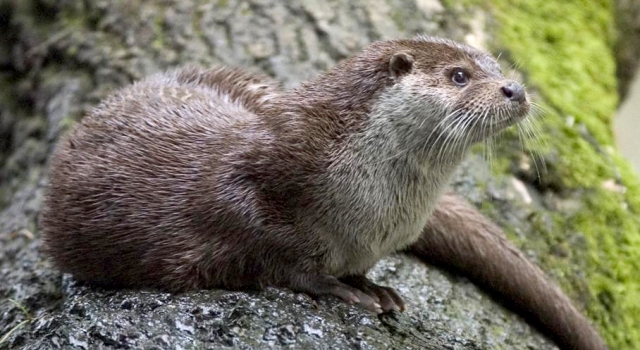
The otter has a snout-vent length of up to 90 cm, plus a tail of 40 cm. The cross-sectionally round and muscular tail serves the otter as a control and stabilising organ.
Otters have a shoulder height of about 25 to 30 cm. Adult otters can reach a body weight of up to 12 kg. On average, females weigh about 7.4 and males 10.5 kg. The body is elongated and cylindrical and the legs are short, the head is rounded and blunt-nosed, and there are long tactile hairs on the snout, which are an important sensory organ in murky water. The toes are connected with webbings The fur is light brown. With age, the throat and fore-neck turn whitish.
The otter's fur provides particularly effective insulation against cold and wetness due to the unusual structure of its hairs: the hairs are interlocked, like a zip, by microscopic interlocking wedges and grooves. The result is an extraordinarily dense fur mesh that holds insulating air bubbles but repels water at the same time. In this way, the otter's skin remains dry and its body warm.
Habitat
It prefers shallow rivers with vegetated banks and flood plains. The decline of such habitats and hunting have led to the European otter disappearing in some places and becoming extremely rare in many areas. However, it can cope with all types of freshwater habitats as long as the waters are clear and rich in fish and offer it sufficient hiding places along the banks.
It reveals its presence by well-camouflaged exits on the banks. Otter droppings (scats), marking secretions and prey remains can be found along the occasionally trodden otter paths. On muddy ground or in snow, not only the footprints (tracks) can be seen, but also the drag marks of the tail.
The text is a translation of an excerpt from Wikipedia (https://de.wikipedia.org/wiki/Fischotter). On wikipedia the text is available under a „Creative Commons Attribution/Share Alike“ licence. Status: 31 August 2021
European badger
Description
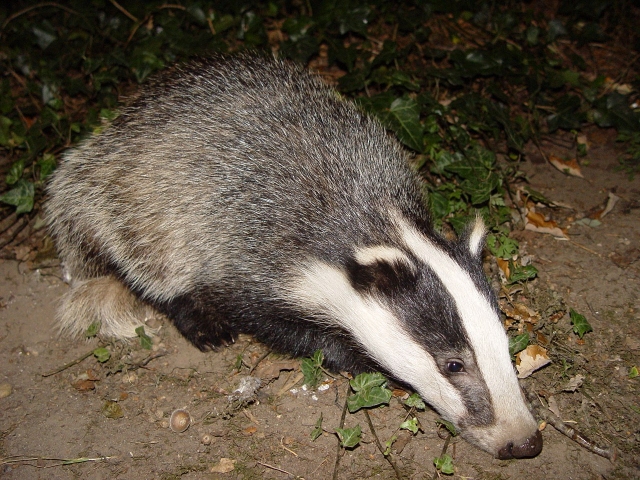
The European badger is a compact, stocky earth species in the family Mustelidae with a slender head, a trunklike snout and strong digging paws. The snout-vent length is between 64 and 88 cm, the tail length between 11 and 18 cm. The average weight is between 7 and 14 kg, rarely up to 17 kg. Females are on average smaller and lighter.
A characteristic feature of the European badger are the black and white markings on the head. On the upperparts, including the lips and the chin, it is predominantly white. From the corners of the mouth, however, black stripes first run straight upwards and then on both sides of the snout to the back and widening over the eyes and the white-rimmed ears to the nape of the neck, where they become lighter and run into the silvery grey of the upperparts and the flanks. The dark eyes are inconspicuously "masked" in a dark stripe. The flanks may show a straw-yellow hue. The individual hairs of the upper side are light coloured and only dark on the subterminal third. The kemps sometimes reach a length of 11 cm, on the flanks up to 12 cm. The entire underpart including the throat and the underpart of the neck is blackish brown with a particularly brownish tone on the belly. On this and in the groin area, the fur growth is sometimes quite thin, so that the bare skin shows through. Badgers in their first year show the clearest contrasts in colouration, older badgers become increasingly lighter.
The rather small eyes show a dark brown iris and round pupils. The proboscis-like snout protrudes at least 1.5 cm above the lower lip. The front paws bear long, horn-coloured and downward curved claws, which are well suited for digging and are twice as long as those of the hind paws.
Habitat
The European badger usually inhabits hilly, richly structured landscapes with woods, copses or hedges. Mixed deciduous forests with a distinct shrub layer are preferred. Large, closed forest areas, pure conifer stands, dune landscapes and extensive wetlands are largely avoided. The European badger is rarely found near settlements. Burrows are often made in forest edge habitats and on slopes, often facing south or west. Foraging often takes place in open, agriculturally used areas. These may be within several hundred m of the burrow.
The upper limit of altitudinal distribution is usually 1200-1700 m, but more rarely the species can be found at higher altitudes up to 2000 m in the Alps or 2500 m in the Caucasus. Here, however, there are only very rarely burrows, most of them are records of individual animals.
The text is a translation of an excerpt from Wikipedia (https://de.wikipedia.org/wiki/Europäischer_Dachs). On wikipedia the text is available under „Creative Commons Attribution/Share Alike“ licence. Status: 31 August 2021
Pine marten
Description
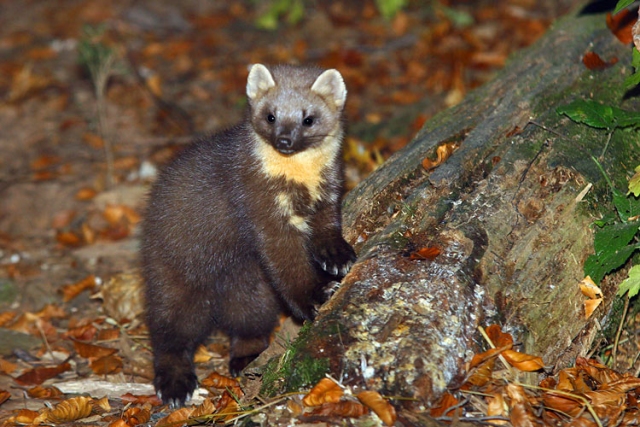
The pine marten's fur is chestnut to dark brown in colour, the throat patch is yellowish brown and rounded downwards and not white and forked as in the stone marten. The winter coat is long and silky, in summer its fur is shorter and rougher. Like many martens, it has an elongated body with relatively short legs, the soles are very hairy. The tail is relatively long and bushy, it serves as a balance organ when climbing and jumping. The head is characterised by the triangular, yellow-rimmed ears, the nose is dark - unlike that of the stone marten. The snout-vent length of these animals is 45 to 58 cm, the tail is 16 to 28 cm long.
Habitat
Its habitat is woodland, mainly deciduous and mixed woodland. Sometimes it can also be seen in large parks. In the mountains it can be found up to the tree line. Pine martens are tree dwellers to a greater extent than other representatives of the true martens. They are very good climbers and jumpers, and can climb up to four metres. When climbing, they are able to turn their feet 180 degrees. They build a number of nests in their territory, primarily in tree hollows, but sometimes also in abandoned squirrel cobs or birds of prey nests. They retreat to these resting places during the day and go in search of food at dusk and at night.
The text is a translation of an excerpt from Wikipedia (https://de.wikipedia.org/wiki/Baummarder). On wikipedia the text is available under „Creative Commons Attribution/Share Alike“ licence. Status: 02 September 2021
Stone marten

Description
Stone martens have the usual marten physique with an elongated, slender rump and relatively short limbs. The tail is relatively long and bushy. The second species of marten living in Central Europe, the pine marten, differs externally in the shape and colour of the throat patch.
In the stone marten, this is white and often forked and can extend to the forelegs, whereas in the pine marten it is yellowish and rounded. The fur of these animals is grey-brown in colour and rough.
Other differences to the pine marten are the pale nose and the hairless soles. The stone marten is also somewhat shorter, but heavier than its relative. The animals reach a head length of 40 to 54 cm, a tail length of 22 to 30 cm and a weight of 1.1 to 2.3 kg.
Habitat
As the only representative of the true martens, the stone marten is not a distinct forest dweller. It prefers open, bushy or tree-covered and often rocky terrain and can be found in mountains up to 4000 m above sea level. As a synanthropic animal, it is often seen in the vicinity of human settlements, where it stays in parks, barns or attics, which is why it is also called a roof marten or house marten.
The text is a translation of an excerpt from Wikipedia (https://de.wikipedia.org/wiki/Steinmarder). On wikipedia the text is available under a „Creative Commons Attribution/Share Alike“ licence. Status: 02 September 2021
European polecat
Description
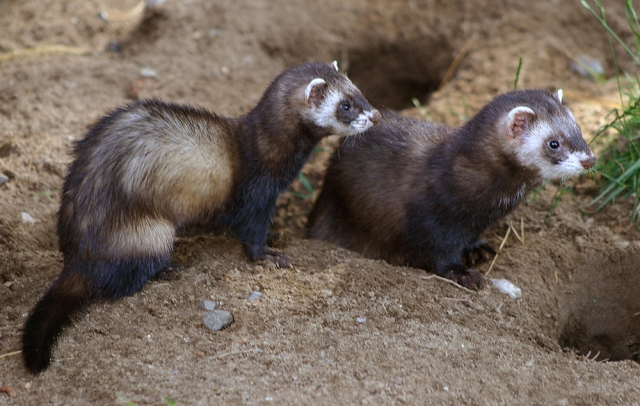
European polecats, or forest polecats, have a slender, elongated body with short limbs. The coat is dark brown or black, the yellowish undercoat shimmers through the outer hairs. The snout is whitish, as is the area behind the eyes and the tips of the ears. Black patches around and in front of the eyes provide a mask-like face pattern. The coat is the same colour in summer and winter, but the summer coat is much thinner.
Habitat
Despite the name forest polecat, the polecat is not a distinct forest dweller; its habitat tends to be the open edges of forests, but also fields and meadows. It is often found near water bodies and wetlands. Sometimes it settles close to villages and on farms, where stables and barns are also part of its hunting ground.
The text is a translation of an excerpt from Wikipedia (https://de.wikipedia.org/wiki/Europäischer_Iltis). On wikipedia the text is available under a „Creative Commons Attribution/Share Alike“ licence. Status: 02 September 2021
White polecat

Description
The white polecat looks very similar to the European or forest polecat, but has a lighter-coloured coat and grows slightly larger. Like all polecats, it has an elongated, slender body with short limbs. The coat has a low, yellow undercoat and some black kemps. The belly and legs are black, and it also has a black face mask.
Habitat
The white polecat is mainly found in Eastern Europe and parts of Asia. Its western limit of distribution is in the eastern parts of Poland, the Czech Republic and Austria. It inhabits open areas such as steppes and semi-deserts, but also lives in fields and wasteland. It does not occur at all in forests and towns.
The text is a translation of an excerpt from Wikipedia (https://de.wikipedia.org/wiki/Steppeniltis). On wikipedia the text is available under a „Creative Commons Attribution/Share Alike“ licence. Status: 02 September 2021
Stoat

Description
Stoats have the elongated, slender body typical of many martens, with rather short legs and a short tail. In the summer coat they show the typical colouration of many weasels with brown upperparts and white underpart. In the winter coat it is completely white, with the exception of a black tail tip, which makes it clearly distinguishable from the common weasel. However, this change of coat does not take place in all parts of the range. In warmer areas, stoats are brown and white all year round, but in the far north they never lose their white winter coat. The animals reach a snout-vent length of 17 to 33 cm, the tail is four to twelve cm long and their weight is 40 to 360 g.
Habitat
Stoats inhabit a range of landscape types, although near-water habitats seem to be preferred. There is no apparent biotope attachment, instead there is a close association with the occurrence of Eurasian water voles, field voles and common voles. Structurally rich landscapes, e.g. with meadows, hedges and copses or residential gardens, are typical. Closed forests, however, are avoided. Stoats can be found at altitudes of up to 3400 m.
The text is a translation of an excerpt from Wikipedia (https://de.wikipedia.org/wiki/Hermelin). On wikipedia the text is available under a „Creative Commons Attribution/Share Alike“ licence. Status: 02 September 2021
Common weasel
Description
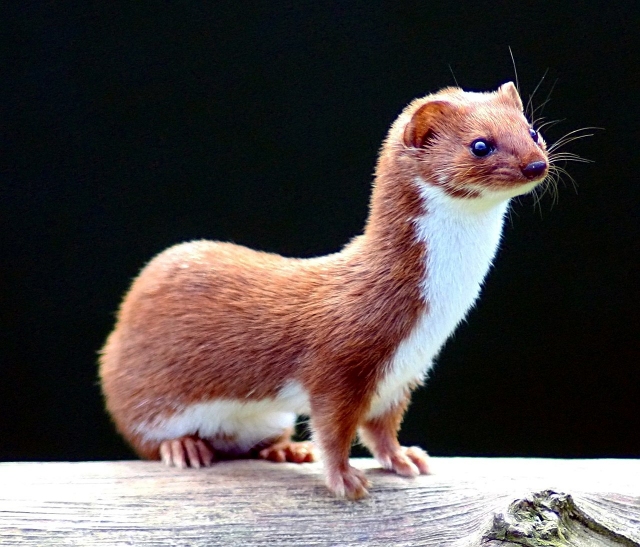
The common weasel is the smallest representative of the order of carnivores (Carnivora), although there are considerable differences in size in its large range. The length of the head varies between 11 and 26 cm, the tail between 2 and 8 cm and the weight between 25 and 250 g. The weasels in North America are generally smaller than those in Eurasia. Animals in North America generally remain smaller than those in Eurasia, where they are known as least weasels. Females are also smaller and lighter on average than males. The coat of the least weasel is distinguished from the stoat by the jagged line between the brown upper side and the white underpart, as well as by brown feet and a brown tail (without the black tip).
As with stoats, common weasels can also change their coat to a white winter coat, but this is very rare in Central Europe. There are regional populations, for example in the Nock Mountains in Austria or in Lithuania, which also change to white in winter.
Habitat
Common weasels inhabit a range of habitats, including grassland and vineyard fallows, forest edges, meadows and pastures. They reach high population densities in summer, especially in agricultural areas. Linear structures such as hedges, untended ditches, old grass strips and field margins are used for locomotion and hunting. Deep forests, deserts and mountains above 3000 m altitude are avoided.
The text is a translation of an excerpt from Wikipedia (https://de.wikipedia.org/wiki/Mauswiesel). On wikipedia the text is available under a „Creative Commons Attribution/Share Alike“ licence. Status: 02 September 2021
Mink

Description
American mink have an elongated body with relatively short limbs and tail. The face is flat and pointed, the toes are partly webbed as an adaptation to the semiaquatic lifestyle. An anal gland secretes a musky secretion, the smell of which is sometimes described as more penetrating than that of skunks. The soft, dense fur is water-repellent, its basic colouration is brown. The chin is coloured white, sometimes white patches are visible on the throat and belly. Through breeding, many colour variations are now available. The animals reach a head trunk length of 30 to 43 cm, a tail length of 13 to 23 cm and a weight of 0.7 to 2.3 kg, whereby the males become considerably heavier than the females. American minks can thus grow much heavier than their European cousins.
Habitat
Originally, the species was restricted to North America. It occurred in Alaska, nearly all of Canada (except the extreme north), and the core United States (the 48 contiguous states) except the southwestern portions. Since the 1950s, escaped or released animals from mink farms have also spread into Europe, largely displacing the native European mink.
American mink are water-bound. They can be found along rivers and lakes as well as in swamps and marshes. However, they need shore areas densely covered with vegetation. They also inhabit estuaries and coastal islands.
The text is a translation of an excerpt from Wikipedia (https://de.wikipedia.org/wiki/Amerikanischer_Nerz). On wikipedia the text is available under a „Creative Commons Attribution/Share Alike“ licence. Status: 02 September 2021
