


Florian Heigl
Raccoon
Description
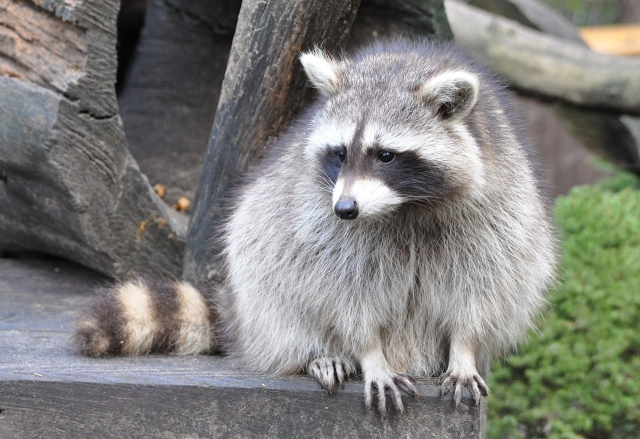
Its body length is between 41 and 71 cm, not including the bushy tail, which is between 19.2 and 40.5 cm long, but usually not much longer than 25 cm. The characteristic facial markings of the raccoon with the black coloured face mask around the eyes, which contrasts sharply with the surrounding white fur, are similar to those of the raccoon dog. The slightly rounded ears are also framed by white fur. On the rest of the body, the long and water-repellent outer fur is coloured in various shades of grey and, to a lesser extent, brown. Raccoons with very dark coloured fur are mainly found in the German population, as there were individual animals with such fur markings in the founder population.
Unusual for a predator are also the five free-standing fingers, although the mobility of the front paws is not comparable to that of primate hands due to the non-opposable thumb.
Habitat
Apart from urbanised animals, water-rich mixed and deciduous forests with a high proportion of oak trees are the preferred habitat of raccoons. Here they find enough food and shelter. In case of danger, they take refuge in a tree; they therefore avoid open areas. Raccoons are good swimmers and prefer to live near rivers or other bodies of water, where they find most of their animal food.
The text is a translation of an excerpt from Wikipediaa (https://de.wikipedia.org/wiki/Waschbär). On wikipedia the text is available under a „Creative Commons Attribution/Share Alike“ licence. Status: 13 September 2021
Wild boar

Description
Seen from the side, the body of the wild boar appears stocky and massive. This impression is intensified by the legs, which are short and not very strong compared to the large body mass. In relation to the body, the head also appears almost oversized. It tapers off in a wedge shape towards the front. The eyes lie high up in the head and are directed obliquely forward. The ears are small and surrounded by a rim of shaggy bristles. The short, stocky and not very mobile neck is only visible when wild boars wear their summer coat. In the winter coat, the head appears to merge directly into the rump. From the forehead to over the back runs a crest of long bristles that can be raised.
The body height decreases towards the hind legs. The body ends in a tail that reaches down to the heel joints and is very mobile. With it, the wild boar signals its mood by pendulum movements or by lifting. Seen from the front, the body appears narrow.
The adult male can be distinguished from the female - when viewed from the side - by the shape of the snout. While it is long and straight in the female, it appears shorter in the male.
fur of adult and one-year old animals
The fur of the wild boar is dark grey to brown-black in winter with long bristly outer hairs and short fine woolly hairs. The woolly coat covers the entire body except for some parts of the head and the lower part of the legs.
In spring, the wild boar loses the long, dense winter coat and has a short, wool-free summer coat with light-coloured hair tips. The change of coat takes place over a period of about three months and begins in Central Europe in the months of April to May. Wild boars appear much slimmer in their summer coat. Wild boars of previous years begin to change to winter coat as early as the end of July or beginning of August. In adult wild boars, the change to the winter coat does not begin until September. The change of coat is completed in November.
spotted wild boars
In free-ranging wild boar populations, individuals with black-brown to black spots of different sizes on a lighter background are frequently found. Occasionally, even black-and-white and black-and-brown-and-white spotted wild boars are observed.
fur of the juvenile wild boars
Habitat
Wild boars adapt to a wide variety of habitats. This is due to the fact that they are omnivorous and can quickly find new food niches. Wild boar's ability to break up the ground gives them access to food that is not available to other large mammals. They are also excellent swimmers and have good thermal insulation, allowing them to adapt to wet areas. However, high snow hinders their locomotion and thus their search for food. Therefore, wild boars are absent in high mountainous areas.
In climatically temperate Central Europe, wild boars develop the highest population density in deciduous and mixed forests, which have a high proportion of oaks and beeches and in which there are marshy regions and meadow-like clearings.
The text is a translation of an excerpt from Wikipedia (https://de.wikipedia.org/wiki/Wildschwein). On wikipedia the text is available under a „Creative Commons Attribution/Share Alike“ licence. Status: 16 September 2021
Roe deer
Description
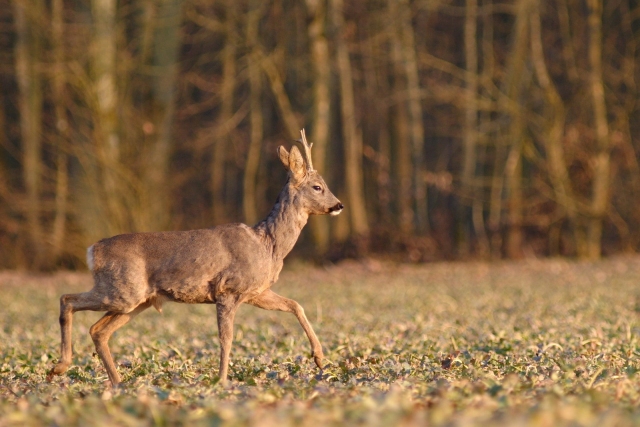
Adult roe deer have a body length of 93 to 140 cm and reach a shoulder height of between 54 and 84 cm. They weigh between 11 and 34 kg, depending on their nutritional status. Female roe deer do not wear antlers.
Due to several characteristics, the roe deer is classified as the so-called "Schlüpfertypus". Unlike the red deer, which escapes with a fast, persistent run when disturbed and is assigned to the "Läufertypus", the roe deer seeks cover in the thicket with a few quick jumps when disturbed. It has a slightly curved and forward sloping backbone, which makes the croup higher than the withers. The antlers of the ram are relatively small. The wedge-shaped body is adapted to silently weaving through dense vegetation. The legs are slender and long in relation to the rump, the hind legs are strongly bent at the hock.
The head is short in proportion to the body length, in profile it appears almost triangular. The ears are long oval and pointed and correspond in length to about two thirds of the length of the head. The neck is slender and longer than the head. The coat is shiny in summer on the upperparts and outerparts of the body, whereby the colouring can vary individually from a dark brown-red to a pale yellow. The inside of the legs and the underbelly are lighter and more yellowish. The region around the anus, called the mirror, stands out from the rest of the coat and is usually a yellowish white colour. Rams have a small white patch on the chin and on each side of the upper lip, and there is often a white patch above the nose. The ears of both sexes are brown-grey on the outside with a dark to black rim, whereas the inside of the ear is light grey to white. The transition from summer to winter coat takes place in September and October. At first it is inconspicuous because the red summer hair covers the growing grey winter hair for a long time. In contrast, the change of coat, which is visible to an observer, is very rapid and is completed within a week in healthy deer. In winter, the colour of the coat varies between light and dark grey. Even in winter coat, the underparts are lighter than the upper parts of the body. The change from winter to summer coat takes place in Central Europe in the period from March to April. The summer hair is first visible on the head, then on the withers.
The fawn's coat is reddish brown and initially has white spotting on the back and flanks. This white spotted pattern gradually becomes less distinct from the age of one month and disappears by the age of two months due to overgrowth by red summer hairs. Under the long red hairs, the white and brown fawn hairs are still present until the change into the winter coat.
Habitat
In the forest landscape of Europe, the roe deer inhabited forest clearings, forest edge zones as well as other habitats rich in undergrowth and with few trees, such as riparian areas, deltas and reeds that do not merge into forest landscapes. The forest areas that are now interspersed or surrounded by agricultural land offer the roe deer significantly more habitat. The population density here is 10 to 20 times higher than in forest areas whose tree population has a natural age structure. Optimal roe deer habitats consist of a tightly meshed mosaic of forestry and agricultural areas and feature thickets, old-growth woods, meadows, as well as tracks and roadsides overgrown with shrubs and herbs.
Regions with harsh winters and high, long-lasting snow cover are not very suitable for roe deer, as they have difficulty moving around and reaching food in high snow. In such regions, roe deer spend the winter in sometimes relatively small areas where less snow accumulates due to topographical features. Deer are also successful cultural successors that also colonise habitats that have been heavily modified by humans. Due to their relatively small size, even small forest remnants or hedges are sufficient cover for them. Accordingly, roe deer also colonise the open agricultural steppe.
The text is a translation of an excerpt from Wikipedia (https://de.wikipedia.org/wiki/Reh). On wikipedia the text is available under a „Creative Commons Attribution/Share Alike“ licence. Status: 23 September 2021
Fallow deer
Description
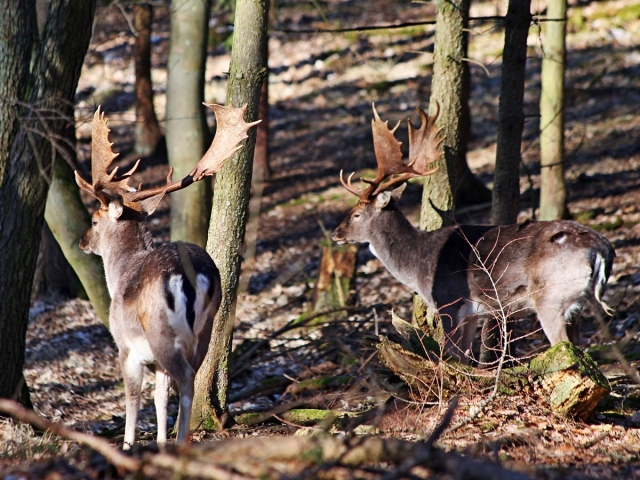
The fallow deer is significantly larger than the roe deer, but smaller and above all lighter than a red deer. The European subspecies has a snout-vent length of 120 to 140 cm, a scut (tail) about 20 cm long and a shoulder height of 80 to 100 cm. The weight of males usually varies between 53 and 90 kg, very heavy males can reach a weight of 110 kg in exceptional cases.
The colouration of the coat is seasonally and individually very variable. In normally coloured individuals, the summer coat is light rusty brown with conspicuous white patches. These rows of spots start almost at the rear edge of the thighs and extend over the sides of the rump and the back to the base of the neck. A dark dorsal stripe runs down the middle of the back, which in the European fallow deer continues to the tip of the tail. The dorsal stripe is bordered on both sides by a white spotted line on the back. A conspicuous horizontal, light-coloured line runs down the middle of the side of the body. The underparts of the belly and the legs are pale and self-coloured, the neck is self-coloured pale rusty brown. The so-called mirror (bright spot around the anus) is bordered by a black rim, so that with the dark tail a vivid pattern of the rear part is created. In winter, the fallow deer is brown-grey on the head, neck and ears, blackish on the back and sides, and ash-grey on the underpart. The spotting is then only vaguely visible.
Habitat
The fallow deer prefers sparse forests with extensive meadows, but is generally very adaptable, so that it can be found in almost all regions of Europe. Ideal fallow deer territories have a dense mosaic of woodlands and fields, with the forest predominantly composed of deciduous trees. The soil is rich in nutrients and produces lush shrub vegetation. The proportion of forest in the respective habitat does not have to be very large, because fallow deer need the forest primarily as cover, but not as a food source.
In Austria, fallow deer are almost exclusively found in enclosures, but can be encountered sporadically.
The text is a translation of an excerpt from Wikipedia (https://de.wikipedia.org/wiki/Damhirsch). On wikipedia the text is available under a „Creative Commons Attribution/Share Alike“ licence. Status: 23 September 2021
Red deer

Description
The red deer is one of the larger deer species, although there are sometimes considerable differences in body size between the subspecies. As a rule, the snou-vent lenght of males is 180 to 205 cm, that of females 165 to 180 cm, plus a tail 14 to 16 cm long in each case. Accordingly, the shoulder height is 105 to 130 and 95 to 115 cm respectively. The weight also varies considerably. The red deer has a broad chest, a relatively long, slender neck and a head that narrows towards the front. The tail is 10 to 27 cm long and narrows towards the tip. The red deer has medium-sized eyes (lights), pointed ears (eaves) half the length of the head and high slender feet (legs).
The colouring of the coat varies depending on the season, sex and age. Apart from the hairs on the mouth, all hairs are changed twice a year.
In Central Europe, the summer coat begins to grow in May to June. It has a reddish-brown hazel tone, characteristic of the red deer. In September to October, the majority of red deer change to a grey-yellow to grey-brown winter coat. In older deer, this change of coat can also begin as early as August. Compared to the summer coat, the winter coat is shaggier and has denser woolly hair under the awns. The calves' coat is reddish-brown with dense rows of white spots. These so-called calf spots are covered by regrowing hair during the summer months.
Many red deer have an dorsal stripe from the nape of the neck to the base of the tail. It is characteristic for all red deer that the back of the thigh is clearly different from the rest of the coat colour. The colouring of this so-called mirror is greyish white to yellowish white. The mirror is framed by blackish hairs and thus clearly set off from the rest of the back.
Habitat
Red deer prefer habitats with a close network of structure-rich forests, thickets and large open clearings. However, they can also survive well in primeval forest-like closed and scarce food forest areas or almost treeless countryside, such as in Scotland. Since the red deer occurs both in the cold high altitudes of the Alps, in the wet river floodplains of south-eastern Europe and in the hot and dry lowlands of Spain, it can be considered an adaptable species as far as its habitat requirements are concerned.
In Central Europe, the red deer's free choice of habitat is severely restricted due to dense human settlement. Since the red deer avoids humans, it is mainly found in forest biotopes here and concentrates there on the forest areas where it is least exposed to contact with humans. Known old long-distance crossings of red deer between red deer areas are not given any special protection. From a biological point of view, today's Central European red deer areas are island-like refuges. The exchange between the different red deer areas, which is necessary for the genetic diversity of the red deer population, is not guaranteed either by law or by spatial planning. There are also no migrations between winter and summer ranges, which were originally characteristic for this deer and played a major role for its food acquisition. In individual hunting grounds, this can lead to a high density of deer with corresponding damage to the forest.
The text is a translation of an excerpt from Wikipedia (https://de.wikipedia.org/wiki/Rothirsch). On wikipedia the text is available under a „Creative Commons Attribution/Share Alike“ licence. Status: 23 September 2021
Japanese deer
Description
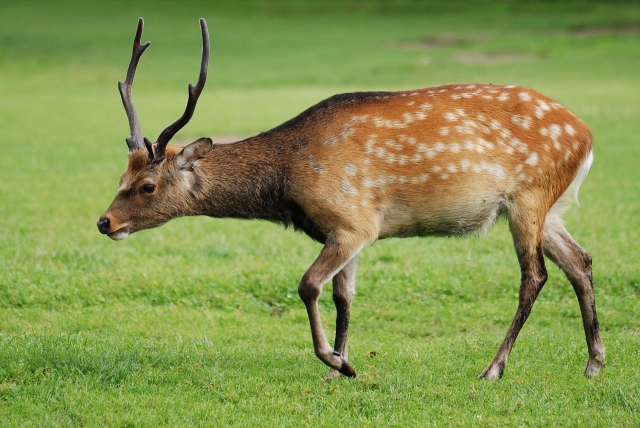
Japanese deer are significantly smaller than red deer and are roughly the same size as fallow deer. They reach a snout-vent lenght of between 95 and 140 cm in male specimens. The height at the withers/shoulder is 64 to 100 cm, the tail is 7.5 to 13 cm long. They weigh up to 80 kilograms.
The summer coat of the Japanese deer is usually reddish brown with numerous white spots arranged in seven to eight longitudinal rows. In winter, these spots fade and are sometimes hardly noticeable, while in summer they contrast markedly with the rest of the coat colour. Japanese deer usually wear their summer coat from the end of May. They show their winter coat from September onwards.
The back of the thigh is clearly different from the rest of the coat colour. This so-called mirror is whitish and framed by darker hairs. The end of the tail is also white, with a dark line running down the middle.
There is a possibility of confusion with the fallow deer, which also has a reddish-brown summer coat with a spotted pattern. However, the shade of red in the most common colour morph of the fallow deer is a rusty shade. Older fallow deer can be distinguished from male Japanese deer by their antlers, as fallow deer develop palms.
Habitat
Japanese deer are a very adaptable species of deer. They prefer forests with a dense undergrowth and are also found in wetlands.
The text is a translation of an excerpt from Wikipedia (https://de.wikipedia.org/wiki/Sikahirsch). On wikipedia the text is available under a „Creative Commons Attribution/Share Alike“ licence. Status: 19. October 2021
Alpine ibex
Description
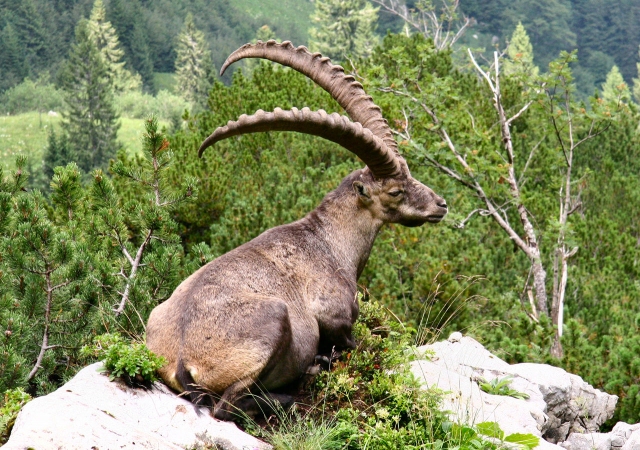
An alpine ibex has an average head length of 150 cm and a shoulder height of 90 cm. Does weight about 40 kg, whereas bucks can weigh over 100 kg. The buck has imposing, curved horns (up to 1 m long), while the doe has only short, barely curved horns. The bucks have a goatee. Bucks have a dark brown coat in summer; the females' coat is more reddish or golden brown. In winter, the fur of both sexes turns greyish.
Habitat
In the Alps, the ibex lives at the altitude between the forest and ice line. It climbs up to altitudes of 3500 m. In winter, however, it stays at lower altitudes than in summer, and even in summer it often descends to alpine meadows to feed, while it goes to the high altitudes to spend the night.
The text is a translation of an excerpt from Wikipedia (https://de.wikipedia.org/wiki/Alpensteinbock). On wikipedia the text is available under a „Creative Commons Attribution/Share Alike“ licence. Status: 19 October 2021
Chamois
Description
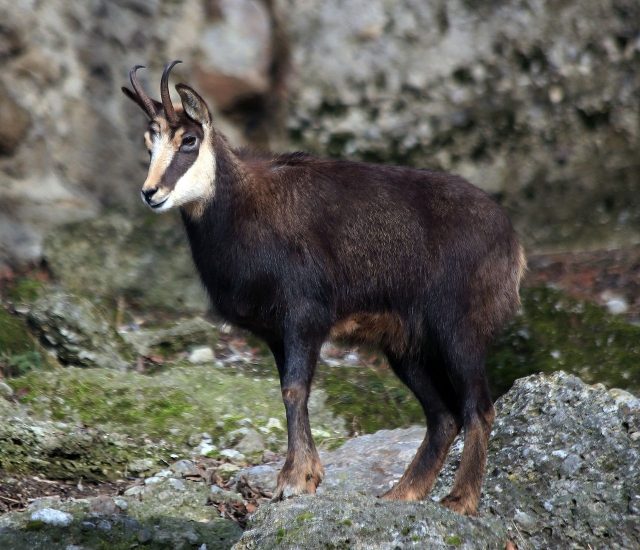
Adult chamois have a snout-vent length of 110 to 130 cm, a tail up to eight cm long, a height at the withers of 70 to 85 cm and a weight of 25 to 40 kg (females) or 35 to 50 kg (males). Chamois have a strong but stocky build. The slender neck carries a short head that narrows strongly towards the snout. Both sexes have horns, also called "Krucken" or "Krickel". These grow up to 25 cm long and are rounded. They are circularly notched at the root, straight upwards and curved backwards at the tip. Unlike the antlers of deer and roe deer, the horns are not shed in winter. The pointed ears of chamois are about half the length of the head.
The chamois has relatively long, strong legs with relatively large hooves.
In summer the chamois is a dirty reddish brown, pale reddish yellow on the underpart, with a blackish brown eel line on the back, pale yellow on the throat and whitish yellow on the neck. The back of the thighs is white, the tail black on the underpart and at the tip. A black longitudinal band runs from the ears over the eyes.
In winter the chamois is dark brown or brown-black above, white on the belly, yellowish white on the feet and head, and slightly darker on the crown and snout. Both coats blend imperceptibly into each other.
Habitat
The chamois depends on steep, if possible partly rocky terrain for its habitat. This is where its physical abilities come into their best play. For example, a comparatively large heart, a high proportion of oxygen-binding red blood cells and the special construction of the spreading hooves enable chamois to move safely and perform well under these conditions. The slope of the landscape is also used to stay in a suitable microclimate at all times, especially since temperatures as low as 12 degrees are considered rather unpleasant by the animals. Whether the terrain is forested is basically of no central importance. In the Alps, chamois tend to stay above the forest belt at altitudes between 1500 and 2500 m. The scarcity of food forces them to stay in the forest. Food shortages force them to descend to lower - forested - altitudes in winter.
The text is a translation of an excerpt from Wikipedia (https://de.wikipedia.org/wiki/Gämse). On wikipedia the text is available under a „Creative Commons Attribution/Share Alike“ licence. Status: 19 October 2021
Moufflon
Description
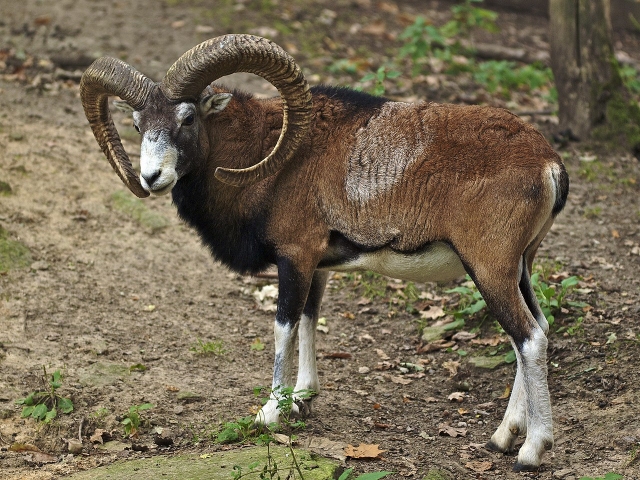
European moufflons have a body length of up to 120 cm, a shoulder height of 90 cm, a weight of 25 to 40 kg for sheep, 35 to 55 kg for rams. The European moufflon has a smooth coat, the rams are chestnut brown in summer, usually with a whitish saddleback, the sheeps are brownish. In winter both sexes are darker. The rams have snail-shaped horns up to 80 cm long.
Habitat
In Central Europe, European moufflons live in deciduous and mixed forest areas both in the lowlands and in the low mountain ranges, also preferring dry and stony soils.
The text is a translation of an excerpt from Wikipedia (https://de.wikipedia.org/wiki/Europäischer_Mufflon). On wikipedia the text is available under a „Creative Commons Attribution/Share Alike“ licence. Status: 19 October 2021
White wagtail
Description
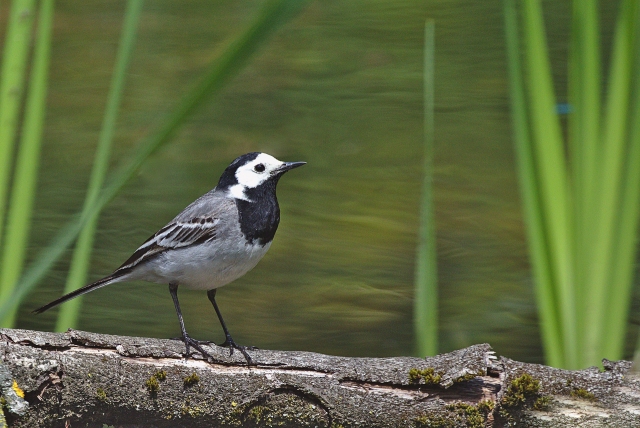
The white wagtail is a slender, rather high-legged songbird with a long tail that is constantly in bobbing motion. The tail accounts for about 9 cm of the 16.5-19 cm body length. The weight is about 25 g. The beak, like the legs and feet, is black, and in basic plumage it has a horn-coloured base.
nuptial plumage
In nuptial plumage, the male's forehead is white except for the middle part of the crown, as is a section behind the eye and the sides of the head and neck. The back of the head and neck are shiny black, as are the chin, throat and forechest, and are usually cleanly contrasted with the white parts of the face and the grey back. The rump is slate to black-grey as are the uppertail coverts, of which the lateral ones on the outer vane are fringed with white. The grey of the shoulder feathers blends into the pure white of the underparts on the breast sides and flanks. The undertail coverts are also white. The tail is glossy black and, as the two outer pairs of feathers are black only at the base and inner vane, shows broad white outer edges, which are particularly noticeable when the bird flies up. In addition, the middle pair of tail feathers is narrowly fringed with white. The wing feathers are blackish brown with white to light grey fringes. The primaries are finely fringed with white, as are the primary coverts and the wing feathers. On the secondaries the outer edges become broader towards the tertials and take up a large part of the outer vane on the latter. Here they are dirty white to light grey. The greater coverts are similarly fringed, the inner ones bearing an extended white, stepped tip. The middle coverts show a broad lace fringe. The underwing coverts are dirty white.
The nuptial dress of the female is similar to that of the male, but the white parts of the face are usually not so distinct from the black and are partly greyish mottled. The black colouring of the nape blends into the grey of the back and is not sharply defined as in the male. In addition, the wing plumage is usually not as contrastingly brightly fringed as in the male. In some females the head markings may be as or similar to those of the male.
basic plumage
The basic plumage of adult birds lack the black areas on the head. They are limited to a crescent-shaped band on the breast and a partly distinct cheek patch. The forehead is dirty white to grey. The head, neck, ear coverts and cheeks are grey. The facial area may have a yellowish tinge. The rest of the plumage corresponds to the nuptial plumage. The male differs from the female only in the darker crown interspersed with black feathers.
juvenile plumage
In juvenile plumage the upperparts are predominantly grey, the back a little lighter, the top of the head and the nape of the neck a little brownish. On top behind the eye there is an over-eye stripe, which like the sides of the neck, the chin and the throat are dirty white. The ear coverts are dark dirty yellow. A crescent-shaped chest band as well as a chin stripe emanating from it are brown-black to yellow-brown. The sides of the breast are grey, the underparts white. Wing and tail plumage resemble adult plumage, but fade quickly and then show little contrast between centres and fringes.
Habitat
The white wagtail inhabits semi-open and open landscapes and is found practically everywhere except in closed forest areas and densely built-up urban centres. Important here are unvegetated or short-grassed ground areas, which are needed for foraging, and the same surrounding, higher structures such as buildings or groups of trees, which have suitable niches for nesting. Preference is given to sites near water bodies - the primary habitat probably consists of muddy, sandy, gravelly or stony banks, as they occur especially in large riverine landscapes. Today, the cultural landscape offers corresponding areas on a large scale, such as pastures, fields, farm roads, asphalted areas, construction and gravel pits or open fallow and ruderal areas. The white wagtail is therefore particularly common in the vicinity of farming villages, where there is also an abundant supply of nesting opportunities. In the mountains, the species can still be found a good distance above the tree line at altitudes of up to 3000 metres.
Outside the breeding season, white wagtails can be found mainly at water bodies of all kinds, but also on ploughed fields. Communal roosting sites are usually on water surfaces in reeds or willow scrub, but also in other sheltered places. Especially birds wintering in more northerly latitudes like to seek out brightly lit places in urban and residential areas at night, which have a warmer microclimate.
The text is a translation of an excerpt from Wikipedia (https://de.wikipedia.org/wiki/Bachstelze). On wikipedia the text is available under a „Creative Commons Attribution/Share Alike“ licence. Status: 19 October 2021
