


Florian Heigl
European robin
Description
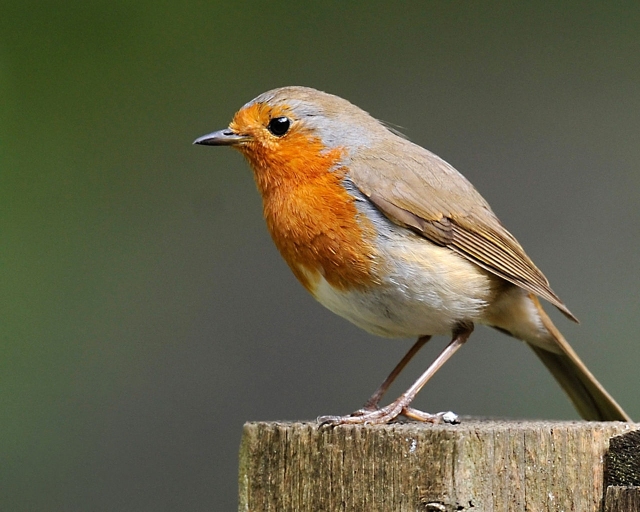
The European robin is roundish in shape with long, thin legs. The orange-red throat, forehead and forechest are easy to recognise and allow easy identification. Feet and iris are dark brown, the beak is black-grey to brown-black. There are three to four beard bristles above each corner of the beak. The size is about 13.5 to 14 cm. The wingspan is 20 to 22 cm and the body weight is usually 15 to 18 grams.
Merkmale ??
The orange-red colouration of adult birds extends from the forehead and throat to the forechest and also includes the sides of the head and neck, the patch being most pronounced on the breast. On the forehead the orange colouration is less distinct and fringed with ash-grey. The upperparts are olive-brown, but in spring it turns greyish due to wear of the outer feather fringes. The white underparts are bordered by the light olive-brown sides of the body. While the uppertail coverts are yellowish brown, the undertail coverts are cream coloured. The tail feathers are dark brown with a yellow-grey outer vane fringe. Primary and greater coverts are large with rusty brown tips. The underwing coverts are greyish white to light brown in colour.
Habitat
The European robin is native to riparian forests, deciduous, mixed and coniferous forests, provided the shrub layer is not too dense and there is a rich ground fauna. It can also be found in bushes, hedges and undergrowth. It often lives in an area close to water. The European robin prefers shady and relatively humid areas to dry and hot areas. In the mountains it can be found up to 2600 m altitude. Its habitat also includes parks, cemeteries, copses and gardens.
The text is a translation of an excerpt from Wikipedia (https://de.wikipedia.org/wiki/Rotkehlchen). On wikipedia the text is available under a „Creative Commons Attribution/Share Alike“ licence. Status: 17 November 2021
Marsh tit
Description
With a body length of 11.5 to 13 cm, the marsh tit is intermediate in size between the great tit and the blue tit.
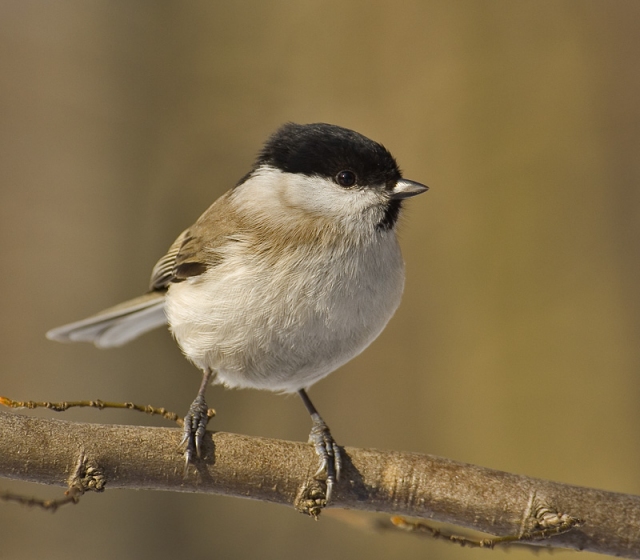
The beak is blackish with lightened edges (possibly in contrast to the willow tit). The iris is dark to blackish brown. The glossy black head cap on adults extends over the forehead and crown, down to the middle of the eye and back into the nape. This contrasts with the white cheeks and ear coverts. The sides of the neck are brownish white. The chin and middle of the throat are black, with some of the feathers finely tipped with white. The upperparts are brown-grey, but often slightly lighter and warmer beige on the rump. The dirty white underparts are pale beige, especially towards the flanks and undertail coverts. The dark brown-grey primaries and secondaries are narrowly brown on the outer vane and fringed with white on the inner vane. The primary coverts are also dark brown-grey, the tertials dull brown-grey. Axle feathers and underwing coverts are white with a beige tinge. The tail feathers are dark brown with an olive-brown fringe on the outer vane; the outer fringe of the outer ones is lightened to whitish. Legs and feet are bluish grey to slaty.
Birds in juvenile plumage are recognisable by their dull sooty-black cap, brown-black throat patch, greyer upperparts and whiter, barely beige underparts.
The marsh tit is very similar to the willow tit. The best way to tell them apart is by their calls and song, but with a little practice they can also be distinguished by their external features. In the willow tit the head is a dull sooty black and the white fringes of the secondaries form a light field on the folded wing. Often the throat patch is much narrower in the Marsh Tit and the cheeks are less pure white. The marsh tit also appears more small-headed and round-headed overall. Other distinguishing features can vary greatly geographically. In Central Europe, the differences are slight. Here, willow tits are more conspicuous for their warm beige flanks, while marsh tits appear more "colourless".
Habitat
The marsh tit prefers deciduous forests or mixed deciduous forests rich in variety and borderlines, with a large stock of old wood, sufficient deadwood and sparse undergrowth. In Central Europe, it typically occurs in mixed forests of oak and beech, but also in floodplain and marsh forests, field copses, orchards, parks, larger gardens with old trees or cemeteries. In pure coniferous or beech forests it is usually found only rarely or in marginal areas.
The name "marsh tit" is misleading, as it is by no means bound to marshy habitats. Although it reaches high settlement densities in wet forests, it avoids sites that are too wet, as well as those that are too dry or nutrient-poor. While the willow tit is usually more common in the wooded and semi-open landscapes of the floodplains, the marsh tit predominates in the closed woodland forms of the lowlands and hill country. In contrast to the willow tit, it can sometimes be found in suitable habitats within cities.
Outside the breeding season, the species is less choosy about habitats. It can often be found in coniferous woods or hedgerows in the more open countryside. It also often visits feeding sites near the edge of forests.
The text is a translation of an excerpt from Wikipedia (https://de.wikipedia.org/wiki/Sumpfmeise). On wikipedia the text is available under a „Creative Commons Attribution/Share Alike“ licence. Status: 17 November 2021
Coal tit
Description
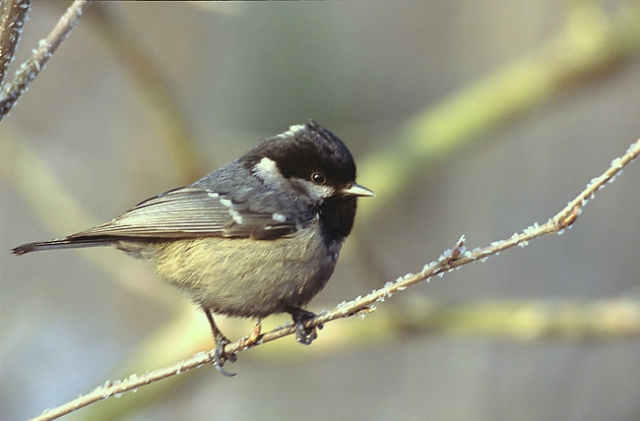
The coal tit is about 11 cm long and weighs between 8 and 10 grams. It has a black crest with a characteristic white patch on the nape of the neck, which stands out as a white longitudinal stripe against the rest of the black plumage on the nape. It has white or whitish cheeks and a black chin patch. The underpart is yellowish to whitish with cream-coloured flanks. The upperparts are bluish grey to olive grey with a narrow double white wing band.
Habitat
The preferred habitat is coniferous forest. In mixed forests they seek out the conifers. In southern Europe, coal tits are also found in deciduous forests; in western Europe they also colonise gardens. As a result of high offspring sizes, the species tends to move into unpopulated areas. In its vast transpalearctic range, which stretches from the Atlantic coast across Eurasia to the Pacific coast, the coal tit is a common breeding bird. In Central Europe, it is found in coniferous and mixed forests from the lowlands to the tree line.
The text is a translation of an excerpt from Wikipedia (https://de.wikipedia.org/wiki/Tannenmeise). On wikipedia the text is available under a „Creative Commons Attribution/Share Alike“ licence. Status: 19 November 2021
Marsh warbler
Description
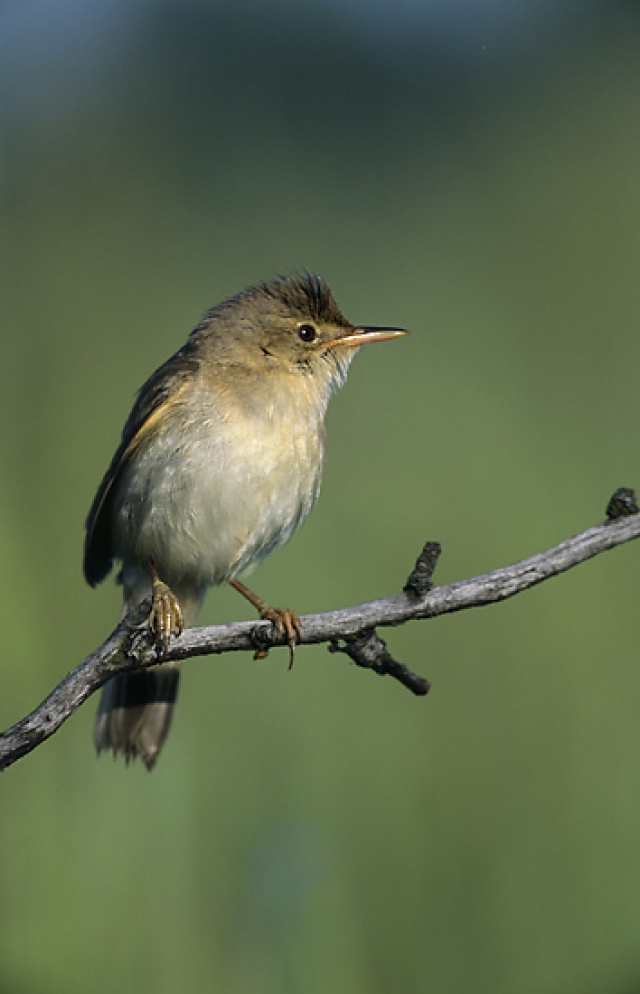
The marsh warbler is about 13 cm long and has a wingspan of 17 to 21 cm. The weight is about 11 to 14 grams. The upperparts are greyish brown, the underparts are yellowish white. The small bird has a whitish throat and a pointed beak. Males and females have the same colouring. The marsh warbler moves skilfully in dense vegetation and imitates the calls and songs of other bird species, which it mixes with typical reed warbler phrases. It can often be heard in late twilight and at night.
Habitat
The marsh warbler lives in dense reeds, bushes and crop fields near water bodies.
The text is a translation of an excerpt from Wikipedia (https://de.wikipedia.org/wiki/Sumpfrohrsänger). On wikipedia the text is available under a „Creative Commons Attribution/Share Alike“ licence. Status: 22 November 2021
Eurasian tree pipit
Description
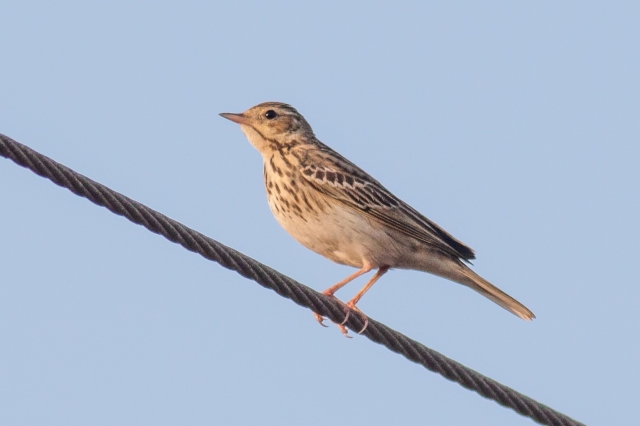
With an average body length of 15 cm, the Eurasian tree pipit is about the same size as a house sparrow. However, it is more delicate and slender than the latter and thus appears visually larger. The wing length of male birds averages just under 90 mm, while the wings of females are about four to five mm shorter.
The body weight of the Eurasian tree pipit during the breeding period is about 22 to 24 grams. At the beginning of the autumn migration, the birds are regularly heavier; particularly well-fed birds can then weigh over 30 grams. Eurasian tree pipits on their return flight from their wintering grounds in Africa have occasionally been found to weigh as little as 16 grams.
The plumage does not differ between the sexes. The upperparts are yellowish to olive brown with diffuse blackish longitudinal stripes, which are more pronounced on the upper part of the head. The rump and uppertail coverts are slightly greener than the rest of the upperparts and are only faintly streaked in some individuals. The underparts are cream to yellowish with a strong streak on the breast and crop sides. The throat, breast and sides of the neck are more yellow. The stripes on the flanks are clearly less broad than on the breast. The outer feathers are partially white. The wing coverts are lightly fringed, forming two light, cream-coloured wing bands. The fringes formed by the tip fringes of the middle arm coverts are the most distinct. The tail overhangs the wing tips by about 3.5 cm.
Above the eye is a pale supercilium, not always clearly visible. The iris is dark brown, the eye ring formed by two rows of feathers is cream-coloured. The nostrils are exposed. The upper side of the beak and the tip of the lower bill are blackish brown. The rest of the lower beak becomes lighter towards the root and the lower chin and is yellowish to flesh coloured. The legs are reddish flesh-coloured, while the feet are pinkish to yellowish flesh-coloured. The talons are pale horn-coloured.
Species-specific to the Eurasian tree pipit is a strongly curved hind talon, which can be between 6.6 and 8.6 mm long. Compared to the hind toe, it is either shorter or at most the same length. In larks as well as in the other members of the peepers, the hind toe is longer and less curved.
possible confusion with other bird species
The meadow pipit is so similar to the Eurasian tree pipit that its flight and way of life, as well as its song, must be used for identification - in addition to a few minor distinguishing features in body structure and plumage colouration. The characteristic features of the Eurasian tree pipit, described above, can only be used for identification in the field under very good observation conditions. In contrast to the more delicate meadow pipit, the Eurasian tree pipit has a stronger beak and a more yellowish breast.
The woodlark, which can also be observed in the habitat of the Eurasian tree pipit and has a similar plumage colouration to the Eurasian tree pipit, can be distinguished from it by its much shorter tail and its more prominent and lighter cream-coloured supercilium.
Habitat
As a ground-breeding bird, the Eurasian tree pipit needs a habitat during its breeding period which, in addition to a stand of tall trees or shrubs, has enough open spaces with a sufficiently dense herb layer. Accordingly, Eurasian tree pipits are absent from extensive arable landscapes or grassland areas. The bird is not tied to a particular tree species. It occurs in coniferous forests as well as in deciduous or mixed deciduous forests.
In addition to scattered, sunny forest edges, clear-cuts, afforestation areas and forest clearings as the most important breeding habitats, Eurasian tree pipits also use heaths, vineyards and moors, provided they have sufficient tree cover and a dense herb layer. Sun-exposed sites are preferred. They are rarely seen in cemeteries, orchards or parks because the herb layer is usually not dense enough.
The altitudinal distribution of the Eurasian tree pipit is also influenced by the presence of herbaceous or dwarf shrub layers. It regularly occurs up to the tree line. In the Alps, it breeds up to an altitude of 2300 m, and in Austria the bird's main distribution is even in the montane zone of the Alps.
The text is a translation of an excerpt from Wikipedia (https://de.wikipedia.org/wiki/Baumpieper). On wikipedia the text is available under a „Creative Commons Attribution/Share Alike“ licence. Status: 22 November 2021
Willow warbler
Description
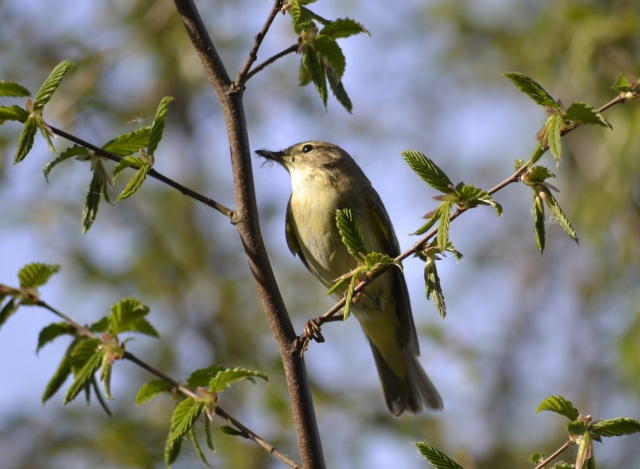
The willow warbler is about eleven to thirteen cm long and has a wingspan of 17 to 22 cm. The weight is about eight to eleven grams. It is difficult to distinguish in appearance from the common chiffchaff (Phylloscopus collybita). Its upperparts are green to olive-brown, its underparts yellowish-white. The small bird has a yellowish throat, breast and over-eye streak. Males and females have the same colouration.
A willow warbler can live up to twelve years.
difference to the common chiffchaff
In Central Europe, the willow warbler is easily confused with the very similar and also common common chiffchaff; they are sibling species. The willow warbler is somewhat more slender and long-winged than the common chiffchaff. The legs of the willow warbler are usually much lighter, the supercilium is longer and more pronounced, especially behind the eye. The primaries projection, i.e. the projection of the primaries over the tertials, is much larger in the willow warbler. Furthermore, in the common chiffchaff the fifth primary has a narrowing on the inside of the outer vane, which is absent in the willow warbler. However, this distinctive feature can only be recognised if the birds are held in the hand.
Habitat
The long-distance migrant is present in almost all of Central and Northern Europe from April to September. The willow warbler lives in sparse deciduous and mixed forests, parks, wetlands, shrublands and gardens.
The text is a translation of an excerpt from Wikipedia (https://de.wikipedia.org/wiki/Fitis). On wikipedia the text is available under a „Creative Commons Attribution/Share Alike“ licence. Status: 22 November 2021
Yellow bunting
Description
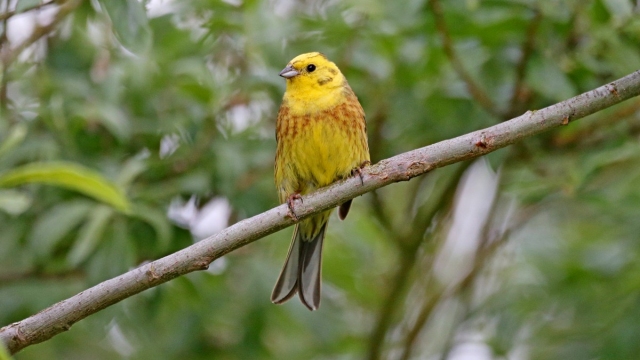
The yellow bunting reaches a body length of 16 to 17 cm and weighs 25 to 30 grams. During the breeding season, the males wear a yellow nuptial dress with a bright yellow head with a few brownish stripes, a yellow underpart with a reddish breast and brownish-grey wing coverts. The upperparts are brown with darker longitudinal stripes, the rump is cinnamon brown. The tail is dark, in flight the white outer edge is noticeable. Females are more inconspicuous greenish brown, but still with yellow tendencies on the throat and underparts. In plain dress, the males resemble the females.
The yellow bunting can be distinguished from the similar-looking cirl bunting by its cinnamon-brown rump.
Habitat
Yellow buntings live in open cultivated landscape with copses, hedges and bushes. In winter, they move around in large mixed troops and search for remaining seeds in fields.
The text is a translation of an excerpt from Wikipedia (https://de.wikipedia.org/wiki/Goldammer). On wikipedia the text is available under a „Creative Commons Attribution/Share Alike“ licence. Status: 22 November 2021
Lesser whitethroat
Description
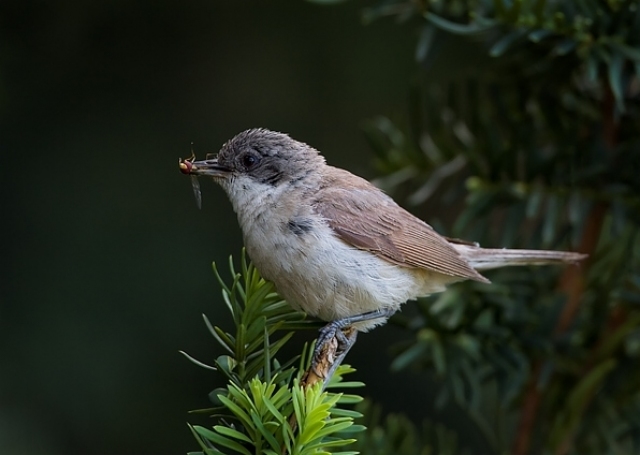
The lesser whitethroat is 11.5 to 13.5 cm in length and weighs 12 to 16 grams. The upperparts are grey-brown, the crown and the relatively short tail are greyer, the underparts are white. The flanks are slightly tinged with light brown. The throat is whitish, the head is grey and the legs dark. The iris is dark, the lower eyelid is light. The grey, demarcated ear covers are the most reliable identification mark. Males and females have the same colouration. A lesser whitethroat can live up to eleven years.
Habitat
The lesser whitethroat lives in gardens, parks, mountains and open woodland areas.
The text is a translation of an excerpt from Wikipedia (https://de.wikipedia.org/wiki/Klappergrasmücke). On wikipedia the text is available under a „Creative Commons Attribution/Share Alike“ licence. Status: 22 November 2021
Eurasian blackcap
Description
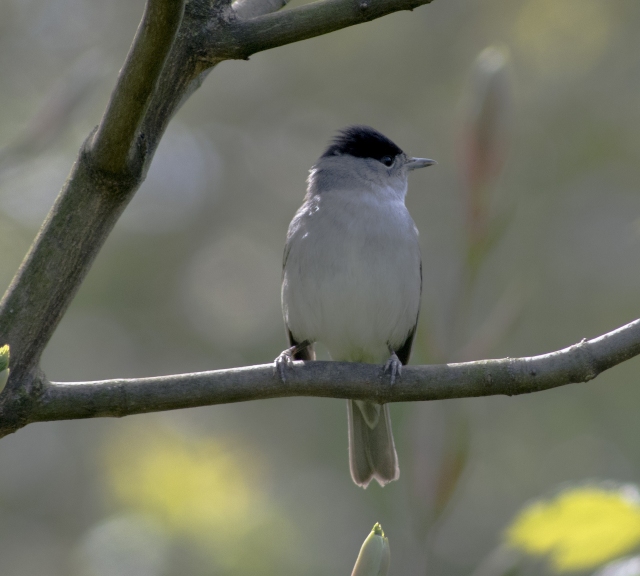
The Eurasian blackcap is 13.5 to 15 cm long and has a wingspan of 20 to 23 cm. It weighs between 15 and 22 grams.
The upperparts are dark grey, the underparts olive grey. The throat and undertail coverts are pale, the iris always black. The tail is always dark, lighter at the base and without white. The flanks are slightly brownish, more so in females and young than in males. The beak and legs are grey.
The black feather cap is characteristic of the males. The scientific species name "atricapilla" (Latin for "blackhead") and the common name Schwarzplattl, which is widespread in Austria and Bavaria, refer to this. Females and young birds have a reddish-brown cap. Males in their first winter have a brown, black or a mixture of both colours.
Habitat
In Central Europe, the Eurasian blackcap is distributed almost everywhere, with the exception of treeless and shrubless areas and the high mountains from about 1500 metres above sea level, with the highest densities in riparian forests, damp mixed forests and shady parks. Treeless shrub stands are avoided. Outside the breeding season it usually stays in bushes that bear many berries, then also in open countryside. In the wintering area it is very versatile in its choice of habitat. The blackcap also breeds in the middle of large cities in bushy and tree-covered gardens and parks. In its choice of breeding territory, the blackcap is the most versatile warbler in Central Europe. It prefers semi-shady places to dry, open and sunny areas. It prefers deciduous woodland to coniferous woodland, but may locally occur more in evergreen vegetation, such as ivy or laurel woodland.
The text is a translation of an excerpt from Wikipedia (https://de.wikipedia.org/wiki/Mönchsgrasmücke). On wikipedia the text is available under a „Creative Commons Attribution/Share Alike“ licence. Status: 01 December 2021
Red-backed shrike
Description
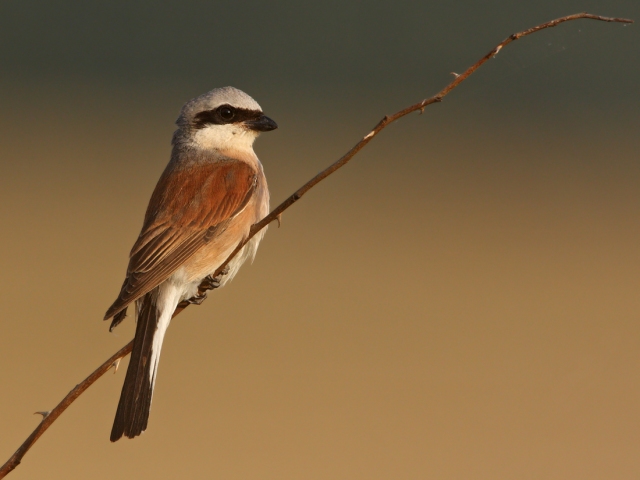
With a length of 16-18 cm, the red-backed shrike is the smallest Central European shrike species. Males and females differ clearly in colouration.
The wing length averages 93 (91-95) mm, in the male it is between 88 and 100 mm, in the female between 82 and 98 mm. The length of the tail is between 71 and 90 mm in the male, and between 68 and 85 mm in the female. The average weight of the male is about 28 grams. In females it can increase to 32.8 grams during the breeding season and is about 28.5 grams outside the breeding season. Before migration, fat deposits can be formed and the weight increased to a maximum of 37 grams. However, this does not seem to be the rule.
Male
The male has a rusty brown to chestnut brown back and shoulder plumage, as indicated by the name " red-backed shrike". The top of the head and the nape of the neck stand out clearly with their light blue-grey. Like other Lanius species, red-backed shrikes have a narrow, black facial mask in which the dark eye, seen from a distance, often disappears almost completely. The mask is sometimes bordered from the grey top of the head by an indistinct, blurred white supercilium, which is often slightly more pronounced behind the eye. The wing coverts are reddish brown with distinctly lighter and redder margins; the primaries are chestnut brown with lighter margins and the seccondaries unmargined dark brown. In rare cases there is a white patch. This is formed by a more or less pronounced white pattern at the base of the primaries The rump is - partly up to the lower back - grey. The tail shows a contrasting black and white, spoon-shaped pattern: the middle tail feathers are mostly black, followed by feathers with a lot of white in the upper area, which increases towards the outer tail feathers. The control feathers are narrowly white fringed at the tips. The underparts are mostly whitish to cream, often the flanks and breast are slightly tinged with salmon to pink.
Female
In contrast to the male, the female does not have a grey upper head. The female's entire upperparts are a solid reddish brown, usually slightly less vivid than the male. The facial mask is more indistinct, usually dark brown to blackish, the eye stands out more clearly from it. The light supercilium is more prominent. The tail is mostly brown with white edges. The underparts are cream to beige in colour and show dark scales on the chest and flanks, some only hinting at them and some with strong scales ("sparrowhawk"). This is sometimes also very pale on the back. With age, the scales may fade, and the female's colouring becomes more and more similar to that of the male.
Lebensraum
The red-backed shrike inhabits well-managed, sunny terrain with open areas of low or sparse vegetation (e.g. shrubberies, meadows, dry grasslands) alternating with scattered hedgerows or copses with less than 50 percent cover. It needs one to three metre high shrubs as roosts for hunting and territorial observation and as nest sites. Briars such as sloes, hawthorns or hedge roses are preferred, but they do not have to be present in large numbers under otherwise favourable conditions.
Accordingly, the red-backed shrike likes to colonise grassland and pastureland rich in hedges, wet fallows, partially drained moors with dam cultures, orchards as well as clearings, windthrow and clear-cut areas or young plantations within forests. In natural regions, forest edges or clearings, especially moist sites, e.g. fringes of alder swamps or willow forests, are of particular importance.
These habitat requirements are predestined for the red-backed shrike in extensively used cultural landscapes - i.e. small-scale habitats divided by hedges and copses and characterised by extensive pasture farming.
Today, the red-backed shrike can often only be found in suitable marginal areas of the cultivated landscape, for example on fallow, scrubby areas, on clear-cut areas and young plantations, even within closed forests, at landfills, gravel pits or motorway embankments and railway embankments.
The text is a translation of an excerpt from Wikipedia (https://de.wikipedia.org/wiki/Neuntöter). On wikipedia the text is available under a „Creative Commons Attribution/Share Alike“ licence. Status: 01 December 2021
