


Florian Heigl
Common buzzard
Description
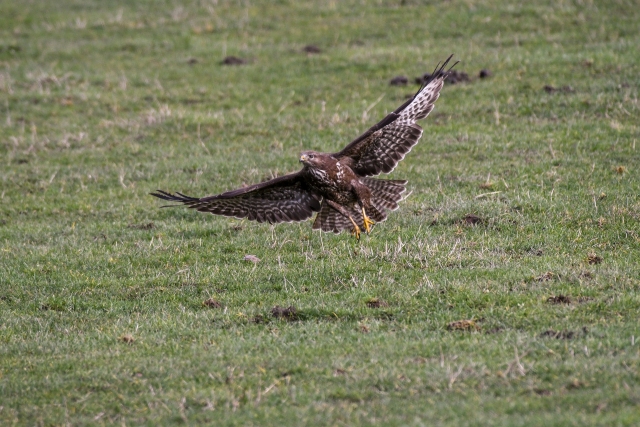
The common buzzard is a medium-sized, compact bird of prey. It is 51 to 57 centimeters long and has a 113 to 128 centimeter wingspan. The wings are relatively broad, and the relatively short tail is rounded at the end. During circling gliding the wings are set up in a flat v-shape. The tips of the primaries are always dark, and the tail is usually narrowly banded all over. The crop area (breast band) is mostly longitudinally striped, rarely solid white to blackish brown, and usually dark even when the underside is otherwise light. The often brighter breast band is darkly longitudinally striped in young birds and transversely banded in adults. The undertail coverts are solid, spotted or banded. The feathers on the lower legs, the so-called pants, are plain, banded or longitudinally striped. The latter two feather parts may be lighter on dark underparts and darker on light underparts. The tail is the surest feature to distinguish the nominate form of the common buzzard from its subspecies and from the rough-legged buzzard. In the nominate form of the common buzzard, the tail feathers are gray, brown, or rusty red with eight to twelve dark cross bands. Further coloration and markings are highly variable.
The nominate form of the common buzzard occurs in very different colorations from almost completely white to almost completely blackish brown in numerous transitions, which is unique in the avifauna of Central Europe, except for the even more variable ruff. Light, intermediate, and dark morphs can be distinguished. The darkest morphs are almost entirely clay-colored to blackish brown, juveniles (from fledging to first molt) with longitudinal stripes on the underside, sometimes extending over the crop. Old birds may have transverse stripes on the underside extending to the darker crop area. The fully banded tail is brown or gray. Intermediate morphs have less distinct markings on the whitish to pale yellowish underside, sometimes without the typical breast bib on the lower part of the crop. The tail is sometimes incompletely banded. The lightest morphs with whitish-pale yellow underparts and dorsum have distinctly less to nearly absent wing and tail banding. Pale yellow individuals often have ochre brown and gray mottling on the back, which is why they look " multicolored."
The horn-colored talons are lighter or darker in all morphs according to the plumage coloration. The beak is black and lighter toward the head. The unplumaged parts of the body (feet and wax skins) are pale pink in newly hatched juveniles and yellow in adults. The iris is variable in coloration from gray, gray-brown to gray, rarely lighter or yellowish and is related to the general plumage coloration.
Habitat
The common buzzard inhabits mainly small wooded areas with adjacent open landscapes, where it forages almost exclusively. In the vicinity of the forest, it prefers pastures, meadows, heath and wetlands or vegetation kept short by humans. Breeding at altitudes above 1000 meters above sea level is rare. Common buzzards are often seen perched on posts along highways as they scan these and other routes while hunting. Forest edges of smaller old-growth stands are preferred for nesting, and the inner parts of closed forests or narrow border strips between fields or individual trees are rarely colonized. Increasing colonization of landscapes with few trees was observed on control plots near Potsdam and in the west of Schleswig-Holstein in Germany. A high proportion of broods was also found in rows of poplars, but also on single trees and in small copses at a distance of less than a hundred meters from individual farmsteads. These new colonizations were already described as not rare before. There are successful broods in direct proximity to houses in the settlement area.
As a synanthropic bird, the common buzzard has also settled the city centers. Here it prefers cemeteries or parks as eyrie sites, sometimes also in the immediate vicinity of residential areas.
The text is a translation of an excerpt from Wikipedia (https://de.wikipedia.org/wiki/Mäusebussard). On wikipedia the text is available under a „Creative Commons Attribution/Share Alike“licence. Status: 17 December 2021
Carrion crow/hooded crow
Description
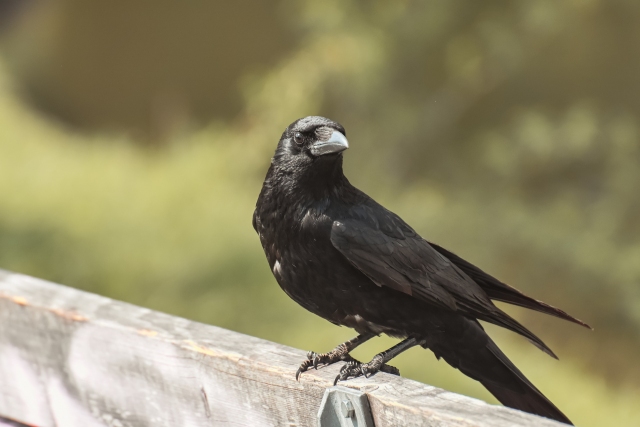
Carrion crows achieve a body length of 45 to 47 cm and a wingspan of 93 to 104 cm when fully grown. Their elevated, slightly curved and robust beak, their short, close-fitting thigh feathers and voluminous body plumage give them a compact, stocky appearance. Their wings are relatively long and moderately digitted, and their tails are broad and slightly rounded. The wing tips extend just beyond the tip of the tail when appressed.
The species occurs in a completely black and a black and gray plumage morph. Mixed forms of different characteristics may also occur. The black morph (C. corone corone) is characterized in fresh plumage by a dull, metallic sheen that ranges between green and blue and is less pronounced than in rooks (C. frugilegus) or ravens (C. corax), for example. The bases of the breast and belly feathers are light gray. With increasing time, the plumage loses saturation and luster and turns slightly brownish, especially on the wing feathers. The black and gray morph, called the hooded crow, matches the carrion crow in colouration of the head, central breast, tail, and wings. The nape, back, and shoulder coverts, on the other hand, are ash-gray to white, as are the small uppertail coverts, lateral breast, belly, and lower tail coverts. The thighs of hooded crows are feathered black, but are often covered by a grayish veil. Birds from the Mediterranean region show distinct black feather shafts in the white plumage areas.
The legs and the beak are slate-coloured in both morphs, and the iris of adult birds is dark brown. Juvenile carrion crows are distinguished from adults by their less voluminous plumage and somewhat slimmer silhouette. In addition, the colours of the plumage are tinted brownish, and in young hooded crows the black breast patch is also less pronounced than in adults.
Habitat
Open and semi-open landscapes characterize the preferred habitats of carrion crows. The birds depend on trees, tall shrubs, or comparable anthropogenic structures as roosting, nesting, and perching sites. Regionally, rock cliffs may also serve this function. For foraging, they use wide-open, short-grass areas that are easy to survey, so both elements must occur in some proximity to each other. In forested areas, the species is therefore restricted to riparian areas, bogs and clearings; the deforestation of large parts of Eurasia in the Holocene, on the other hand, opened up new habitats for it, such as arable and pasture land, villages and cities. The revegetation of large European cities through parks and avenues allowed it to enter their centers from the 19th century onward. However, modern urbanization was initially slow for the carrion crow in Europe. Only with increasing prosperity and widespread availability of human waste in the second half of the 20th century were they able to establish themselves in larger numbers in cities. In the meantime, they usually occur there in higher population densities than in rural areas because of better food availability and less pressure from hunting and predators. The carrion crow inhabits a variety of very different habitats, but is generally absent from dense forests and steep slopes. An important locational factor is territories of goshawks, where carrion crows usually cannot breed successfully. The species occurs from sea level up to about 750 m, in some high mountains such as the Alps it can also be found at altitudes above 1000 m, sometimes even up to 2000 m.
The text is a translation of an excerpt from Wikipedia (https://de.wikipedia.org/wiki/Aaskrähe). On wikipedia the text is available under a „Creative Commons Attribution/Share Alike“licence. Status: 17 December 2021
Wood pigeon
Description
Woodpigeons are large, robustly built pigeons with relatively long tails and rather small heads. With a body length of 38-43 cm and a wingspan of 68-77 cm, they are the largest pigeons in Central Europe. Sexual dimorphism is weak in terms of size and weight, males are slightly larger and heavier than females.
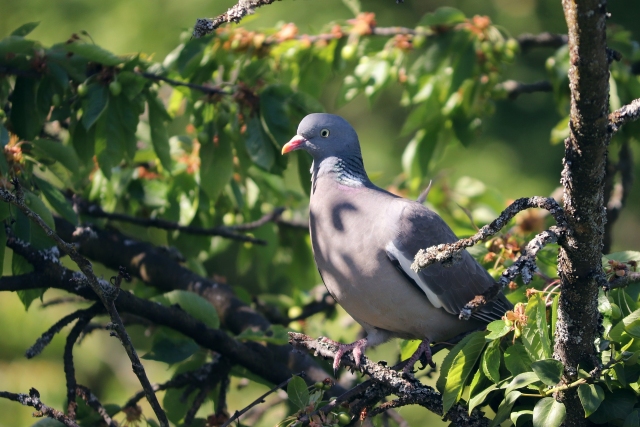
In adult woodpigeons, the anterior dorsum and shoulder area are slate gray to grayish brown, the rest of the rump is blue-gray on top. The crop area and breast are diffusely grayish wine-red, becoming lighter toward the belly and very light gray in front of the undertail coverts. The head is blue-gray. On the sides of the neck and nape there is a green metallic shimmering band from top to bottom, then a white patch on the sides of the neck only, and then again on the sides of the neck and nape a shiny purple band. The inner secondary coverts, the large primary coverts, and the alula are slate gray. The outer vanes of the outer secondary coverts are predominantly white and the outermost secondary coverts are completely white; this creates a striking white band on the upper wing. The primaries are blackish gray, the outer vanes of the 1st to 9th primaries have a narrow, sharply defined white fringe, this fringe is only diffusely defined on the 10th (outermost) primaries. The secondaries are predominantly ash-gray. The rectrix are broad blue-gray at the base above, followed by a diffuse light gray subterminal band and a broad black terminal band.
The beak is pink to red at the base, orange to yellowish at the end with a horn-coloured tip. The fleshy membrane over the nostrils is white. The legs and toes are light to dark red. The iris is light yellow.
The sexes are very similar externally. Females show less red on the chest and the white spots on the sides of the neck are slightly smaller.
Habitat
Woodpigeons inhabit wooded landscapes of all kinds; if necessary, single trees or bushes are sufficient for a settlement. If these are also missing, the animals breed e.g. in dunes, on beach meadows or in grain fields also on the ground. Breeding in populated areas has been known in Europe since at least 1821; today, woodpigeons breed in avenues, parks and cemeteries, often even in the centers of cities. The breeding sites should not be too far away from suitable feeding habitats; in Europe today, these are mainly agriculturally used areas such as grassland and fields, but also forests and green areas used for breeding. Depending on what is available, foraging flights may be limited to the nest vicinity, but may also occur regularly over distances of 10 to 15 kilometers.
The text is a translation of an excerpt from Wikipedia (https://de.wikipedia.org/wiki/Ringeltaube). On wikipedia the text is available under a „Creative Commons Attribution/Share Alike“licence. Status: 17 December 2021
European kestrel
Description
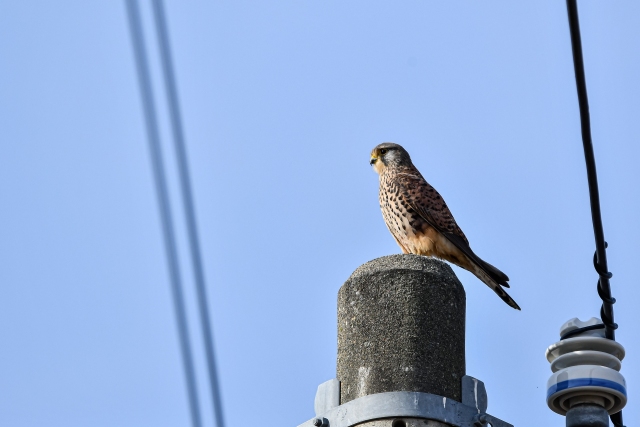
Kestrels show a pronounced sexual dimorphism in their plumage. The most striking distinguishing feature between male and female kestrels is the head colouration. Males have a gray head, while females are uniformly reddish brown in colour. Males also have small black and sometimes diamond-shaped spots on their reddish-brown backs. Their uppertail coverts, as well as the rear back and tail feathers are also light gray. The tail feathers has a distinct black terminal band with a white fringe. The underpart is pale cream and only very lightly mottled or streaked with brown. The underbelly and underwing coverts are nearly white.
The adult female is darkly cross-banded on the back. Unlike the male, the tail feathers are brown and also show several transverse stripes and a distinct terminal band. The underpart is also darker than on the male and shows heavier spotting. Juvenile birds are similar to females in their plumage. However, their wings appear rounder and shorter than adult kestrels. In addition, the tips of the primaries have lighter fringes. Ceroma and eye ring, which are yellow in adult birds, are light blue to greenish yellow in juveniles.
In both sexes, the tail is rounded as the outer tail feathers are shorter than the middle tail feathers. In adult birds, the wing tips reach the end of the tail. The legs are rich yellow, the talons black.
Habitat
typical habitats of the European kestrel
The kestrel is an adaptable species that can be found in a variety of habitats. In general, kestrels avoid both dense closed forests and completely treeless steppes. In Central Europe, it is a common bird of the cultivated landscape, which can live wherever there are shrubs or forest edges. Basically, it needs open areas with low vegetation for hunting. Where trees are absent, it uses the poles of power lines as nesting sites.
In addition to the presence of nesting opportunities, it is primarily the availability of prey that influences which habitats are occupied by the kestrel. If prey is sufficiently available, it shows great adaptation to different heights.
synanthropic birds
An example of a city populated by kestrels is Berlin. The Berlin kestrel expert group of the Naturschutzbund Deutschland has been studying these animals in the urban habitat since the late 1980s. On average, the population in Berlin fluctuates between 200 and 300 breeding pairs and collapses sharply, especially after hard winters. The population is supported by the provision of nesting aids in public buildings such as churches, schools or town halls. "Natural" nesting opportunities in wall niches are mainly found in old buildings. Yet these are increasingly being renovated. Modern high-rise buildings usually have only a few wall holes and cavities to provide nesting opportunities for kestrels. Accordingly, about 60 percent of the birds in Berlin now breed in nesting aids that have been provided specifically for them.
The city presents dangers for the animals. Falcons regularly collide with cars or crash into windows. Young falcons can fall out of the nesting niche and are found weakened. Up to 50 animals are cared for annually in the two stations of the Berlin kestrel expert group.
The text is a translation of an excerpt from Wikipedia (https://de.wikipedia.org/wiki/Turmfalke). On wikipedia the text is available under a „Creative Commons Attribution/Share Alike“licence. Status: 17 December 2021
Eagle owl
Description
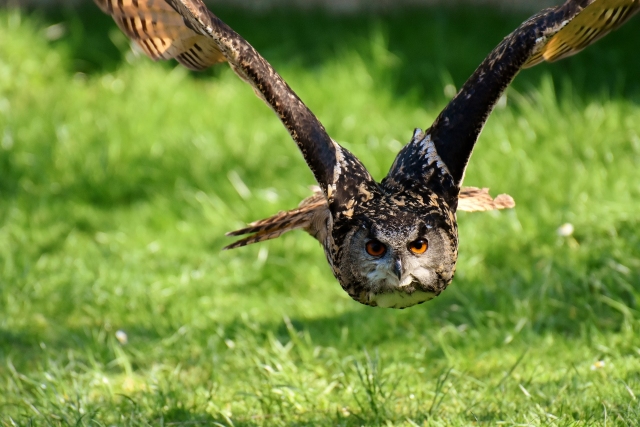
The eagle owl is the largest present owl species on earth. Females are significantly larger than males (reverse sexual dimorphism). The heaviest Central European female eagle owl weighed 3200 g. The difference in size between males and females is also evident in the wingspan. The wingspan of males averages 157 cm, that of females 168 cm.
The head is large and has strikingly long feather ears. These usually stand off obliquely to the side or back. The eagle owl also has the facial disc typical of owls, but less pronounced than, for example, the long-eared owl or barn owl. The body plumage of that species in Central Europe is a light brown with dark longitudinal and transverse stripes. The back is darker than the belly, and the underparts of the wings are also more lightly feathered. The individual subspecies of the eagle owl differ in body size and in the basic colouration of their plumage.
Habitat
Mainly due to human persecution, the eagle owl was largely restricted to the low mountain ranges and the Alps in Central Europe. In the meantime, the lowlands are increasingly being recolonized. The typical hunting ground or foraging area has an average size of 40 square kilometers. In its range, the eagle owl shows how strongly it can adapt to the different conditions of its habitat. Eagle owls live in almost treeless desert mountains and steppes, in sparse boreal coniferous forests, and in subtropical latitudes. They are also found along seashores.
The ideal hunting ground for the eagle owl is diversely structured and interspersed with hedges, water bodies and field shrubs as well as open field areas. While eagle owls defend the narrow area around the nest, this does not apply to their hunting ground. This partly overlaps with that of neighboring individuals. In habitats that offer optimal conditions, the population of eagle owls can be very dense.
The text is a translation of an excerpt from Wikipedia (https://de.wikipedia.org/wiki/Uhu). On wikipedia the text is available under a „Creative Commons Attribution/Share Alike“licence. Status: 17 December 2021
White stork
Description
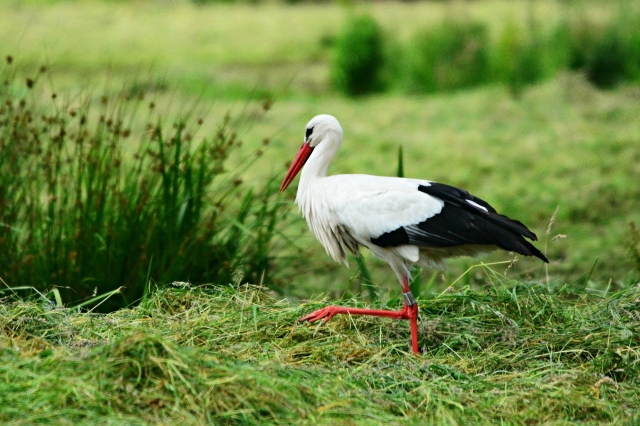
White storks are about 80 to 100 cm tall and have a wingspan of about 200 to 220 cm. Except for the black wing feathers, the plumage is pure white, beak and legs are reddish. White storks weight about 2.5 to 4.5 kg.
Habitat
The white stork, which can reach an age of over 35 years, nests on rocky ledges, trees, buildings, and power poles. It inhabits open and semi-open landscapes and prefers wet and watery areas such as floodplains and grassland lowlands. Its hunting method is highly characteristic and makes it recognizable even from a distance: it strides through meadows and marshes in search of prey and then swoops down on its prey in a flash with its beak. It can also lurk like a heron with bent legs at a mouse hole and then suddenly pounce. In shallow waters, it scours the water for prey.
The text is a translation of an excerpt from Wikipedia (https://de.wikipedia.org/wiki/Weißstorch). On wikipedia the text is available under a „Creative Commons Attribution/Share Alike“licence. Status: 17 December 2021
Black-headed Gull
Description
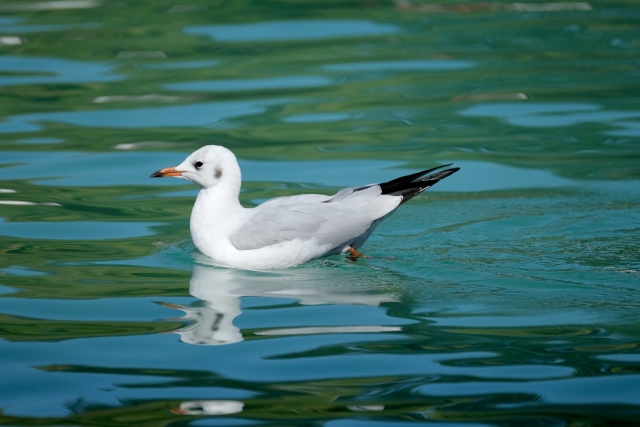
With a body length of 35-39 cm and a wingspan of 86-99 cm, black-headed gulls are the smallest regularly breeding species of the gulls themselves in Central Europe (i.e. notwithstanding the terns). Males are larger and heavier than females. In the nuptial plumage from early March to July, the head is dark blackish brown, the eyes are narrowly rimmed with white, and this rim is not closed in front. The back, upper and lower wing coverts, and upper surface of the secondaries and inner primaries are light gray; the rest of the rump and tail are white. The outer primaries are predominantly white, showing a black terminal band and narrow black margins on the inside of the inner vane. Only the outermost primaries also has narrow black margins on the outer edge of the outer vane. This forms a broad white wedge on the upperparts of the wing, which is dark edged; in flight this feature is often useful for species identification from a great distance. The beak and legs are red. The iris is dark brown. In basic plumage, only the eye region and ear area are diffusely blackish, and the red beak has a blackish tip.
Habitat
During the breeding season, the species inhabits the shore areas of larger bodies of water, especially inland, but for some time now also increasingly on coasts; it mainly lives in still waters, and less frequently in larger rivers with low flow velocities. In winter, they visit favorable feeding habitats of all kinds, including short-grass meadows, arable land, garbage dumps, sewage treatment plants, harbors, and water bodies in cities. In recent decades, the black-headed Gull has increasingly appeared in urban areas far from water bodies in squares, pedestrian zones and similar places.
The text is a translation of an excerpt from Wikipedia (https://de.wikipedia.org/wiki/Lachmöwe). On wikipedia the text is available under a „Creative Commons Attribution/Share Alike“licence. Status: 17 December 2021
Mallard
Description
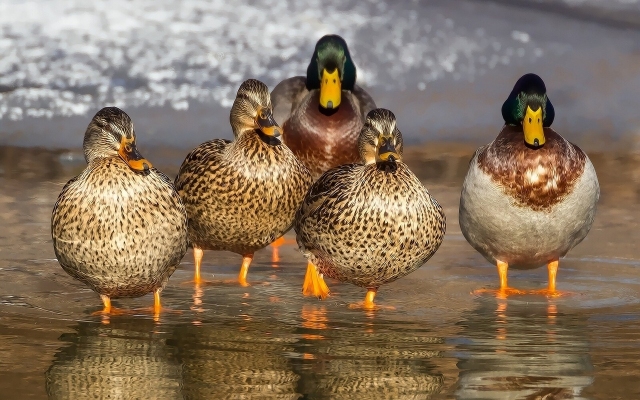
Mallards are up to 58 centimeters long, their wingspan is up to 95 centimeters. In the period between July and August, the male wears his basic plumage and looks very much like the female. The male's beak is still distinctly yellow, sometimes with a greenish tinge, while the female's beak is orange in base colour and sometimes completely covered with dark gray to brown, sometimes only in the middle. The female has a mottled brown-gray colouration, making them well camouflaged on land. The only noticeable feature is the blue wing patch, which matches that of the male. In flight, the white edging of the blue wing patch is visible in both sexes. The plumage of the drake is gray with brown breast, brownish back, and black uppertail and undertail coverts. The head is metallic green with a white throat ring underneath, and the beak is greenish yellow. On the trailing edge of the wings is a metallic blue band fringed with white, the wing patch. The black feathers at the tip of the tail are curled up into drake feathers.
Habitat
The mallard is very adaptable and can be found almost everywhere where there are bodies of water. Mallards swim on lakes, in ponds, inland waters, mountain lakes and also stay in small forest and meadow ditches.
The text is a translation of an excerpt from Wikipedia (https://de.wikipedia.org/wiki/Stockente). On wikipedia the text is available under a „Creative Commons Attribution/Share Alike“licence. Status: 17 December 2021
Coot
Description
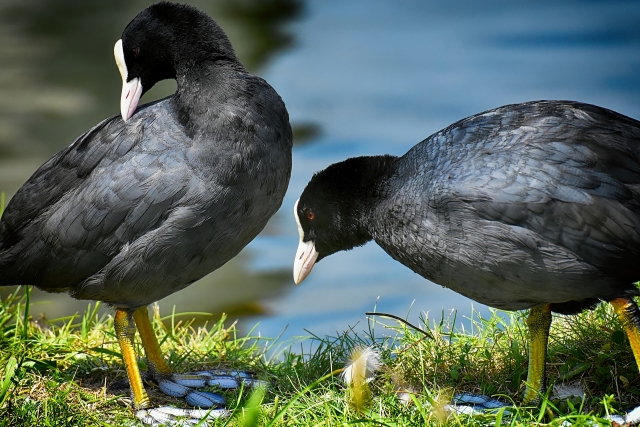
The coot is a medium-sized, roundish rail with a body length of 36 to 42 cm, which is usually found swimming duck-like on the water, lying relatively high in the water. The head is relatively small, the tail short. The beak is about 30 mm long, white or slightly pinkish, pointed with a curved ridge and a strong base. The eponymous blaze is a bright white horny shield above the beak that covers the forehead and varies in size individually, age-wise and between the sexes. At 14 to 30 mm long, it is usually slightly shorter than the beak and between 6 and 19 mm wide. Looking at the head in profile, the indentation between the upper beak and the shield forms an acute angle, in contrast to other species such as the comb coot. The feet are strong and the long toes are webbed. The iris is red to dark brown-red in colour. The sexes do not differ in plumage. Males usually have a larger forehead shield than females, but this is not a reliable distinguishing feature due to individual variation. When both stand side by side, a slight difference in size is noticeable.
Adult birds show a slate grey to blackish plumage on the back, with a brownish to olive shimmer. The throat and lower neck are darker, the head and neck velvety black. The underpart is grey to grey-brown. There are very fine (not visible in the field) whitish lace fringes on the breast and belly. The brown-black primaries have whitish tips, the outermost a fine white outer fringe. The wing feathers are predominantly blackish. There is an olive-brown tinge on the inner greater coverts, a white fringe on the front edge of the wing and - a feature noticeable in flight - a white fringe on the rear edge of the secondaries. The underwing coverts are grey to light grey and show white tips in the area of the hand wing. The rectrix are brownish black. The legs are pale ash-grey, pale greenish yellow or bright yellow. The heel joint becomes a stronger golden brown with age. The toes and webbed lobes are pale olive with dirty blue-green joints. The margins of the lobes are lead-grey to blackish.
Habitat
The coot breeds on standing or slow-flowing waters with shallow banks and suitable riparian vegetation for nesting, such as a well-developed reed zone or bushes protruding into the water. Optimally, there should be open water areas in addition to shallow, herbaceous areas. The water must have a high or medium nutrient content. Particularly nutrient-poor waters are largely avoided - the species is therefore often absent from mountain lakes. While brackish water lagoons are quite accepted, the coot does not breed on the seashore.
Since the size of the water body plays a subordinate role, the coot is sometimes also found at small forest ponds or at flooded areas in broken forests. The species is also tolerant of its surroundings. It can also be found at water bodies in closed forest areas or in cleared landscapes. However, it prefers a mosaic of reedbeds, wet grassland, small hills or islets and scrub.
In Central Europe, the coot breeds in eutrophic shallow lakes, fishponds and sewage ponds, on silted-up bogs or drainage ditches, gravel pits, quarry ponds and retention basins, on slow-flowing rivers and oxbow lakes. It is also frequently found in residential areas, where it occurs, for example, at ponds in parks.
The text is a translation of an excerpt from Wikipedia (https://de.wikipedia.org/wiki/Blässhuhn). On wikipedia the text is available under a „Creative Commons Attribution/Share Alike“ licence. Status: 17 December 2021
Starlet
Description
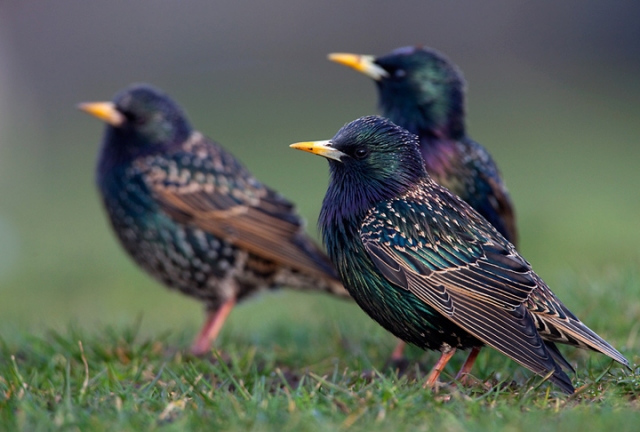
With a body length of 19 to 22 cm, the starling is somewhat smaller than the blackbird. The tail is much shorter compared to the blackbird. The wings appear triangular and pointed in flight.
In basic plumage, the body feathers are blackish with a metallic green or purple sheen and have white to beige tips. The whole body appears brightly dotted. The wing and rrectrix are blackish brown with light brownish fringes, the secondaries also have a broad, shiny metallic fringe. The plumage is formed in spring by wearing off the light patches of the body plumage, the body is then blackish and shiny metallic. The beak is yellow in plumage and blackish in plumage. The legs are reddish brown, the iris of the eyes is dark brown.
The sexes differ only slightly, females are slightly less intensely shiny metallic in colour than males, and the dot pattern on the body is usually more prominent in females in the plumage. The base of the underbeak is blue-grey in males in nuptial plumage and whitish in females.
Freshly fledged starlings lack the metallic sheen, the body is earthy brown, only the throat is lightened to whitish. The wings and feathers are dark brown without metallic shine. The beak is dull brown, the legs dark greyish brown.
Habitat
In Europe the starling is widespread, it is only absent inside large closed forest areas, in completely cleared agricultural landscapes and at altitudes from about 1500 metres. Cities are also colonised up to the centres. Highest densities are reached in areas with groups of trees rich in cavities and neighbouring grassland for foraging.
The text is a translation of an excerpt from Wikipedia (https://de.wikipedia.org/wiki/Star_(Art)). The text is available on Wikipedia under a „Creative Commons Attribution/Share Alike“ licence. Status: 14 December 2021
