


Florian Heigl
BirdLife Austria

BirdLife Austria is the only ornithological association in Austria that is active nationwide. Since its foundation in 1953, BirdLife Austria has carried out scientifically founded nature and bird conservation projects in four core areas:
- Protection of species
- Protected areas and habitats
- Sustainability
- Awareness raising
We are very pleased to have won BirdLife Austria as a partner in the project Roadkill. Since the core areas of this association fit perfectly to the tasks of the project Roadkill, we will intensively work in the future to intensify the basic research on road-killed birds and the protection of birds on roads by planning joint research projects, exchanging data for nature conservation analyses and improving the scientific methods for data collection.
Austrian Herpetological Society

The Austrian Herpetological Society is a non-profit association and accredited environmental organisation which aims to support research in the field of amphibian and reptile research and the conservation of amphibians and reptiles and their habitats. In the context of the activities of the association the very successful Citizen Science project herpetofauna.at is conducted. "Herpetofauna" collects amphibian and reptile observations throughout Austria. In addition to the location of the specimen and the taxon, accompanying data such as habitat quality, endangerment, stage of development etc. are also recorded. Only data that are photographically documented are processed. To date, more than 20,000 reports from "Citizen Scientists" have been included in the database and are available for research.
The cooperation with the Austrian Herpetological Society enables us to have the entries on amphibians and reptiles checked again by declared experts in this field and, if necessary, to point out any errors! This is a great enrichment for our project and directly increases the data quality.
We are looking forward to future cooperation and mutual benefit!
Natural History Museum Vienna

The Natural History Museum Vienna (NHM) with more than 30 million collector's items is considered one of the most important natural history museums in the world. Founded by Emperor Franz Joseph I, it is home to many unique pieces. What some people don't know is that NHM conducts research at the pulse of time. Citizen Science is also an integral part of the museum's research landscape.
In the course of creating a Citizen Science strategy, information was collected on the various Citizen Science projects located in the museum. Eight projects at the NHM involve citizens in scientific research.
The scientific herpetological reference collection (amphibian and reptile species) of the Natural History Museum Vienna comprises about 210,000 objects.
The cooperation with the Department of Herpetology enables us to have the entries on amphibians and reptiles checked again by declared experts in this field and, if necessary, to point out any errors! This is a great enrichment for our project and directly increases the data quality.
We are looking forward to future cooperation and mutual benefit!
At the Austrian Citizen Science Conference
From 26th to 28th June 2019 we were with our project at the 5th Austrian Citizen Science Conference in Obergurgl/Tyrol: https://roadkill.at/en/about/publications/item/224-austrian-citizen-science-conference-2019
Austrian Citizen Science Conference 2019
From 26th to 28th June 2019 we were with our project at the 5th Austrian Citizen Science Conference in Obergurgl/Tyrol. A great event of the Citizen Science Network Austria. The organizing committee consisted of representatives of the University of Innsbruck, the University of Natural Resources and Applied Life Sciences Vienna, the Center for Citizen Science at OEAD, Schweiz forscht (CH), Bürger schaffen Wissen (D) and Partizipative Wissenschaftsakademie at the University of Zurich and ETH Zurich. The participants and the scientific contributions were therefore correspondingly diverse. Representatives from universities, universities of applied sciences, associations, museums, funding organisations and many more came to exchange ideas across disciplines.
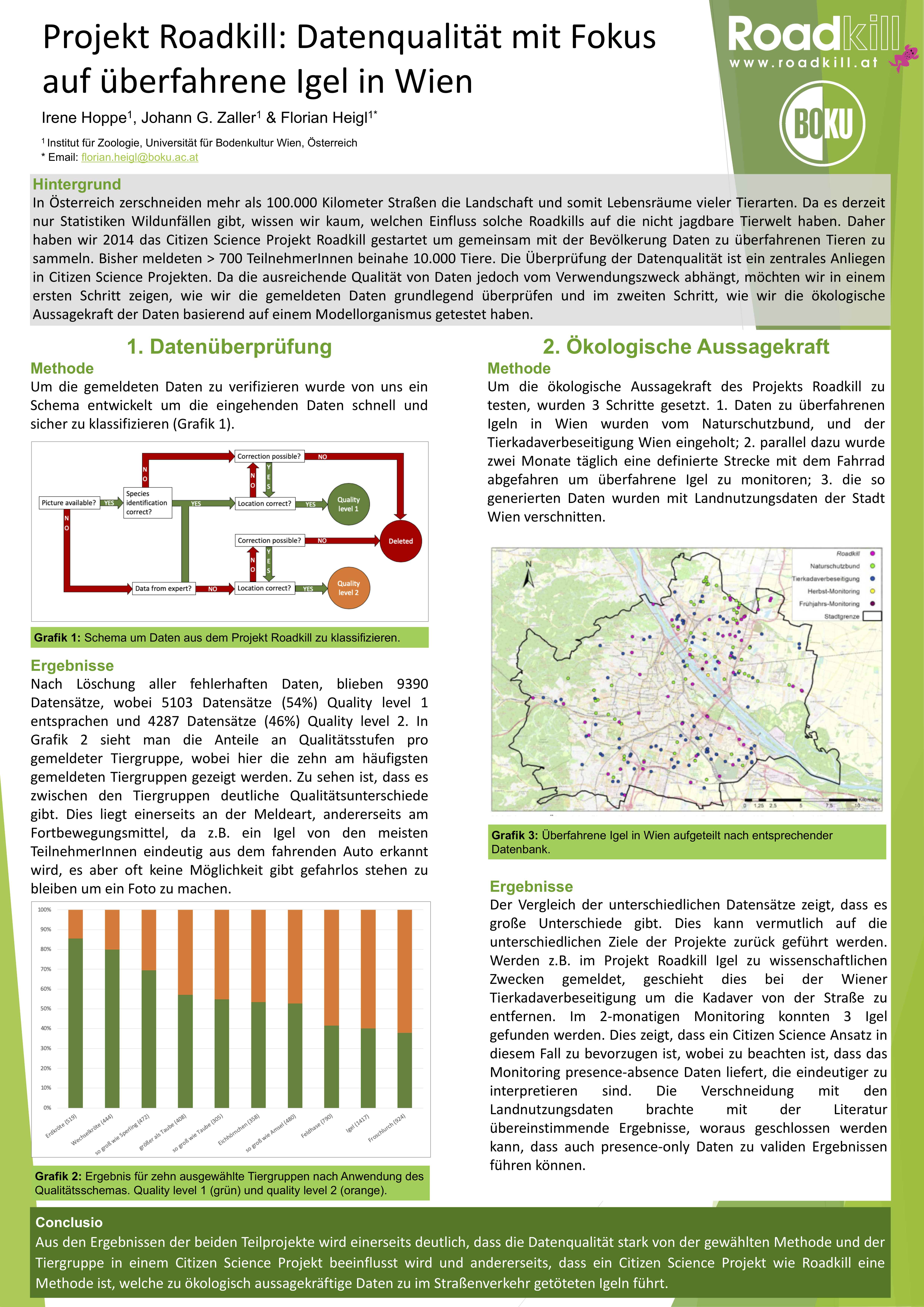
We were at the event with a poster on data quality and gave an insight into Irene Hoppe's master thesis (in German):
SDG conference in Vienna
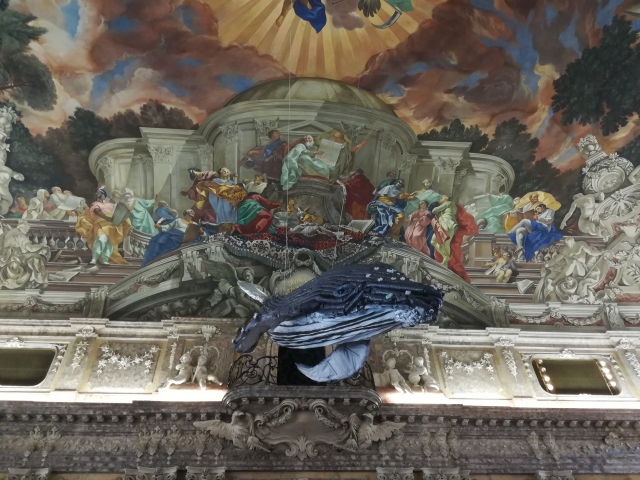

On April 5th we had the opportunity to present a poster at the Austrian Academy of Sciences showing how our project can contribute to the UN Sustainable Development Goals. The Austrian Academy of Sciences organised the international symposium "Global Sustainable Development Goals in a Mediatized World" on 4 and 5 April 2019. Achieving the goals laid out in the Agenda 2030 in a mediatized world poses new challenges and opportunities for all stakeholders, including the scientific community.
You can see the presented poster here:
First amphibian of the year in Austria
The first amphibian in Austria was reported by our participant Petra Tischler: https://www.spotteron.com/roadkill/spots/71838
First amphibian of the year
The first amphibian in Germany was reported by our participant "auf Twitter @westrad_de": https://www.spotteron.com/roadkill/spots/69812
spring is coming
Spring is coming and so is the new roadkill season: https://roadkill.at/en/news-en/item/186-spring-is-approaching-on-the-road
Data for the nature conservation organisation Naturschutzbund Niederösterreich
Within the framework of our cooperation, data on amphibians in Lower Austria that had been road-killed were provided to the Naturschutzbund Niederösterreich. These data are now used to identify hotspots for amphibians on roads in Lower Austria where additional amphibian protection measures can be taken.
