


Florian Heigl
Eurasian collared dove
Description
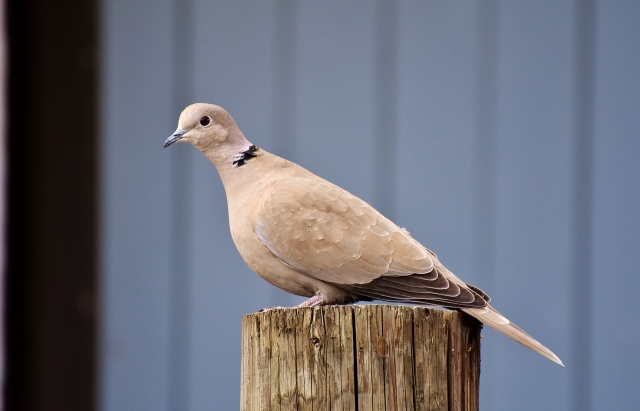
The eurasian collared dove is 31 to 33 cm in length and thus about the same size as the feral dove. However, it is lighter and longer-tailed, making it appear slimmer and more delicate. Its wingspan is 47 to 55 cm; it weighs 150 to 200 grams. The plumage is uniformly light beige-brown, the wing tips are slightly darker, the head and underparts are slightly lighter. The reddish eye has a narrow white eye ring. The most striking feature is a deep black nape stripe in the adult plumage, which is additionally framed by a narrow white stripe. The sexes are alike.
Habitat
Eurasian collared doves are synanthropic birds. They originate from Asia, but as they found an increasingly better food supply in more northern areas of Europe through agricultural and domestic waste, they expanded their habitat over the whole of Europe in the course of the 20th century. In the meantime, they are advancing further to the north-east. Their expansion in the middle of the 20th century could be observed and recorded in detail. They have now established themselves as resident birds and live in parks and gardens, always close to settlements, preferably in quiet residential areas where there are a few conifers. They need the latter, as they prefer to breed in conifers. They are not very shy.
The text is a translation of an excerpt from Wikipedia (https://de.wikipedia.org/wiki/Türkentaube). On wikipedia the text is available under a „Creative Commons Attribution/Share Alike“ licence. Status: 14 December 2021
Great spottet woodpecker
Description
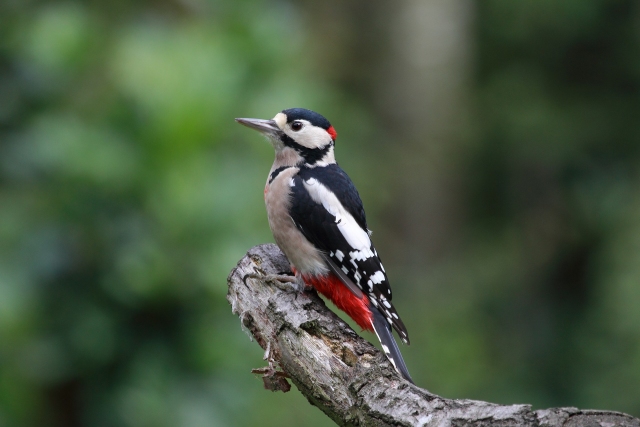
The great spotted woodpecker is about 23 cm tall. Its wingspan is between 34 and 39 cm. It weighs between 60 and 90 grams. Its plumage is black on top with two large white wing spots and yellowish-grey underneath. The undertail coverts are a vivid red. Only the male has a red nape patch and juveniles have a red crest. The cheeks are white, the part above the beak rather grey. There are black stripes on the sides of the neck.
Great spotted woodpeckers have pointed, curved talons on their climbing feet, which they use to hold on to the bark. Two talons point forwards and two point backwards. Their skin is unusually thick, which protects them from insect bites. A flexible, joint-like connection between the broad base of the beak and the skull absorbs the vibrations that occur when carving the woodpecker's cavity. The upright and stable posture on the tree is supported by strong muscles that control the supporting tail feathers. To prevent inhalation of the resulting wood flour, the nostrils of the great spotted woodpecker are covered with fine feathers.
Visually similar and therefore easily confused with the great spotted woodpecker in Central Europe are the middle spotted woodpecker, the lesser spotted woodpecker, the white-backed woodpecker and the syrian woodpecker, but all of them occur much less frequently in Austria.
Habitat
The great spotted woodpecker is the least specialized native woodpecker species and therefore the most common. It can be found in both deciduous and coniferous forests, but also in parks and in cultivated landscapes, provided there are avenues, shelterbelts or small groups of trees. Mixed oak and beech forests with a lot of old and dead wood are optimal habitats for it. Monotonous pure spruce stands have only low woodpecker abundance.
The text is a translation of an excerpt from Wikipedia (https://de.wikipedia.org/wiki/Buntspecht). On wikipedia the text is available under a „Creative Commons Attribution/Share Alike“licence. licence. Status: 17 December 2021
Eurasian jay
Description
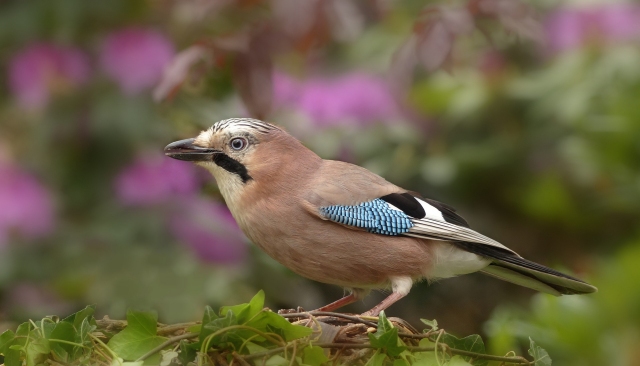
With a body length of 32 to 35 cm, the eurasian jay belongs to the medium-sized corvids, its wingspan is about 53 cm and its weight is about 170 grams. The strong beak is greyish-black to black. The feet are greyish-brown to brown flesh-coloured with yellowish or whitish soles. The iris is bluish-grey with a reddish inner and outer ring and an equally fine speckling.
The sexes do not differ in plumage colouration. The head is more or less conspicuously marked depending on the subspecies. The eurasian jay has white parts on the forehead and crown, the narrow, elongated feathers of which are streaked with black and can be raised to form a bonnet when excited. The region around the eye is also white with black streaking, often except for the front ear coverts. There is also a distinct black beard stripe, which is about the size of the beak. Chin and throat are white. The back of the ears, sides of the neck and the nape are reddish beige to dull chestnut. This colouration continues on the back, shoulders and underparts, turning more greyish brown on the back and slightly lighter on the underparts. The middle of the belly and the under-tail coverts are white, as are the back and the rump. The latter feature is often very noticeable, especially in flight, and contrasts with the blackish-brown colouring of the rectrix. The base of the feathers is grey with a grey-blue cross banding, which is hidden by the upper tail coverts. The tail ends with a relatively straight edge.
The roundish, broad wings are strikingly and characteristically coloured. The beige-pink colouring of the upper side continues on the lesser and middle coverts. The primary coverts and greater coverts are black on the inner vane and bear a black cross banding on the outer vane on a sky-blue background. This colourful plumage, which forms a blue field below the shoulder when the bird is sitting, is a particularly characteristic feature of the species. The primaries are dark brown with a pale fringe, which increasingly bears a blue-black cross banding towards the inner primaries. The secondaries are blackish brown with a white outer plume towards the base of the feathers. These form a white field when the wing is folded and are also clearly visible in flight. Sometimes there is a blue-black band in the white areas, mostly not visible. Towards the brown-black tertials, several secondaries show a chestnut-brown colouration with a broad, black terminal fringe.
Habitat
In Central Europe, the eurasian jay inhabits deciduous, mixed and coniferous forests during the breeding season. It prefers sparse stands with a rich lower tree layer or a high shrub layer, or richly structured forests in which small areas alternate with different age classes, clearings, densities or slash. In monotonous forest forms such as spruce or pine forests, but also, for example, beech forests, it occurs in low density, only in marginal areas or in the area of clearings and slashes.
In correspondingly forest-like habitats, it also breeds close to settlements, for example in parks, extensive gardens or cemeteries. In the open countryside, the jay is rarely found during the breeding season. But after the breeding season during ripeness, it specifically seeks out solitary oaks or hazel bushes in the open landscape.
The text is a translation of an excerpt from Wikipedia (https://de.wikipedia.org/wiki/Eichelhäher). On wikipedia the text is available under a „Creative Commons Attribution/Share Alike“ licence. Status: 17 December 2021
European green woodpecker
Description
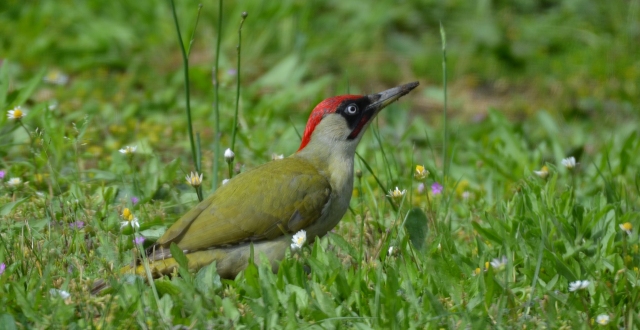
The green woodpecker reaches a length of 32 centimeters and has a wingspan of up to 52 centimeters. The upperpart is dark green, the underpart is pale light to gray-green in colour. The sides of the head are marked by a black facial mask that extends from the beak to behind the eyes. The top of the head and the nape of the neck are red, the rump is greenish-yellow. The ear area, chin and throat, on the other hand, are whitish. The wings are brown-black, yellowish or brownish-white spotted. The rectrix are blackish banded on a greenish-gray ground. The differences between the sexes are slight, in the male the cheek patch is red with a black edge, in the female this cheek patch is solid black. The eyes of the green woodpecker are bluish-white, and the beak and feet are lead-gray. Males and females are the same size and weight.
The juvenile plumage differs greatly from adult plumage, being distinctly duller overall. The sides of the head, neck and underparts are heavily dark spotted to banded on an almost white ground. The red parts of the head colouration are inconspicuous and mostly interspersed with gray spots. The wings and the upperparts also show a distinct white mottling.
In Central Europe, the European green woodpecker can only be confused with the somewhat smaller but otherwise very similar gray woodpecker. Unlike the green woodpecker, however, the grey woodpecker has a gray head, a dark red eye, and only a narrow black chin stripe. The grey woodpecker also lacks the red crest of the green woodpecker, only the male has a red forehead, while the female lacks a red head mark. Often already the place of observation gives clues for species identification, the grey woodpecker is missing in the northwest of Central Europe and is much more bound to mountains and to forest compared to the green woodpecker.
Habitat
It prefers semi-open landscapes with extensive old woods, especially forest edges, copses, meadows, parks, groves and large gardens with trees. Within extensive woodlands, it only occurs in heavily cleared areas, forest meadows and larger clearings. The species shows a strong preference for deciduous forests; in extensive coniferous forests it can be very rare or absent over large areas.
Due to its strong specialization on ground-dwelling ants, the green woodpecker is susceptible to severe winters with high snow levels. Its main distribution area is therefore the lowlands and the lower altitudes of the low mountain ranges up to an altitude of about 500 m above sea level.
In the Alpine region, this limitation of distribution with regard to sea level does not exist. In the Bavarian Pre-Alps and Alps, the Green Woodpecker inhabits all altitudes from 600 to 1400 m above sea level quite evenly and has been recorded up to 1700 m above sea level.
The text is a translation of an excerpt from Wikipedia (https://de.wikipedia.org/wiki/Grünspecht). On wikipedia the text is available under a „Creative Commons Attribution/Share Alike“ licence. Status: 17 December 2021
Northern lapwing
Description
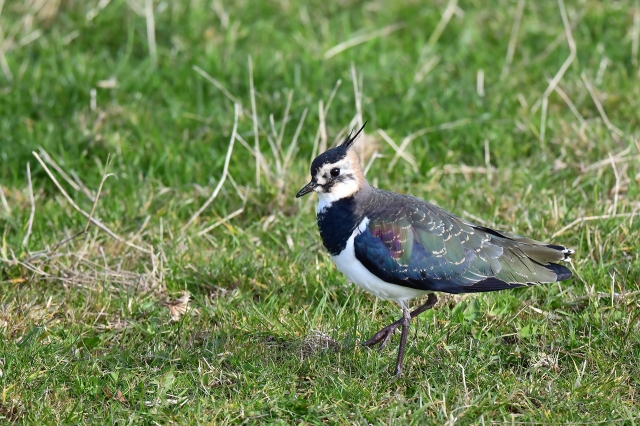
The northern lapwing reaches about the size of a pigeon at 28 to 31 centimeters in body length, and has a wingspan of 70 to 80 centimeters. Adult northern lapwings have a shimmering metallic green-gray mantle with a blue-purple shoulder patch. The belly is white in colour with a black, sharply defined breast band. The head is white with a black forehead that ends in a long two-tipped cap, called a Holle. Starting from the black beak, a blurred black band runs under the eye to the back of the head. The abdomen is washed out sandy to rusty orange in colour. In nuptial plumage, the male differs from the female only by a longer crest, a somewhat more intense black colouration, and the continuous throat patch. For a plover, northern lapwings have comparatively short legs, which are coloured dark red to brown.
In basic plumage, the chin and fore-neck are white in both sexes. The feathers of the upper hand coverts and shoulders are fringed with pale yellowish brown, creating a scale-like pattern. The crest is noticeably shorter than in breeding plumage. Juvenile lapwings look like adults in basic plumage, but also have broader, yellow-brown feather fringes as well as a distinctly lighter, brown-coloured breast band.
Habitat
Northern lapwings breed primarily in open, flat landscapes with short grass or no grass at all, in meadows and pastures, preferably along the edges of water bodies, on wet meadows, heaths and moors. Northern lapwings also breed in fields. During winter and the migratory season, the birds also stay in harvested fields and plowed fields. In winter, northern lapwings can be seen widely dispersed on old pastures, but also as troops on muddy areas.
The text is a translation of an excerpt from Wikipedia (https://de.wikipedia.org/wiki/Kiebitz_(Art)). On wikipedia the text is available under a „Creative Commons Attribution/Share Alike“ licence. Status: 17 December 2021
Common cuckoo
Description
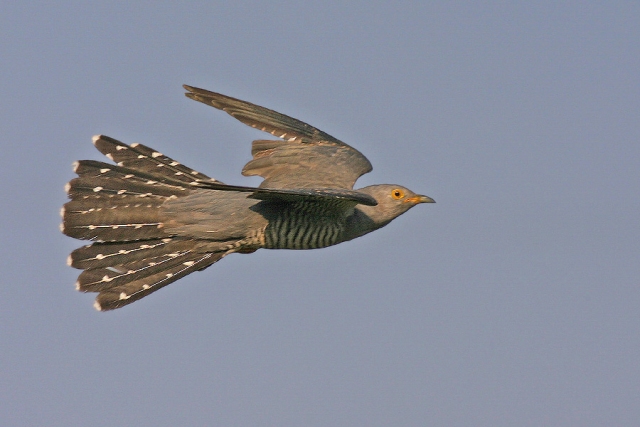
With a wingspan of 55 to 60 centimeters and a body length of 32 to 34 centimeters, the common cuckoo is almost as large as a turtle dove, but more delicate and slender. The weight of the male is 110-140 grams, the female 95-115 grams. The wings are pointed and the rounded tail is 13-15 centimeters long. In flight, the species looks similar to a sparrowhawk, but has more pointed wing tips. When sitting, the common cuckoo appears short-legged. The stepped tail is not infrequently fanned and slightly raised, and the wings are often left hanging somewhat splayed.
Adult males are slate gray on the upperparts. The uppertail coverts have light gray, very thin, narrow terminal seams. The chin, throat, sides of the neck, and forechest are uniformly light gray and lighter than the upperparts; the rest of the underparts are white with broad grayish-brown banding. The undertail coverts are white to isabelline. The tail is dark slate gray with a distinct white terminal fringe. The iris, eyelid ring, and beak base are pale yellow.
Adult females appear in two colour morphs. The gray morph closely resembles males, but shows a rusty beige to yellowish tint on the breast and a thin dark cross banding. The brown morph is rarer and is rusty brown on the upperparts and breast. The entire plumage is dark cross banded. The tail is brown and dark banded with a thin white terminal band. The iris, eyelid ring, and beak base are light brown.
The juvenile birds are slate gray, sometimes with a rusty brown tinge. The entire plumage is thinly dark cross-banded. The small and large wing coverts have narrow white fringes. The iris is dark brown, the eyelid ring is pale yellow, and the base of the bill is pale. Juvenile birds can be identified by the white patch on the nape.
In both morphs and in juvenile plumage, the legs are yellow and the beak is horn-gray except for the base.
Habitat
It inhabits cultivated landscapes as well as biotopes above the tree line, the dunes of the sea coasts and almost all habitats in between: sparse deciduous and coniferous forests, swamp forests or even upland moors and steppes. It does not occur in the Arctic tundra and in extensive dense forests. The occurrence of the birds that serve as hosts for it during reproduction is crucial. In its habitat there must be sufficient small structures such as shrubs, hedges, scattered trees and perching opportunities. It is also found in the outskirts of cities.
The text is a translation of an excerpt from Wikipedia (https://de.wikipedia.org/wiki/Kuckuck). On wikipedia the text is available under a „Creative Commons Attribution/Share Alike“ licence. Status: 17 December 2021
Common partridge
Description
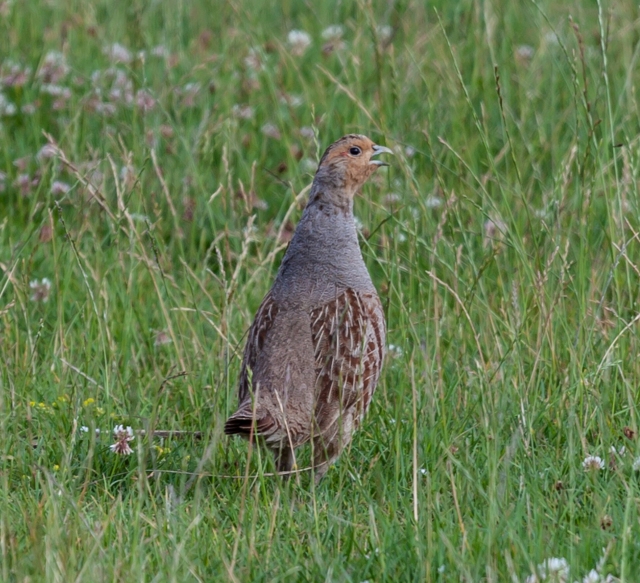
The common partridge, like all members of the genus, is of stocky build with short legs, short round tail and short round wings. The orange-brown head, light gray forebody and reddish-brown lateral banding are characteristic. The tail, with the exception of the central rectrix, is vivid russet. There is a more or less pronounced dark brown patch in the shape of a horseshoe at the center of the lower breast, sometimes absent in females and often much smaller. In spring and summer the common partridge wears the nuptial plumage, in autumn and winter the basic plumage. The straight beak is yellow and brown or gray at the base. Common partridges have a body length of about 30 centimeters, a wing length of 14.6 to 16 centimeters, and a tail length of 7.2 to 8.5 centimeters. Males and females are similar in size; however, the latter are slightly heavier. Body weight ranges from 290 to 415 grams for males and 300 to 475 grams for females.
Habitat
The common partridge lives mainly in lower altitudes below 600 m, but it can also be found in higher altitudes of the low mountain ranges and alpine valleys. The original habitats were steppes, especially tree and shrub steppes. Due to their high adaptability, common partridges are synanthropic birds and live in heaths as well as on arable land, grassland and fallow land, herbaceous meadows and in richly structured mixed areas. In warmer areas with fertile soils the highest population densities are reached. Optimal habitats are characterized by alternating multi-crop agricultural use with hedgerows, shrubs, field and road margins, offer small-scale structured plots and have little forest cover. Necessary cover is provided by a high proportion of boundary lines. Boundary lines are characterized by many hedge strips and thus much cover. Stubble fields and fallow land are very popular as resting and feeding places. Areas with winters with little snow are clearly preferred. Root crop fields (potatoes, beets, cabbage) provide optimal conditions, as there is good protection from weather deformities and aerial predators under the large-leaved plants. The raw soils between the plants warm up quickly and dry out quickly, allowing dust baths and rapid escape.
The text is a translation of an excerpt from Wikipedia (https://de.wikipedia.org/wiki/Rebhuhn). On wikipedia the text is available under a „Creative Commons Attribution/Share Alike“ licence. Status: 17 December 2021 2021
Common moorhen
Description
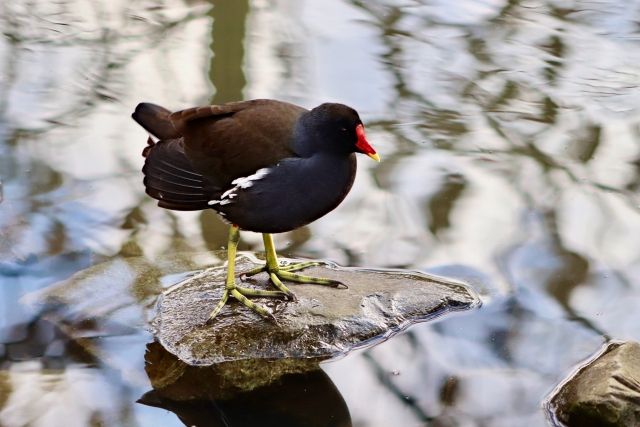
The subspecies of the common moorhen occurring in Europe is slightly smaller than a partridge with a body length of about 33 centimeters. The adult birds are dark olive-brown on the upperparts of the body, and dark gray-black on the head and neck and the underparts of the body. Males and females look alike, differing only slightly in size and weight. They have a red forehead, a red beak with a yellow beak tip, and red eyes. The short tail with black and white undertail feathers is often stilted upward. On the underparts, the plumage is slate gray, with white barring on the flanks. Feet and legs are yellowish green; above the intertarsal joint the legs have a red band. The bird is conspicuous because it constantly bobs its stilted tail and rhythmically nods its head while swimming.
Habitat
The optimal habitat of a common moorhen is a highly eutrophic and shallow water body with dense reed vegetation on the shore and larger floating leaf communities on the open water surface. However, due to its high adaptability, the species is also found in waters that do not correspond to this optimal habitat. It also uses smaller pools and waterholes that have a water surface area of 20 to 30 square meters, and can be found in peat extraction areas, sewage fields, along floodplains and slow-flowing rivers, as well as clay and gravel pits, among other places. The common moorhen is also one of the species that has captured urban areas as a habitat and can be seen there in gardens, parks and zoos if these offer sufficient water areas. It has only low demands on water quality. More essential than this is the presence of suitable riparian vegetation.
The text is a translation of an excerpt from Wikipedia (https://de.wikipedia.org/wiki/Teichralle). On wikipedia the text is available under a „Creative Commons Attribution/Share Alike“ licence. Status: 17December 2021
Eurasian sparrowhawk
Description
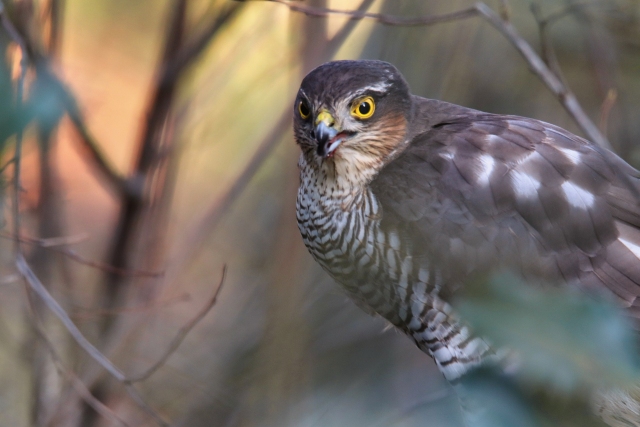
Females are just larger than a kestrel, with a body length of 35-41 cm and a wingspan of 67 to 80 cm, and are close in size to small goshawk males. Sparrowhawk males are much smaller, with a body length of 29-34 cm and a wingspan of 58 to 65 cm. The wings are relatively short, broad, and rounded at their tips, and the tail feathers are relatively long. These characteristics do not allow for extreme flight speeds, but do enable high maneuverability in confined spaces. Legs and toes show distinct adaptations for hunting small and fast songbirds. The legs are comparatively long and very thin. The middle toe is very long and can be used to grasp objects, while a protuberance on the underside of the toe means that the digit can be closed without leaving a gap, and so can still hold individual feathers. The claws are long and very pointed.
Juveniles are brownish on the upperparts until the first molt, all coverts have light brown-beige edges. The underparts are white and barred that looks broader and often teardrop- or heart-shaped.
The large plumage has distinct barring on a white to beige-brown ground in all dresses, and on a yellowish ground in young birds. The legs are yellow, as is the ceroma of the beak. The iris is pale yellow in young birds, dark yellow in adult females, and mostly orange in males. The beak is black, blue-gray at the base.
Sexual dimorphism in terms of body size and weight is extreme in this species. The difference is so great that there is no overlap between the sexes in terms of body measurements.
Possibilities of confusion exist in Central Europe primarily with the goshawk. In perching birds the distinction is usually easy, goshawks are much larger and stronger, this is especially noticeable when looking at the legs and head. Goshawks never show orange on the breast and belly and have a distinct whitish over-eye stripe, which is only hinted at in sparrowhawks. Sparrowhawk eyes are proportionally much larger and thus more conspicuous than in the goshawk.
It is more difficult to distinguish flying birds. The body proportions of sparrowhawks and goshawks are very similar, so at greater distances it is often impossible to distinguish gliding or soaring birds in particular. In reasonably good visibility conditions, however, the much more massive body and proportionally longer wings of the goshawk are recognizable even in flight. In actively flying individuals, the frequency of wing beats also often allows species identification: this is about twice as high in sparrowhawks as in goshawks.
Habitat
The occurrence of the species is limited in most of its range to the north as well as to the south by the distribution of these coniferous forests. Only in Central and Western Europe, as well as in the Western Mediterranean, where other small representatives of the genus Accipiter inhabiting deciduous forests are absent, it also inhabits deciduous forests of the temperate zone, as well as the Mediterranean hardwood forests. In recent decades, this raptor species also shows a strong tendency towards urbanization and now inhabits parks, cemeteries and similar green spaces in many cities in Europe.
The text is a translation of an excerpt from Wikipedia (https://de.wikipedia.org/wiki/Sperber_(Art)). On wikipedia the text is available under a „Creative Commons Attribution/Share Alike“licence. Status: 17 December 2021
Tawny owl
Description
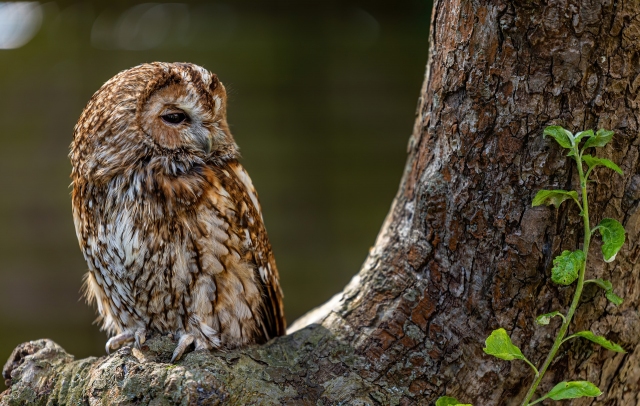
The tawny owl achieves a body length of 40 to 42 centimeters and weights between 330 and 630 grams. Females tend to be heavier than males. The body structure is compact, and the head appears large in proportion to the body size. Feathered ears, as in the long-eared owl, are absent. The facial disc is dark-framed and predominantly solid beige-brown. Above the facial disc there are two whitish colour lines, which are especially noticeable in the darker colour morphs. The thick beak is strongly curved and usually sulfur yellow with a horn-coloured to light gray beak base. The ceroma appears swollen and is slightly greenish. The iris is blackish brown and the pupil is blue-black. The eyelids are bald and pale red. The talons are gray at their root, then change to a horny brown and end in a black tip.
Tawny owls occur in Central Europe in a variety of colour morphs. This ranges from a gray colour variation to a brown to a rusty brown. The basic colouration of the plumage is determined neither by age nor by sex, as it was assumed for a long time. It is rather an adaptation to different habitats. The different colour morphs may well occur in the same area and also mate with each other. Pairs with different basic colouration often have young with both colour variants.
The plumage is very loose, making the tawny owl appear larger than it actually is. The upperpart of the body is generally darker than the underside. The plumage has a bark-like camouflage colouration: The shoulders and wings have bright drop spots that act like sunspots in the semi-darkness of the forest, increasing camouflage. Similar plumage colouration with drop spots is also found in a number of other birds such as scops owls, wrynecks, pygmy owls, and nightjars, which prefer to stay near logs during the day. The feathers on the top of the body each have lateral branching longitudinal stripes. This branching is denser, especially on the back and uppertail coverts, so that the plumage appears more washed out here. The wing feathers are brown, with whitish cross bands on the outer plumes and pale brown on the inner plumes.
Habitat
Although the tawny owl prefers old deciduous and mixed forests, it is also frequently found in coniferous forests and in cultivated landscapes. The tawny owl is basically very adaptable and, for example, also breeds in rabbit burrows in the low-tree dune landscape of the Netherlands. It also colonizes urban habitats. Tawny owls also breed in parks, cemeteries and avenues as well as gardens with old trees. If left undisturbed, they also breed in close proximity to humans. Therefore, there are relatively frequent broods in barns or in the chimneys of old houses.
The text is a translation of an excerpt from Wikipedia (https://de.wikipedia.org/wiki/Waldkauz). On wikipedia the text is available under a „Creative Commons Attribution/Share Alike“licence. Status: 17 December 2021
