


Florian Heigl
Eurasian wren
Description
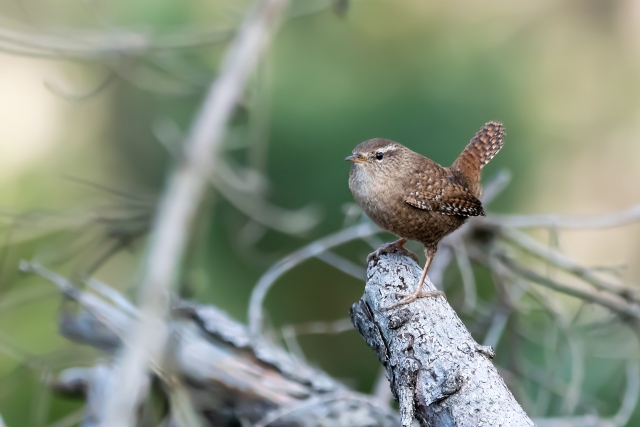
The Eurasian wren is round in shape and usually has a raised tail. The pointed, slightly curved beak is blackish brown in the upperpart and yellowish in the underpart. The iris of the eye is nut brown. The plumage is reddish brown on top and pale brown on the underpart. An indistinct cream-coloured over-eye line ends at the dark ear coverts. There are dark brown wavy lines on the tail, wings and flanks. Males and females look the same. While the wings of the female are 45 to 48 mm long, those of the male are between 49 and 53 mm long. The feet are flesh-coloured to brownish. Wrens have a body length of 9.5 to 11 cm. The wingspan is 14 to 15 cm and the body weight is usually between 7.5 and 11 grams.
The wren can climb vertically up a trunk with its long toes and strong talons, but cannot descend headfirst. It flies straight and level over the ground with rapid wing beats.
Habitat
The wren lives in bushes, hedges and in the thickets of woods, gardens and parks. If there are enough hiding places, it can be found in the open cultivated landscape. Its preferred habitats include floodplains with exposed roots and climbing plants as well as woods and copses rich in undergrowth. It often inhabits areas near bodies of water. The Eurasian wren hibernates in woods, parks and gardens with covering shrubs and a herb layer, often near large bodies of water. It is often found solitary in barns and stables, in semi-natural gardens also on the walls of houses, usually gardens with a pond. It is not particularly shy there.
The text is a translation of an excerpt from Wikipedia (https://de.wikipedia.org/wiki/Zaunkönig). On wikipedia the text is available under a „Creative Commons Attribution/Share Alike“ licence. Status: 01 December 2021
Common chiffchaff
Description
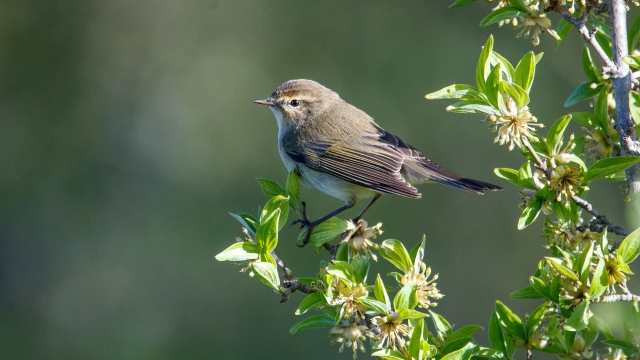
Common chiffchaffs are small, compact and short-winged leaf warblers with a rather large head and without conspicuous markings. The body length is 10-12 cm, the weight 6-10 g. The sexes do not differ in appearance and weight, but males are slightly longer-winged than females.
The upperparts are greyish-brownish green, the rump is often slightly lighter green. The throat, the underpart of the rump and undertail coverts are dirty white with individually very variable amounts of yellow and beige on the throat and breast. Especially in autumn, the flanks are often covered in beige-brown. Wing feathers and tail feathers are grey-brown, the edges of the outer plumes are narrowly fringed with yellow-green. A yellowish supercilium is clearly visible in front of the eye, behind the eye usually only indistinctly. The dark eye stripe divides the light eye ring into a lower and an upper half. The area below the eyes and the ear coverts are quite dark, so that the lower part of the light eye ring contrasts clearly with it. The short and fine beak is usually not very noticeably bright orange at the base and sides, and dark horn-coloured for the rest. The legs are usually dark brown or greyish black, rarely lighter brown.
difference to the willow warbler
Habitat
The species inhabits a wide range of wooded habitats and is also frequently found in parks and the greened outskirts of towns. Forest areas with a structured tree layer, a well-developed shrub layer and at least a sparse shrub cover and correspondingly structured green spaces are preferred. The species hardly ever occurs in monotonous stands with largely no undergrowth, such as in closed copper beech forests. In Central Europe, the highest settlement densities are reached in alder swamp forests and wet riparian forests with 7 to 14 territories/10 ha.
The text is a translation of an excerpt from Wikipedia (https://de.wikipedia.org/wiki/Zilpzalp). On wikipedia the text is available under a „Creative Commons Attribution/Share Alike“ licence. Status: 01 December 2021
Eurasian skylark
Description
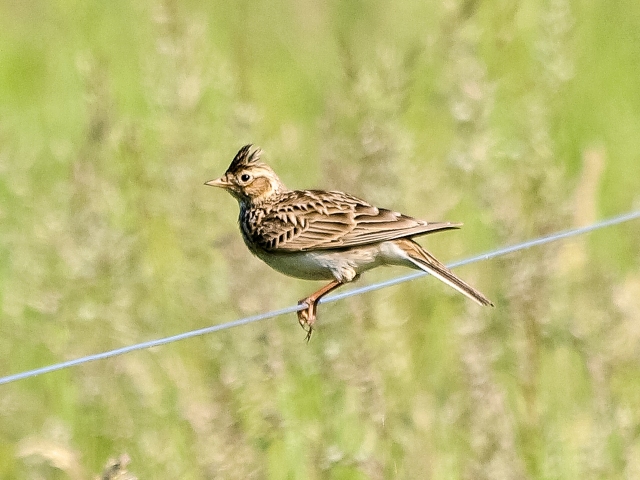
Eurasian skylarks are medium-sized, slender larks with rather long wings, a light cap that can be raised in the male, a strong beak, a relatively long tail and a long hind talon. The bird's body length is 16 to 18 cm and it weighs 30 to 45 g. The basic colour of the upperparts is beige to reddish brown. The top of the head and the back including the rump are finely streaked with blackish brown and dotted. The upper breast and flanks are clearly dark longitudinally streaked and dotted on a yellowish white or light brownish ground, the rest of the belly and the flanks are white.
The wingspan ranges from 30 to 35 cm. The wings are dark grey-brown, the inner primaries and secondaries have a narrow whitish terminal band. The tail is grey-brown, on the fifth tail feather counted from the inside outwards the outer vane is narrowly whitish fringed, on the outermost (sixth) tail feather the outer vane is almost completely whitish and also the inner vane on the distal half is predominantly whitish.
The yellowish white, strong over-eye stripe ends at the rear edge of the ear coverts. These are strong reddish brown and lightly edged. The moustachial stripe is broad white, the weakly developed chin stripe is dark grey-brown, the throat white.
The legs are light brown. The beak is horn-coloured, the lower beak is lightened at the base. The iris is dark brown in adults and light brown in juveniles.
Habitat
The eurasian skylark inhabits not too wet, wide open spaces with low and often patchy vegetation of grasses and herbs. In Central Europe, it is largely bound to agriculturally used areas, the main breeding habitats being fertilised meadows, pastures and fields.
The text is a translation of an excerpt from Wikipedia (https://de.wikipedia.org/wiki/Feldlerche). On wikipedia the text is available under a „Creative Commons Attribution/Share Alike“ licence. Status: 14 December 2021
European quail
Description
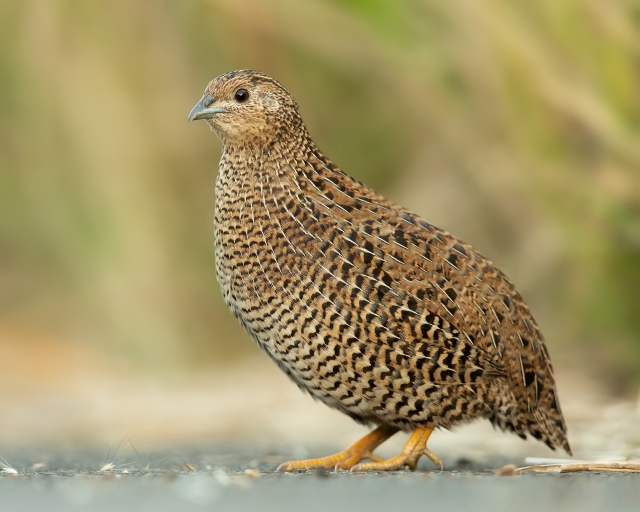
Adult males, also called quail cocks, have an overall grey-brown colouration with a multitude of reddish-brown and black streaks. On the middle of the head as well as on the sides of the crest, the white shaft lines of the feathers form three longitudinal stripes. The sides of the head are dark dashed. A reddish band runs from the angle of the beak, enclosing the whitish throat at the side. This reddish band is in turn bordered by an indistinct creamy white band with a narrow brown edge. A brown stripe runs across the middle of the throat. The upper chest is cream coloured with small white longitudinal stripes, changing to white-grey in the lower chest area, which also extends over the belly.
The front dorsum has black horizontal stripes and spots, the white shaft stripes of the feathers give a longitudinal pattern. The wings are grey. Wing coverts and wing feathers have a transverse pattern of thin whitish stripes. The rump and upper tail are dark with a transverse pattern of broad black and narrow reddish and white stripes.
The females, also called quail hens, are very similar to the males. However, they are usually only a solid white-grey on the breast and fore-neck. The band bordering the throat only extends to the side of the throat.
Both the cocks and the hens have a small and curved beak. The size of the quail is about 15 to 20 cm, its weight about 90 to 110 grams. Adult birds moult part of their small feathers in March and April. The annual complete moult begins in the second half of June, but moulting times can vary greatly from individual to individual.
Young birds are coloured similarly to females, but their plumage is slightly duller. The chicks are pale yellowish beige on the underparts. The upperpart of the body is orange-beige with a dark forehead patch. Starting from the forehead patch, two parallel, dark parietal stripes extend to the nape of the neck. A blackish brown central stripe runs down the middle of the back to the tail. There are two dark stripes on each wing.
Due to their small size and predominantly grey plumage, quails cannot be confused with any other species in Central Europe.
Habitat
The habitat of the quail are open fields and meadows with a high herb layer providing cover. It prefers areas with deep to somewhat moist soils. Typical breeding habitats are cereal fields, fallow land, alfalfa and clover fields. However, it also occurs in salt marshes with salt weed stands and in loamy wormwood steppes. At higher altitudes, it also inhabits meadows surrounded by forest.
The text is a translation of an excerpt from Wikipedia (https://de.wikipedia.org/wiki/Wachtel_(Art)). On wikipedia the text is available under a „Creative Commons Attribution/Share Alike“ licence. Status: 14 December 2021
Common blackbird
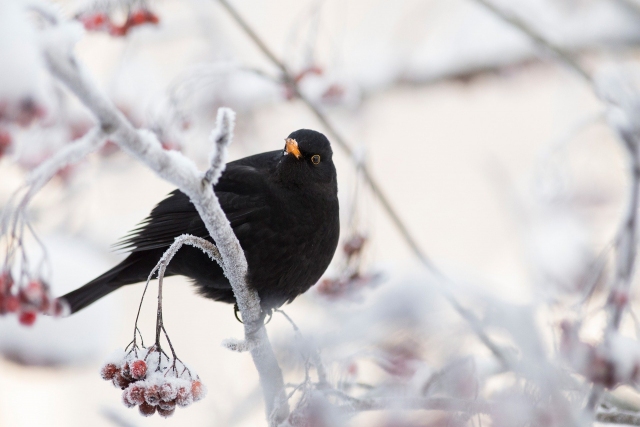
Description
The plumage of the males is solid black, the beak is strikingly light yellow to orange. In addition, males show a distinct ring around the eyes, the colour of which is similar to that of the beak, but can be somewhat brownish. This eye ring contrasts strongly with the dark brown iris. This eye ring is less distinct in the female, and the beak is also less conspicuous and light horn-coloured instead of yellow. The plumage colouration of the female is much more variable and predominantly dark brown, sometimes going into grey or reddish brown. The legs and toes of both sexes are dark brown. Compared to the smaller starling, which also has dark feathers and often stays on the ground, the blackbird has a much longer tail.
plumage of adult common blackbirds
The upperparts of females are dark olive-brown to olive-grey in colour, the forehead often slightly less dark. The colouration of the lighter underparts varies greatly from individual to individual. The chin and throat are light dirty grey to reddish brown with dark stripes. The chest is brown-grey, yellow-brown to reddish-brown with more or less distinct speckles. The belly is brown, grey-brown or grey, sometimes with a distinctly scaled appearance due to a pale terminal fringe of feathers. The tail feathers are dark to blackish brown, primaries and secondaries dark brown with olive tinted outer vanes.
Habitat
The blackbird originally preferred to live in the interior of moist, dense forests. Even today, it breeds in the dark locations of undergrowth-rich forests and forages on vegetation-free or short-grassed ground. In such a habitat, the blackbird's vision, which is exceptionally good for songbirds in twilight, is certainly an advantage. At the other end of the extraordinarily broad habitat spectrum today are the busy centres of large cities, so that because of this contrast the terms woodland and urban blackbird have become common.
Today, the blackbird occurs in almost all types of cultivated landscape. Its habitats include front gardens, parks and park-like areas, groups of trees and shrubs in industrial areas, meadows, bushy heaths and largely open fields, provided they are broken up with copses or shrubs. In addition to semi-natural, old forests, monoculturally managed forests are also colonised, whereby deciduous forests are preferred to coniferous forests. The blackbird also breeds in reeds. In all habitats, the birds, which forage on the ground, do not move too far away from vegetation providing cover.
By far the highest settlement density is achieved within built-up areas, often with four or more breeding pairs per hectare. In forests, on the other hand, the density is considerably lower, rarely more than 0.5 breeding pairs per hectare. In rural areas and villages, the settlement density is usually between that of towns and forests.
Mountain forests are also colonised by the blackbird. In the Alps, it occurs up to the timberline.
The text is a translation of an excerpt from Wikipedia (https://de.wikipedia.org/wiki/Amsel). On wikipedia the text is available under a „Creative Commons Attribution/Share Alike“ licence. Status: 14 December 2021
Common swift
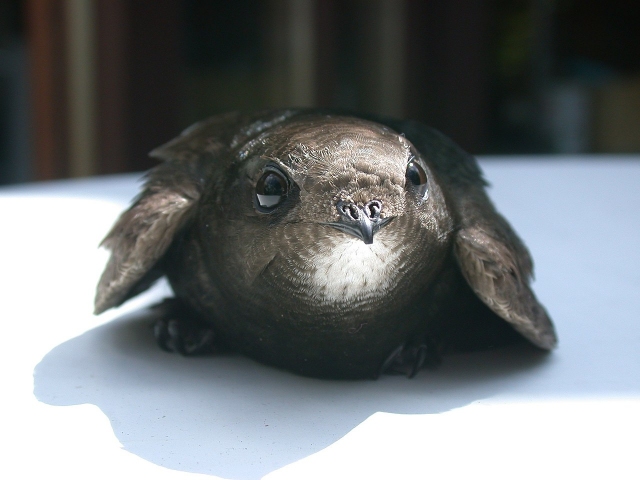
Description
The shape is similar to a swallow, but the swift is slightly larger than European swallows. The wings are long compared to the body and their crescent shape is easily seen in gliding flight. The tail is relatively short and forked. Males and females cannot be distinguished externally. The plumage is sooty to brownish black except for the greyish-white throat patch, which is, however, difficult to see in flight. The face, seen from the front, appears roundish; the eyes are relatively large and the iris is deep brown. The small, black beak is slightly curved downwards. The short feet are blackish flesh-coloured. The four toes end in sharp talons; as in all swifts, they are all pointed forward.
Adult swifts weight about 40 grams on average, but the weight varies quite a bit with nutritional status. Non-breeders and swifts that have just arrived at the breeding site are usually somewhat heavier than breeding birds. The trunk length averages 17 cm, and when the wings are put on they cross and overhang the tail by about four cm. The wingspan is between 40 and 44 cm. Compared to other bird species, the primaries are very elongated; the upper and lower arms are short and compact.
The juvenile plumage is darker and less shiny, the white of the throat is more extensive and purer than in adult birds. In addition, young birds are distinguished from adults by the white feather seams, which are most conspicuous on the axillary feathers, the wing coverts, the large plumage and especially on the forehead. Only the fringes of the forehead feathers remain until the juvenile moult, while the other white fringes disappear quite soon due to wear. One-year-olds look like adult swifts; they are best recognised by the worn juvenile plumage, in which the ends of the tail feathers are more rounded.
Habitat
In Central Europe, the swift mainly breeds on multi-floor old buildings, including residential houses, church towers, factory buildings or railway stations. On such buildings, many cavities on roofs and façades are used, such as eaves or roller shutter boxes. New buildings with a dense outer skin offer hardly any breeding opportunities. Due to the availability of suitable breeding sites, swifts often settle in only a few places, such as town centres, industrial or harbour facilities, and in small towns often exclusively on churches or other historic buildings.
Swifts were originally predominantly rock-breeders, but today they are rare in Central Europe and only known from a few regions, such as the Elbe Sandstone Mountains. It is assumed that the transition from rock-breeding to building-breeding took place in the Middle Ages. Possibly, castles built of rough natural stone were the link through which the birds approached human buildings and became a synanthropic bird.
The text is a translation of an excerpt from Wikipedia (https://de.wikipedia.org/wiki/Mauersegler). On wikipedia the text is available under a „Creative Commons Attribution/Share Alike“ licence. Status: 14 December 2021
Barn swallow
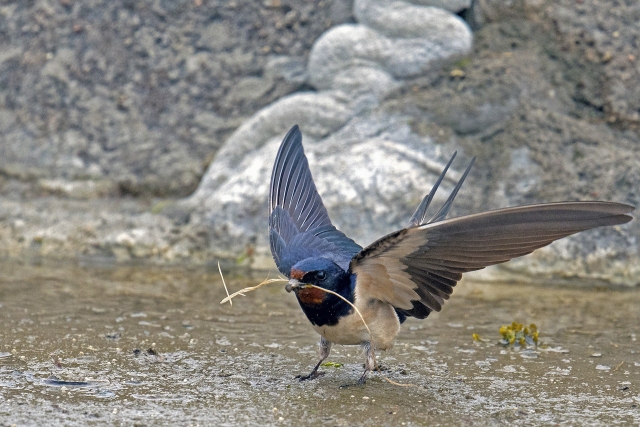
Description
The barn swallow is about 19 to 22 centimetres in length, of which two to seven cm are accounted for by the tail feathers. The weight of males during the breeding season is between 16.1 and 21.4 grams, females weigh between 16 and 23.7 grams. The wingspan is 32 to 34.5 cm.
The barn swallow is very slender with a characteristic deeply forked and long tail. The back is a shiny metallic blue-black. The underpart is creamy white. The maroon colour on the throat, which is framed entirely in black, and on the forehead and chin is also characteristic. There are white spots on the tail feathers, which can be seen when the tail is spread.
Habitat
The species lives in the open cultivated landscape where there are farms, meadows and ponds. The birds spend the summer between April and September or early October in their breeding grounds. These are located throughout Europe, Northwest Africa, the temperate regions of Asia and in North America up to an altitude of about 1000 metres and as far as the Arctic Circle. Barn swallows winter in central and southern Africa. Asian wintering grounds are found in India and Iran.
The text is a translation of an excerpt from Wikipedia (https://de.wikipedia.org/wiki/Rauchschwalbe). On wikipedia the text is available under a „Creative Commons Attribution/Share Alike“ licence. Status: 14 December 2021
Mistle thrush
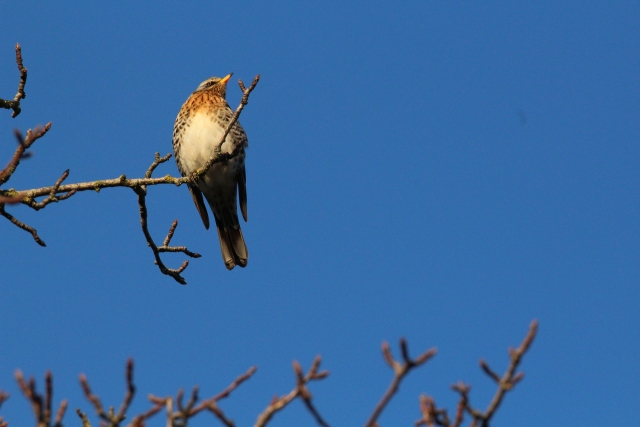
Description
The mistle thrush can reach a body length of about 26 to 29 cm. The body weight can be up to 140 grams. The mistle thrush resembles the song thrush, which, however, only grows to a maximum length of 22 cm. The upperpart is grey-brown and the underpart is white with dark brown spots. The underwing is white. Males and females have the same colouration.
Habitat
The mistle thrush lives in sparse forests, parks and smaller woods in Central Europe. In the south of its range it is mainly found in the mountains, but in central and western Europe it is increasingly found in towns and villages. Most mistle thrushes migrate to south-western Europe in autumn and spend the winter there.
The text is a translation of an excerpt from Wikipedia (https://de.wikipedia.org/wiki/Misteldrossel). On wikipedia the text is available under a „Creative Commons Attribution/Share Alike“ licence. Status: 14 December 2021
European song thrush
Description
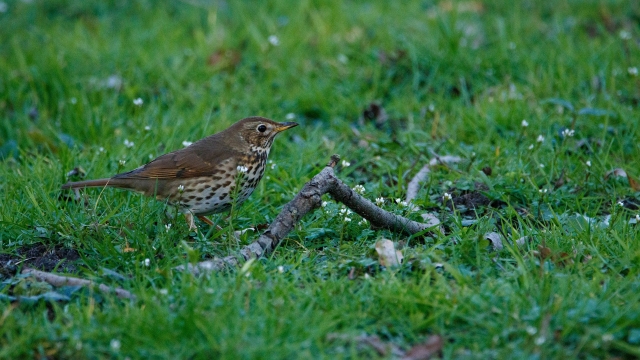
With a body length of 20-22 cm, the song thrush is somewhat smaller than a blackbird and also appears more delicate and short-tailed. The wing length averages 80 mm. The average weight in winter is about 70 g, the minimum weight at the end of the breeding season is 60 g. If fat deposits have been built up at migration time, a song thrush can weight up to 90 g. The upper head is warm greyish-brown.
The top of the head is warm grey-brown, with a lighter over-eye stripe indicated, but usually only in the area of the forehead. The lore are dark brown and show a light speckling. The ear coverts are light brown. The nape, sides of the neck and front of the back are warm brown, the rest of the upperparts are greyish brown to olive brown. The chin and front throat are beige to cream, the front chest and flanks are overlaid with a yellowish brown colouration, which blends smoothly into the dull white of the rear chest and belly. The underparts are also patterned with blackish-brown spots, which are elongated and narrow on the chin and throat and become denser into a moustachial stripe. This is set off by an unpatterned, light-coloured edge towards the brown rein. Towards the belly the spots become larger as well as roundish fan-shaped and form implied rows. In spring they can look inverted V-shaped or heart-shaped. Towards the flanks they sometimes become lighter, on the underbelly more sparse. The rectrix and wing feathers are largely brown with a reddish brown, lighter outer plume. The three inner secondaries are often indistinctly light fringed. The greater and middle coverts bear a pale lace patch. The underwing coverts are rusty yellow and stand out clearly in flight from the otherwise rather greyish brown to grey underwing.
The eye is dark brown with a cream-coloured ring. The beak is blackish brown with yellowish underbeak branches. The feet are yellowish brown to brownish pink in adults and pinkish pearly in juveniles.
Sexual dimorphism is not pronounced. Only the average size of males is slightly bigger.
In juvenile plumage the upper side is warmer brown and shows an intense cinnamon yellow blotch on shoulders and back. The underpart is more yellowish than in adults, and the spotting on the underpart is less contrasting.
The song thrush can be confused with the mistle thrush, which is, however, one fifth larger, has a teardrop-shaped round, very coarse mottling on the underpart and is rather dull grey-brown above. The tail, which appears much longer, shows white tips on the outer feathers and the flight is wavy. The red-winged thrush is also similar, but smaller, showing strong fox-red flanks and the same underwing coverts in flight. In addition, the underpart is more streaky and the head pattern of light over-eye streak and light moustachial stripe is much more distinct.
Habitat
The song thrush inhabits a variety of forest types, but shows a preference for conifers, much and dense undergrowth, shade and high humidity. Unlike other thrush species, it does not depend on forest edge habitats or open areas for foraging. It is particularly fond of spruce regrowth as a nesting site.
In the Alps and the low mountain ranges, it is particularly common in forests with spruce and silver fir. These can be pure coniferous forests, but also mixed forests with spruce interspersed and undergrowth. It is usually rarer in pure deciduous forests.
In the lowlands, it occurs in all types of forest except in beech woods without undergrowth and similar habitats. However, young spruce afforestations and moist, undergrowth-rich habitats such as riparian or moor forests are preferred. It also occurs here in smaller habitats such as juniper heaths, field copses, rows of poplars with undergrowth and the like. Since the beginning of the 20th century, it has also increasingly penetrated urban habitats such as garden settlements, parks or cemeteries.
The text is a translation of an excerpt from Wikipedia (https://de.wikipedia.org/wiki/Singdrossel). On wikipedia the text is available under a „Creative Commons Attribution/Share Alike“ licence. Status: 14 December 2021
Eurasian jackdaw
Description
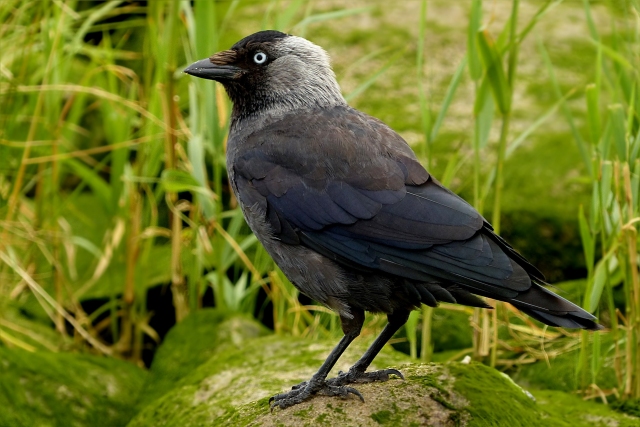
The eurasian jackdaw is a medium-sized corvid with a body length of 33-39 cm. It appears stocky - especially in comparison with most ravens and crows - and has a stout, strong beak and relatively short legs. The jackdaw's tail is of medium length and slightly rounded in comparison to the genus, its wings are round, weakly digitated and fall slightly behind the tail when attached. Male jackdaws grow larger on average than females, although there is overlap in the dimensional ranges: Males reach a wing length of 208-255 mm and a tail length of 122-138 mm. Their beak grows to 20.6-21.5 mm from the nostrils to the tip, and the male tarsometatarsus 42.3-49.0 mm. The male weight is 174-300 g. With 205-250 mm wing length, 115-134 mm tail length, a 19.8-23.2 mm long bill and 41.2-46.5 mm length of the tarsometatarsus, and a weight of 175-282 g, females achieve only slightly smaller maximum measurements, but significantly smaller mean values.
The sexes are very similarly coloured, differing at most in a slightly lighter colouration of male birds at certain times of the year. The nasal bristles, forehead, crown, eye area, cheeks and chin down to the throat are black in adult jackdaws. The black head plate has a metallic blue or violet shimmer. The back of the crown, the back of the head, the nape of the neck and the ear coverts contrast with the black crown due to their light to slate grey coloration, but merge into black in the cheek, throat and nape area. On the sides of the neck and in the nape of the neck, some individuals develop a sometimes more, sometimes less distinct, silver-grey band, which becomes broader towards the breast and separates the plumage of the head from the body plumage. The eurasian jackdaw's back, like its wings and tail, is black-grey to black.[2] The wing feathers have a faint greenish or bluish sheen. The underparts - breast, flanks, belly and abdomen - are slate grey and darker than the back of the head. From moult to moult, especially the grey areas of the plumage fade. In black feathers, usually only the edges fade, resulting in a scaly pattern on the back. The nasal bristles turn rusty brown with time. Old birds have a whitish-blue iris, which contrasts strikingly with the black facial plumage. Their beak is black, as are their legs.
Juveniles differ from adults in colour only in a few details. Their plumage colours are duller and have much less sheen than adults. The black parts of the adult plumage appear more brownish or greyish, and the colour separation of the head plate from the back of the head is less distinct. The most obvious difference is the eye colour: after the juvenile moult, the iris colour of the birds changes from light blue to dark brown. Only after about one year does it become lighter again on the outside, and from the third year of life it is completely white-blue again.
Habitat
The availability of potential breeding sites and suitable areas for foraging influence the habitat selection of the eurasian jackdaw. As a predominantly cavity-nesting bird, it is strongly dependent on old wood stands with woodpecker cavities, on rock holes or on buildings with sufficient niches in its habitat, at least during the breeding season. Quarries, rocky coasts, settlements with old buildings, medieval churches as well as parks and groves with large, old trees are therefore frequently used breeding habitats by the jackdaw. They also serve as roosting sites outside the breeding season. Forests are colonised only at the edges (maximum 2 km from the forest edge).
The species needs relatively wide open areas to forage on the ground. These areas must have low vegetation (maximum 15-20 cm) so that the eurasian jackdaw can move around on them, so parkland and pastureland are preferred. Because they should also be rich in insects, the bird likes to use dry grasslands and extensively cultivated areas. In the course of the year, the eurasian jackdaw uses very different areas - pastures, steppes, stubble fields, floodplains - for foraging.
The eurasian jackdaw is relatively weather and temperature tolerant, but avoids extremes of heat and cold. It is more likely to be found in lowlands and valleys than in mountainous areas. Below 500 m it is usually widespread, between 500 and 1000 m it is often found only in local aggregations. In some exceptional cases, breeding habitats extend beyond 1000 m, for example in the Alps, in the Atlas or in Kashmir up to about 2000 m. Outside the breeding season, it can also be found at altitudes of up to 3500 m.
The text is a translation of an excerpt from Wikipedia (https://de.wikipedia.org/wiki/Dohle). On wikipedia the text is available under a „Creative Commons Attribution/Share Alike“ licence. Status: 14 December 2021
