


Roadkill Team
Institut für Zoologie
Department für Integrative Biologie und Biodiversitätsforschung
Universität für Bodenkultur Wien
Gregor-Mendel-Straße 33
1180 Wien
Report roadkills
The core of the project Roadkill is the reporting of roadkill via apps or online forms. All questions and analyses in the project are based on this. The reports are made by Citizen Scientists who see roadkill animals on their daily routes and report them. It is important to note that only vertebrates that have clearly been killed by road traffic in Austria can be reported.
Click here to go directly to the report of an animal (in German): https://roadkill.at/dateneingabe-roadkill
In order to report a roadkill, you must first register. All you need is an email address, a user name and a password. Reporting can be done via apps for iOS and Android smartphones, or simply via the internet browser. Our website and apps are developed by Spotteron. If you already have an account with a Spotteron app, you can also use it in our online entry form or in the apps.
Now more specifically, how can you join in?
Project Roadkill is available as an Android app for your smartphone in the Google Play Store as a free download:
https://play.google.com/store/apps/details?id=com.spotteron.roadkill
A separate app is also available free of charge for iPhones in the iTunes Store:
https://itunes.apple.com/at/app/roadkill-spotteron/id1007563102?mt=8
You can also use our online entry form (in German).
Before you can actively participate using the Spotteron App, you need to register or log in. As described above, we only need a username, email and password for registration or your existing Spotteron account. If you are driving on a road in Austria and observe a dead animal that has been hit by a vehicle, simply report it via our app for Android or iOS or via the online form on the project website. You can do this on the spot, or you can make a note of the spot and enter the data at home on a computer with an internet connection.
However, always pay attention to your own safety! Do not enter any spots while you are driving yourself; do not take a photo on unclear stretches of road; always pay attention to the traffic and do not risk anything to enter a new spot! Your safety always comes first!
Download the app instructions from Spotteron:
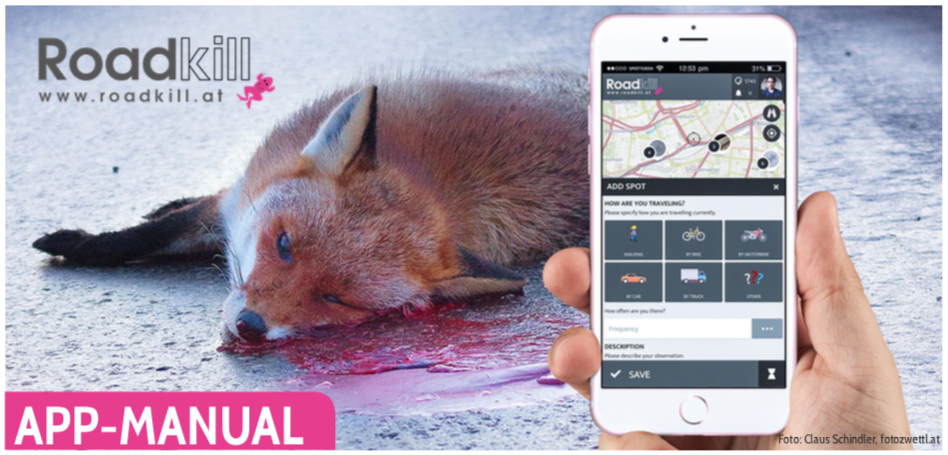
If you have any further questions about the exact process of data submission, please send us an email.
How can I avoid roadkills?
You can already do a few things to avoid roadkills. If you know that amphibian migrations are taking place on your route, reduce your speed to be able to react in time to animals on the road. As amphibian migration usually takes place at night and often in rainy weather, the animals are usually difficult to spot in time. Whether frogs and toads survive if you "take them between the tyres" is not completely clear. On the one hand, dead animals that seem to have burst due to negative pressure are found again and again, on the other hand, a study from Australia with cane toads suggests that the animals do survive. You can find more details here in German: http://www.herpetofauna.net/interessantes/amphibientod_schnelles_fahren.html
If you would like to get more involved in the protection of frogs, toads, newts, etc. along roads, you are sure to find an association in your area that maintains amphibian protection fences along roads and would be happy to have your help. A very good platform for finding associations or identifying amphibians and reptiles is also the forum at www.herpetofauna.at
Most wildlife accidents happen at twilight, so drive especially carefully then and pay more attention to the edges of the road. The signs "Achtung Wildwechsel" indicate particularly dangerous places and should be taken seriously, even if you have never seen game there yourself.
Many thanks at this point to the developers of Spotteron for the easy-to-use and reliable apps and the website.
Background
Working together to increase knowledge, protection and understanding
Roads play a vital role in shaping our daily lives, both in Austria and worldwide. They connect places, enable mobility, and facilitate the transportation of goods, medical aid, and social interaction. At the same time, roads occupy a significant portion of our landscape and are therefore also part of the habitat of numerous animal species. However, while we humans see roads as paths and connections, many animals see them as something completely different: some use them as migration corridors, while others see them as insurmountable barriers. Vertebrates in particular are at a disadvantage when roads become impassable due to heavy traffic, crash barriers or fences. Some animals avoid roads altogether, while others cross them regardless of traffic. The result is that thousands of animals die on Austria's roads every year.
Why does roadkill affect us all?
Official figures are only available for huntable game, such as deer, wild boar and badgers. But what about all the others? What about hedgehogs, toads, squirrels, snakes and birds? Currently, there is a lack of data on these species, even though they are just as often, if not more often, killed on the roads.
This is where the Roadkill project comes in: a citizen science project run by BOKU University. We want to work with you to find out which and where animals are killed on Austria's roads, and why. Only those who understand the connections can develop solutions.
What is citizen science?
Citizen science means that scientific research is carried out in collaboration with society, rather than behind closed doors. With the Roadkill project, you can contribute to the research yourself. Every observation counts, whether you are out walking, cycling or driving.
Your experiences and knowledge are valuable and will help improve our understanding of animal movements and traffic risks. Participation is voluntary and flexible – you can contribute as much or as little as you like. Find out more in the 'Get involved' section.
What does "roadkill" mean?
The term 'roadkill' refers to all animals killed in traffic accidents. Unlike the German term 'Wildunfall', which usually only applies to larger mammals, 'roadkill' also includes smaller animals and endangered species. In other words, it encompasses all those that hardly appear in official statistics, yet represent a significant part of the problem.
Why should we care?
When roads cut through habitats, animals may be killed while travelling to find food or mates. Migratory species, such as toads in spring, are particularly affected.
However, this issue should not be underestimated for human beings either, as animals on the road pose a safety risk. Evasive manoeuvres or sudden braking can cause accidents, sometimes with serious consequences. Furthermore, many people find roadkill distressing or traumatic.
Objectives
Working together to increase knowledge, protection and understanding
Scientific objectives
-
Establishment of a reliable database to analyse the influence of various factors on roadkill.
-
Identification of the causes and influencing factors that lead to roadkill.
-
Development of models to calculate the probability of roadkill on Austrian roads.
Nature conservation objectives
-
Establishing partnerships to translate reported roadkill incidents into concrete conservation measures
-
Conducting scientific studies on endangered vertebrate species that are particularly affected by roadkill
Social objectives
-
Raising public awareness of roadkill in Austria
-
Raising awareness of the presence and endangerment of animals on roads
-
Promoting understanding of the habitat needs of animals
-
Communicating the necessity and effectiveness of protective measures in road traffic
