


Florian Heigl
European snow vole

Description
The European snow vole is a relatively large and long-tailed vole. The snout-vent length is 90-140 mm, the tail length 50-76 mm, the length of the hind foot 17.0-22.5 mm and the ear length 13-19 mm. The animals weigh 19-60 g, rarely up to 68 g. As in all species of the genus Chionomys, the fur is soft and dense, light grey on top with a brownish tinge, the underpart is whitish. The upperparts of the feet and the ears have short white hairs, the tail also has white hairs and a white end tassel. The whiskers are also very long, typical of the species, over 35 mm long.
Habitat
Unlike most voles, the European snow vole is bound to soils interspersed with rock and coarse stone and is the only European vole to occur in the high mountains. The snow vole inhabits the Alps at altitudes between 1000 and 4000 m, other mountains up to 4700 m altitude. It inhabits mainly alpine mats and heaps of coarse debris above the tree line. Especially in the Mediterranean region, however, the species also inhabits dry and rocky slopes with shrubbery or loose tree cover and is already present there at altitudes from 125 to 250 m. Occasionally, the animals also inhabit mountain huts and other buildings.
The text is a translation of an excerpt from Wikipedia (https://de.wikipedia.org/wiki/Schneemaus). On wikipedia the text is available under a „Creative Commons Attribution/Share Alike“ licence. Status: 20 August 2021
Muskrat
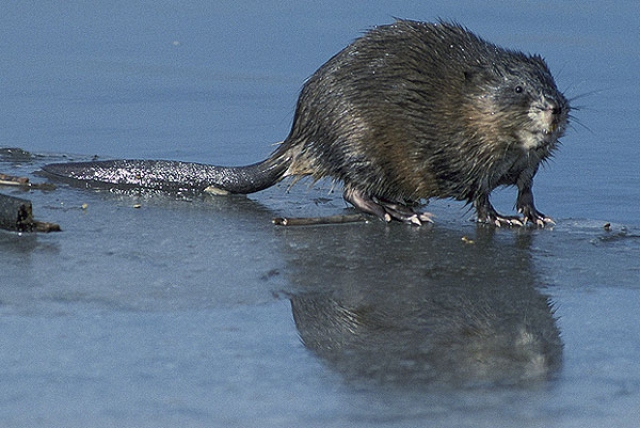
Description
With a snout-vent length of about 35 cm and a tail length of about 22 cm, the muskrat is smaller than a nutria (Myocastor coypus) or a beaver (Castor fiber) and larger than a brown rat (Rattus norvegicus). The weight is usually between 0.8 and 1.6 kg (maximum: 2.3 kg). The muskrat has a stocky, rat-like shape. The short and thick head merges externally into the rump without a neck. The tail is almost naked and not round but flattened.
The muskrat is excellently adapted to life in the water. It has ears that can be closed watertight, with the auricles hidden deep in the fur. Although its hind paws, unlike those of beavers and nutrias, do not have webbed feet, the muskrat is a skilled swimmer and diver. Instead of webbed toes, muskrats have so-called webbed bristles: stiff hairs that grow as a fringe along the edges of the toes, thus enlarging them like paddles. The main impulse for locomotion in the water is provided by the long, strong legs and the widely spread hind feet. To control and support the swimming movement, the muskrat uses its tail, which it moves to the right and left in a horizontal plane. Its fur is very dense and water-repellent, so it can often stay in the water for long periods.
Habitat
Muskrats spend most of their time in water. They are excellent swimmers and can dive for up to ten minutes. On land, however, the muskrat appears rather clumsy. The shy animal accepts almost any reasonably suitable flowing and still water as a habitat. Muskrats are usually nocturnal and crepuscular. However, as with many other species, such as the red fox and wild boar, their day and night rhythms are dependent on human disturbance. In areas where they are relatively undisturbed, they can often be seen during the day.
The text is a translation of an excerpt from Wikipedia (https://de.wikipedia.org/wiki/Bisamratte). On wikipedia the text is available under a „Creative Commons Attribution/Share Alike“ licence. Status: 20 August 2021
European hamster
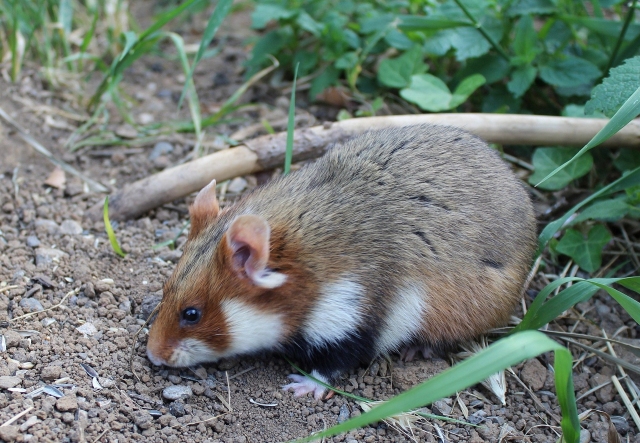
Description
European hamsters reach a snout-vent length of 20 to 34 cm, with a 4 to 6 cm long, almost hairless tail. The weight of adult animals varies between 200 and 650 g. Males are usually larger and heavier than females. The hamster is considered the most colourful European fur-bearing animal. The fur colouration is variable: the most common form is a yellow-brown upperpart and a dark, almost black underpart. There are several white patches on the flanks, on the cheek, in front of and behind the forelegs. The striking counter-colouration (back lighter than belly) is plausibly explained by the fact that a hamster, when it can no longer flee, rears up to defend itself: the black belly imitates the mouth of a larger predator with the four white paws as "fangs". The region around the snout and around the eyes is reddish brown in colour, the feet and the tip of the nose are again white. There are also melanistic (almost entirely black) and strikingly light-coloured field hamsters. The undercoat is uniformly grey. All hamster species have well-developed, expandable cheek pouches, which they sometimes use to carry up to five kg of grain into their burrow, even though they only need two kg of food to survive the winter. The feet are broad and have well-developed claws.
Habitat
They are typical ground dwellers and are found almost exclusively in loess and clay soil.
The text is a translation of an excerpt from Wikipedia (https://de.wikipedia.org/wiki/Feldhamster). On wikipedia the text is available under a „Creative Commons Attribution/Share Alike“ licence. Status: 20 August 2021
Alpine field mouse
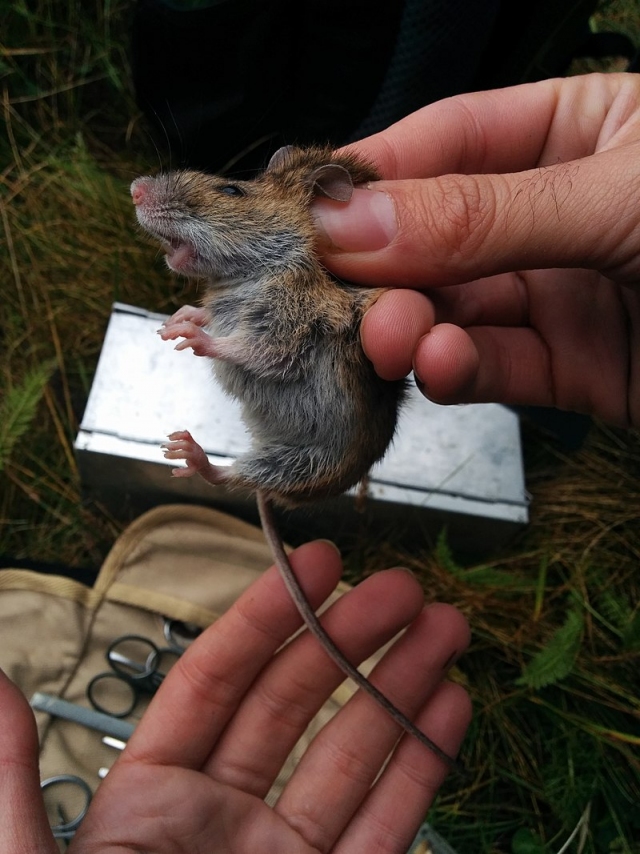
Description
The snout-vent length is between 9 and 12 cm and the tail length between 10 and 12 cm. The weight varies between 20 and 38 g. The alpine field mouse is brown on the back and on the outside of the limbs, with the upperparts being the darkest. The belly and the inside of the limbs are dark to white-grey. A yellowish spot often occurs on the throat. Morphological differences to the yellow-necked mouse are only found in details of the skull structure. The hind feet are quite large for a wood mouse, about 2.5 cm long. These and the long tail help the animal to climb in rocky terrain.
Habitat
Their habitat is forests or other tree stands interrupted by grassy areas or rocky spots.
The text is a translation of an excerpt from Wikipedia (https://de.wikipedia.org/wiki/Alpenwaldmaus). On wikipedia the text is available under a „Creative Commons Attribution/Share Alike“ licence. Status: 23 August 2021
Yellow-necked mouse
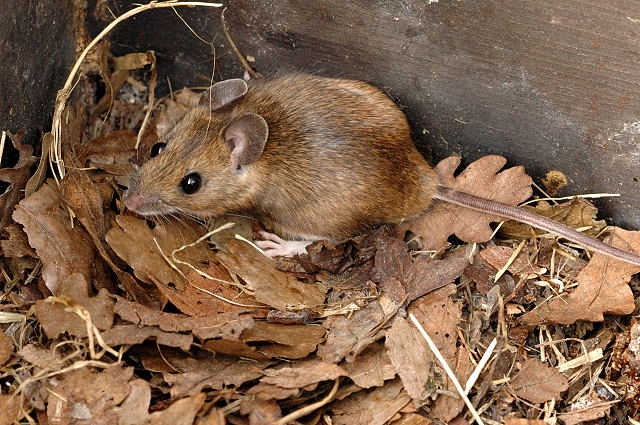
Description
The yellow-necked mouse belongs to the medium-sized species of the genus Apodemus. The ears are relatively large, the eyes large and prominent. The snout-vent length is 88-130 mm, the tail length 90-135 mm, the length of the hind feet 22-27 mm and the ear length 15-20 mm. The animals weight 16-56 g, mostly 26-36 g. The coat is warm reddish or yellowish brown on top. The underpart is almost pure white; the demarcation to the upperpart colouring is very clear. A chest pattern is usually developed in Europe as a continuous yellowish-brown collar. The hind feet have white hairs on top.
Habitat
Yellow-necked mice are largely forest-bound. Older deciduous forests dominated by beech and oak are considered optimal habitats. They also live in hedgerows and gardens with many trees. In autumn, yellow-necked mice often invade buildings. The altitudinal distribution ranges from sea level to about 2100 m in the Alps.
The text is a translation of an excerpt from Wikipedia (https://de.wikipedia.org/wiki/Gelbhalsmaus). On wikipedia the text is available under a „Creative Commons Attribution/Share Alike“ licence. Status: 23 August 2021
Wood mouse
Description
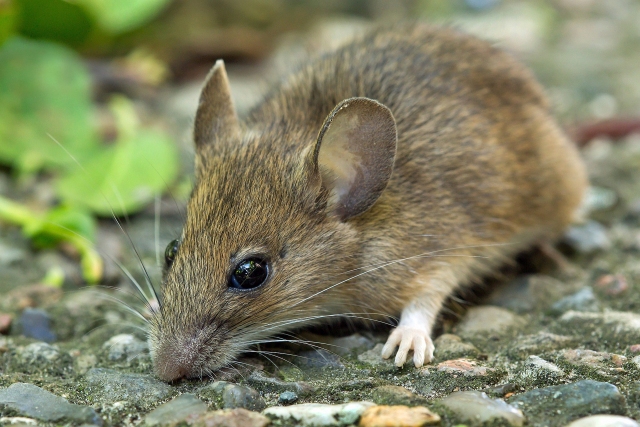
The wood mouse belongs to the smaller species of the genus Apodemus. The ears are relatively large, the eyes very large and clearly protruding. The snout-vent length is 80-110 mm, the tail length 70-115 mm, the length of the hind feet 20.0-23.5 mm and the ear length 15-20 mm. The animals weigh 13-36 g, mostly 18-25 g. The coat is yellowish to brownish grey on top, with a reddish brown overcoat on older animals. The underpart is dirty white, the demarcation to the upperpart colouring is not very clear. The thoracic pattern is absent or only a yellowish brown, longitudinal oval spot. The hind feet have white hairs on top. There is a danger of confusion, especially with the yellow-necked mouse.
Habitat
Contrary to its name, the wood mouse inhabits mainly fringing biotopes of the agricultural landscape in most of its range, especially hedges, fallow land, ditch margins and water banks, but also parks and gardens. In the north-east of the range, the species is largely restricted to these areas and at most inhabits very open, dry coniferous forests here. In the west and south of the range, wood mice also occur in closed upland forests. The main reason for the absence in forests in most of the range is apparently their extensive colonisation by the larger and more competitive yellow-necked mouse.
Wood mice often enter buildings and also use façade vegetation to get under the roof covering.
The text is a translation of an excerpt from Wikipedia (https://de.wikipedia.org/wiki/Waldmaus). On wikipedia the text is available under a „Creative Commons Attribution/Share Alike“ licence. Status: 25 August 2021
Pygmy field mouse

Description
The pygmy field mouse reaches a snout-vent length of 85 to 102 mm, a tail length of 64 to 97 mm as well as a weight of 12 to 26 g. It has hind feet 17 to 22 mm long and ears 14 to 16 mm long. While the coat of the upperparts for western populations is described as grey-brown without yellowish tones, specimens with light sandy or reddish-brown upperparts may occur in Asian populations. In all populations there is a distinct border to the white underpart with a light grey tinge. Furthermore, the tail is divided into a brown upper side and a whitish underpart. The pygmy field mouse has white upperparts on their feets. Occasionally there is a throat patch that differs from the surrounding fur.
Habitat
This rodent prefers to live in lowland or hilly areas up to 400 m altitude. However, it can reach 1400 m in the Carpathians and 3000 m in Asian mountains. The pygmy field mouse prefers to live in semi-open or open landscapes and avoids central areas of forests. It can be found on forest edges, in open forest areas with dense undergrowth, on meadows and fields close to forests or on other cultivated areas. In dry regions, it seeks the vicinity of watercourses.
The text is a translation of an excerpt from Wikipedia (https://de.wikipedia.org/wiki/Zwergwaldmaus). On wikipedia the text is available under a „Creative Commons Attribution/Share Alike“ licence. Status: 25 August 2021
Striped field mouse
Description
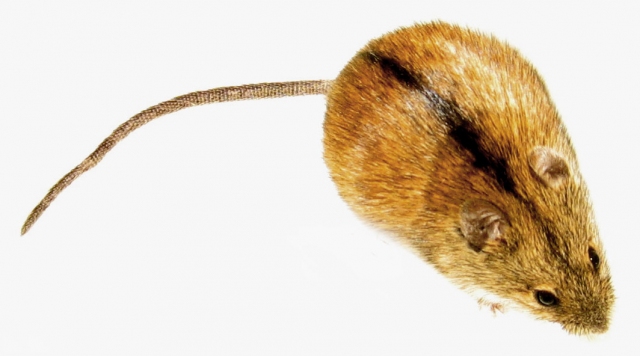
The striped field mouse belongs to the smaller species of the genus Apodemus, the tail is relatively short and the ears are smaller than in other representatives of the genus. The snout-vent length is 75-115 mm, the tail length 60-92 mm, the length of the hind foot 16-21 mm and the ear length 10-13 mm. The animals weigh 14-35 g. The coat is warm reddish brown on top, only greyish brown in young animals. A narrow black stripe (dorsal stripe) runs down the middle of the back, extending from the nape of the neck to the rear of the back. The underpart is greyish white.
Habitat
The striped field mouse inhabits richly covered and predominantly moist habitats such as forest edges, bushes, wet meadows and reed banks, but also - and apparently increasingly - gardens and parks. It mainly inhabits lowlands, but occurs in Macedonia up to 1750 m altitude. In summer, the species also inhabits grain fields, in winter it is often found in barns and similar buildings.
The text is a translation of an excerpt from Wikipedia (https://de.wikipedia.org/wiki/Brandmaus). On wikipedia the text is available under a „Creative Commons Attribution/Share Alike“ licence. Status: 25 August 2021
Harvest mouse

Description
The harvest mouse is one of the smallest rodents. It reaches a snout-vent length of 55 to 75 mm, the tail measures about 50 to 75 mm. Its weight is 5 to 7 g. Its upperparts are reddish brown, in some areas also dark brown. The underpart is sharply set off from the back and is white. The unusually long tail is used as a prehensile tail and is bicoloured. The ears barely protrude from the fur. The eyes are very small and dark brown. The skull is also very small; harvest mice can squeeze through holes of one cm in diameter.
Habitat
Their habitat is areas of high vegetation, for example tall grasses, reeds and cane thickets and bamboo thickets, but also grain fields. Occasionally they are also found in hedgerows or rice fields.
The text is a translation of an excerpt from Wikipedia (https://de.wikipedia.org/wiki/Zwergmaus). On wikipedia the text is available under a „Creative Commons Attribution/Share Alike“ licence. Status: 25 August 2021
House mouse

Description
House mice living in the wild reach a snout-vent length of 7 to 11 cm, a tail length of 7 to 10 cm and a weight of about 20 to 25 g. The white mice kept in laboratories and the fancy mice available in the pet shop can become much heavier, 45 to 60 grams are not uncommon. The body is mouse-grey to brown-grey on top, the underpart is somewhat lighter. The tail has clearly visible scale rings and is sparsely hairy.
Adult house mice have longer tails than voles. A vole's tail is shorter than half its torso (from nose to base of tail), a house mouse's tail is longer than half its rump. The incisors of the upper jaw are slightly notched.
There is a similarity to the wood mouse, which also often stays indoors. In wood mice, however, the light underpart is more clearly separated from the darker fur on the upperparts than in house mice. Unlike the house mouse, the wood mouse does not have a notch on the back of the upper incisors.
Habitat
When the house mouse is not living near humans, it mainly inhabits steppes, desert areas and cultivated land. There it digs burrows and builds nests in which it stores its food.
The text is a translation of an excerpt from Wikipedia (https://de.wikipedia.org/wiki/Hausmaus). On wikipedia the text is available under a „Creative Commons Attribution/Share Alike“ licence. Status: 25 August 2021
